 MapUrbex
A practical guide to urbex in Spain: abandoned places, ghost developments, legal basics, and safety rules for responsible exploration.
Urbex in Spain: Complete Guide to Abandoned Places and Exploration Rules
Urbex in Spain covers a wide range of landscapes, from unfinished coastal resorts to former industrial sites and depopulated villages. Few countries in Europe combine tourism megaprojects, rural decline, and post-industrial heritage in such a visible way.
That diversity makes Spain attractive to photographers and researchers. It also makes preparation essential. Access rules vary by ownership, heritage status, and safety conditions, so responsible urban exploration in Spain starts with verification, not improvisation.
What should you know before doing urbex in Spain?
Urbex in Spain means exploring abandoned places only when access is lawful and conditions are safe. The country has hotels, factories, ghost developments, and rural ruins, but many sites are private property, protected heritage, or structurally unstable. The responsible rule is simple: verify the site's status, respect ownership, never force entry, and leave no trace.
Quick summary
- Spain is known for varied abandoned places, especially unfinished resorts, industrial ruins, depopulated villages, and housing-bubble developments.
- Legality depends on ownership, barriers, signage, and local restrictions. Abandonment does not mean public access.
- The main risks are collapse, asbestos, exposed shafts, heat, isolation, and active security.
- The best urbex approach in Spain is research-first, preservation-first, and no publication of sensitive access details.
- Ghost developments are a major theme in Spain's recent history, especially after the real-estate crash.
- MapUrbex helps explorers focus on verified locations, curated maps, and responsible planning.
Quick facts
- Country: Spain
- Topic: Urbex in Spain
- Common site types: hotels, factories, mining sites, ghost urbanizations, villages, sanatoria, military remains
- Key historical drivers: rural depopulation, industrial decline, failed tourism projects, and the 2008 housing crisis
- Legal baseline: private property, heritage protection, and safety restrictions matter more than whether a place looks empty
- Best planning tool: use curated resources such as Browse all urbex maps
Why is Spain one of Europe's most varied urbex destinations?
Spain is one of Europe's most varied urbex destinations because its abandoned places come from several different historical cycles at once. Rural depopulation emptied villages, industrial restructuring closed mines and factories, speculative construction left unfinished developments, and some coastal megaprojects were halted by legal or environmental disputes.
This mix creates strong visual contrast. In one country, you can find empty apartment blocks, weathered agricultural hamlets, former rail infrastructure, and large hospitality projects frozen in place. For readers interested in one of the clearest post-2008 patterns, Ghost Towns in Spain: What the Housing Bubble Left Behind provides useful context.
Regional geography also matters. Andalusia, Aragón, Castilla-La Mancha, Asturias, Catalonia, Galicia, and parts of the Mediterranean coast all contain different kinds of abandoned environments. That is why urban exploration in Spain is less about one iconic place and more about understanding regional patterns.
What types of abandoned places can you find in Spain?
Spain offers several distinct categories of abandoned places, and each category comes with different legal and safety considerations. The most common examples are unfinished hotels, ghost developments, industrial sites, depopulated settlements, and closed medical or military facilities.
| Type of place | Typical context | Example or pattern | Main caution |
|---|---|---|---|
| Coastal hotels and resorts | Halted tourism or legal disputes | El Algarrobico and similar unfinished or disused projects | Security, legal disputes, unstable upper floors |
| Ghost developments | Real-estate speculation before the financial crash | Empty streets, unfinished blocks, half-built estates | Open shafts, exposed rebar, active ownership |
| Industrial sites | Factory closures, mine decline, rail restructuring | Warehouses, depots, silos, workshops | Contamination, machinery hazards, collapse |
| Depopulated villages | Long-term rural exodus | Empty hamlets in inland provinces | Fragile roofs, hidden owners, seasonal occupation |
| Medical and military sites | Closure, relocation, or obsolescence | Old sanatoria, barracks, bunkers, batteries | Restricted zones, asbestos, deep shafts, sharp debris |
The important point is that these places are not interchangeable. A depopulated village may still have owners. A disused hospital may be more dangerous than a factory because of contamination and sealed areas. A famous hotel ruin may be under active surveillance or ongoing litigation.
What are the top 5 abandoned environments for urbex in Spain?
The top abandoned environments for urbex in Spain are coastal hotel projects, housing-bubble developments, industrial landscapes, depopulated villages, and closed medical or military sites. These categories appear repeatedly across the country and explain most searches for abandoned places in Spain.
1. Coastal hotels and unfinished resorts
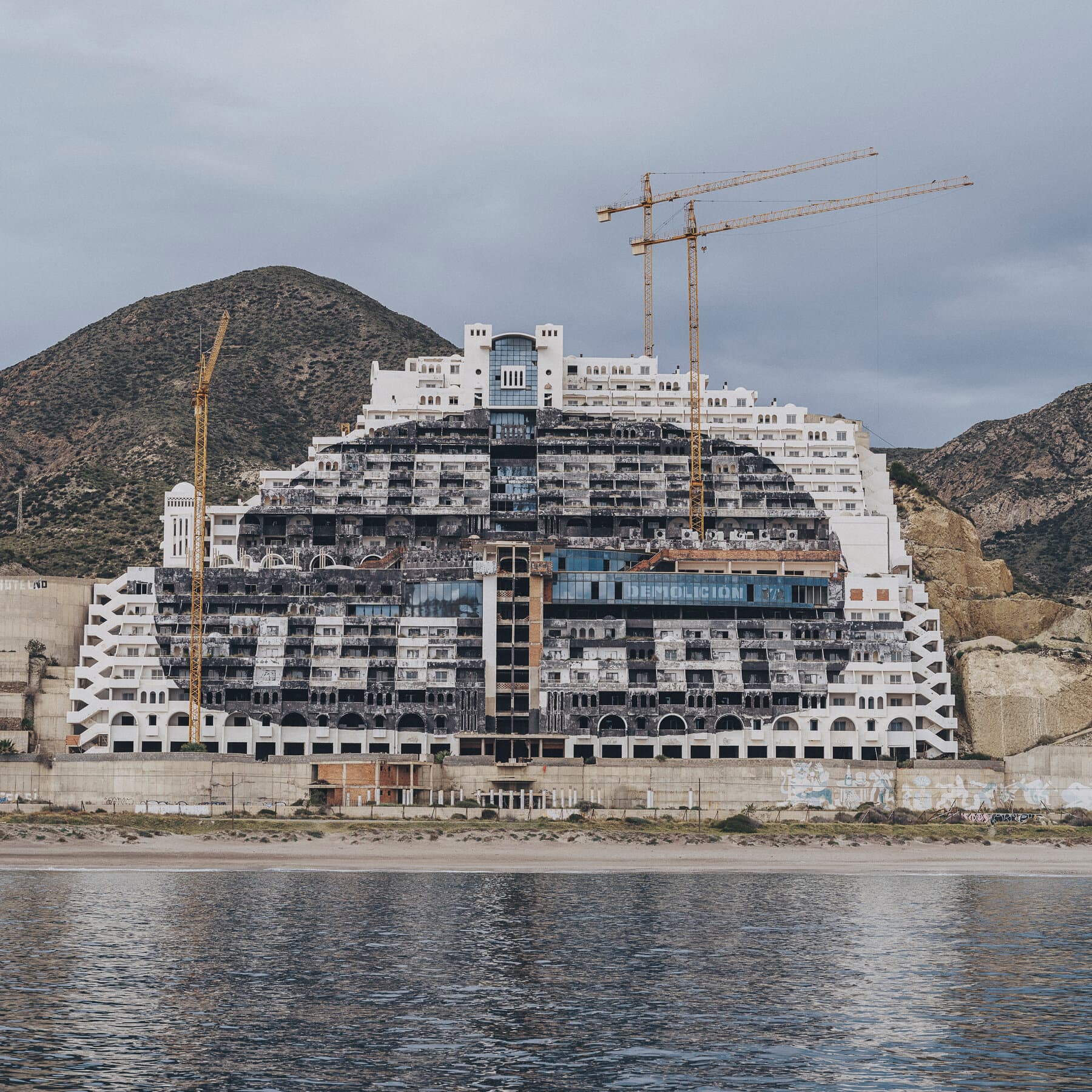
Coastal hotel ruins are among the most photographed abandoned places in Spain because they are visually dramatic and tied to the history of mass tourism. The abandoned Hotel El Algarrobico in Almeria is the best-known symbol of this pattern. It became widely cited because it represents a larger conflict between development, coastline protection, and unfinished construction.
These sites often look open from a distance, but that does not make them safe or lawful to enter. Large hotels can contain unsecured stairwells, broken glazing, unstable rooftop sections, and active perimeter monitoring. They should be treated as high-risk structures, not casual photo stops.
2. Housing-bubble ghost developments
Ghost developments are one of the most distinctive Spanish urbex themes because they are linked directly to the property boom and collapse. Across parts of Castilla-La Mancha, the Madrid periphery, and sections of the Mediterranean coast, unfinished streets and apartment blocks became symbols of speculative overbuilding.
For urban researchers, these places are important because they document a recent economic cycle in visible form. For explorers, they are also deceptive. A half-empty development may still have owners, construction firms, caretakers, or live utilities. The safest way to study this category is through background research and broad landscape observation rather than impulsive entry. More historical context is available in Ghost Towns in Spain: What the Housing Bubble Left Behind.
3. Industrial and mining landscapes
Industrial ruins in Spain reflect the decline or restructuring of mining, manufacturing, transport, and energy infrastructure. Former workshops, rail depots, foundries, silos, and extraction sites appear in several regions, especially where local economies changed faster than redevelopment plans.
These sites can be visually rich, but they are often the most contaminated. Sharp metal, unstable gantries, flooded lower levels, and residue from past industrial use are common. If a site shows active fencing, warning signs, or evidence of partial reuse, the correct assumption is that it is not open for exploration.
4. Depopulated villages and isolated hamlets
Depopulated villages are central to the story of abandoned rural Spain. In inland provinces, long-term migration toward cities left many small settlements partially or almost entirely empty. Stone houses, chapels, schools, and agricultural buildings can survive for decades in a slow state of collapse.
This category requires extra respect. Some villages are not truly abandoned; they may still have heirs, agricultural use, seasonal visitors, or heritage value. Others are memorial landscapes tied to war, migration, or economic hardship. Treat them as cultural sites first and urbex subjects second.
5. Closed hospitals, sanatoria, and military sites
Closed hospitals, tuberculosis sanatoria, military batteries, and former barracks attract attention because they combine atmosphere with strong historical narratives. They are also among the least forgiving places for inexperienced explorers.
Medical sites may contain hazardous materials, sealed sections, and difficult legal status. Military remains can involve cliffs, tunnels, or restricted land. If this category interests you, the best starting point is comparative research such as Abandoned Hospitals in Europe: Responsible Urbex Guide, not a rush to enter a risky structure.
What are the main urbex rules in Spain?
The main urbex rules in Spain are straightforward: do not enter without permission where access is restricted, do not force entry, do not damage or remove anything, and leave immediately if asked to do so. Spanish abandoned sites are often private, monitored, or protected, so legal access must be assumed to be limited unless clearly confirmed otherwise.
Use these practical rules as your baseline:
- Do not cross fences, locked gates, sealed doors, or posted warning signs.
- Do not assume a site is public because it looks empty or unfinished.
- Do not take objects, documents, tiles, medical items, or architectural fragments.
- Do not break windows, cut wire, pry doors, or reveal bypass methods online.
- Do not enter sites that are occupied, partially reused, or visibly maintained.
- Do not publish exact location details for fragile or high-risk places.
- Respect memorials, religious buildings, and heritage ruins with extra care.
Responsible urbex is compatible with documentation, photography, and research. It is not compatible with trespassing, forced access, or damage.
Access the free urbex map
How can you stay safe during urban exploration in Spain?
Urbex safety in Spain depends on conservative decision-making. The biggest mistakes are entering in heat, underestimating structural decay, and treating large empty sites as if they were controlled visitor spaces.
A practical safety checklist includes:
- Scout in daylight and leave enough time to exit before dark.
- Watch for extreme heat, dehydration, and wildfire conditions, especially in summer.
- Avoid roofs, upper floors with water damage, and unsupported staircases.
- Assume asbestos, mold, dust, or chemical residue may be present in older sites.
- Never enter shafts, wells, tunnels, tanks, or confined spaces without professional training.
- Travel with at least one other person and keep a charged phone available.
- Wear sturdy footwear and avoid loose clothing near sharp metal or broken glass.
- Leave immediately if you encounter security, residents, animals, or unstable movement.
Spain adds some climate-specific risk. Heat can be severe in inland and southern regions, storms can change conditions quickly in mountain areas, and isolated sites may have poor signal coverage. In practice, safety urbex Spain means planning for environment as much as architecture.
How should you plan an urbex trip across Spain responsibly?
A responsible urbex trip in Spain starts with verification, route planning, and realistic expectations about access. The best trips are built around confirmed information, not rumors from old forums or social media posts.
Start by grouping targets by region and by risk level. Long-distance travel in Spain can be substantial, so an itinerary that looks close on a map may still involve several hours of driving. If you are building a broader itinerary, How to Plan an Urbex Road Trip in Europe is a useful framework.
Then use curated resources instead of chasing random coordinates. Browse all urbex maps is the best starting point for structured research, and the free option below helps you review locations with a preservation-first mindset.
Good planning also means knowing when not to go. Coastal heat, holiday crowds, hunting seasons in rural areas, and storm damage can all change the risk profile of a site. Responsible explorers cancel visits when the conditions are wrong.
FAQ
Is urbex legal in Spain?
Urbex is not automatically legal in Spain just because a place is abandoned. Access depends on ownership, barriers, signage, and local restrictions. If a site is private, protected, fenced, occupied, or secured, you should not enter without authorization.
What are the most common abandoned places in Spain?
The most common categories are unfinished resorts, ghost developments, industrial ruins, rural villages, and closed medical or military sites. Each category reflects a different part of Spanish economic and social history. They also carry different risks, so they should not be approached in the same way.
Can you photograph abandoned sites in Spain?
Photography does not override property rights or safety rules. You can document a site responsibly only when you are in a lawful position to do so. In fragile places, it is also good practice to avoid sharing entry clues or exact coordinates.
Should you share exact locations online?
In most cases, no. Sharing exact access details can increase vandalism, theft, and unsafe visits. Preservation-first urbex favors limited disclosure, especially for fragile sites, memorial spaces, and places with hazardous structures.
Are ghost towns in Spain always completely empty?
No, many are not completely empty. Some so-called ghost developments still have owners, caretakers, utilities, or a small number of residents. That is why visual emptiness should never be treated as proof of legal access.
Conclusion
Urbex in Spain is compelling because the country's abandoned places record several overlapping stories: rural decline, industrial change, speculative construction, and interrupted tourism projects. That variety makes Spain one of the richest countries in Europe for visual research on abandonment.
The right way to approach it is slow, verified, and preservation-first. Focus on context, legality, and safety before photography. If you want a structured starting point, use MapUrbex resources instead of unreliable coordinates.
Browse all urbex maps
