 MapUrbex
A practical guide to urbex in Spain, with 10 notable abandoned places, context for Barcelona and Madrid, and responsible exploration advice.
Urbex in Spain: 10 of the Most Mysterious Abandoned Places
Spain is one of the richest countries in Europe for abandoned landscapes. Former industrial districts, ruined villages, unfinished resorts, and crisis-era developments all contribute to a very varied urbex scene.
Searches for urbex Barcelona and urbex Madrid are especially common. In practice, however, many of Spain's most memorable abandoned places are spread across Aragón, Andalusia, Valencia, Catalonia, and the Madrid orbit rather than inside the city centers themselves.
This guide is informational first. It highlights places that matter for understanding urbex in Spain, while keeping MapUrbex's preservation-first approach: verify status, respect property, and never force entry.
What are the most mysterious urbex places in Spain?
The most discussed urbex places in Spain include Poblenou's former industrial sites near Barcelona, the old village of Belchite, El Quiñón in Seseña near Madrid, the unfinished Hotel El Algarrobico, the Preventorio de Aigües, and several semi-abandoned villages and colonies. Some are heritage sites, some are private property, and some have changed status, so verification always matters.
| Place | Region | Why it stands out | Status note |
|---|---|---|---|
| Poblenou industrial remnants | Barcelona | Classic industrial urbex landscape | Constant redevelopment |
| Hospital del Tórax | Terrassa | Famous former sanatorium in Catalan urbex culture | Historic reference; current access is controlled |
| Corbera d'Ebre old village | Tarragona | Civil War ruins with strong atmosphere | Memory site, not a trespass target |
| El Quiñón, Seseña | Toledo / Madrid orbit | Symbol of the housing bubble | Partly inhabited and changing |
| Belchite Viejo | Zaragoza | Ruined old town preserved after war | Managed heritage context |
| Ochate | Álava | Tiny abandoned village tied to legends | Rural and legal access checks required |
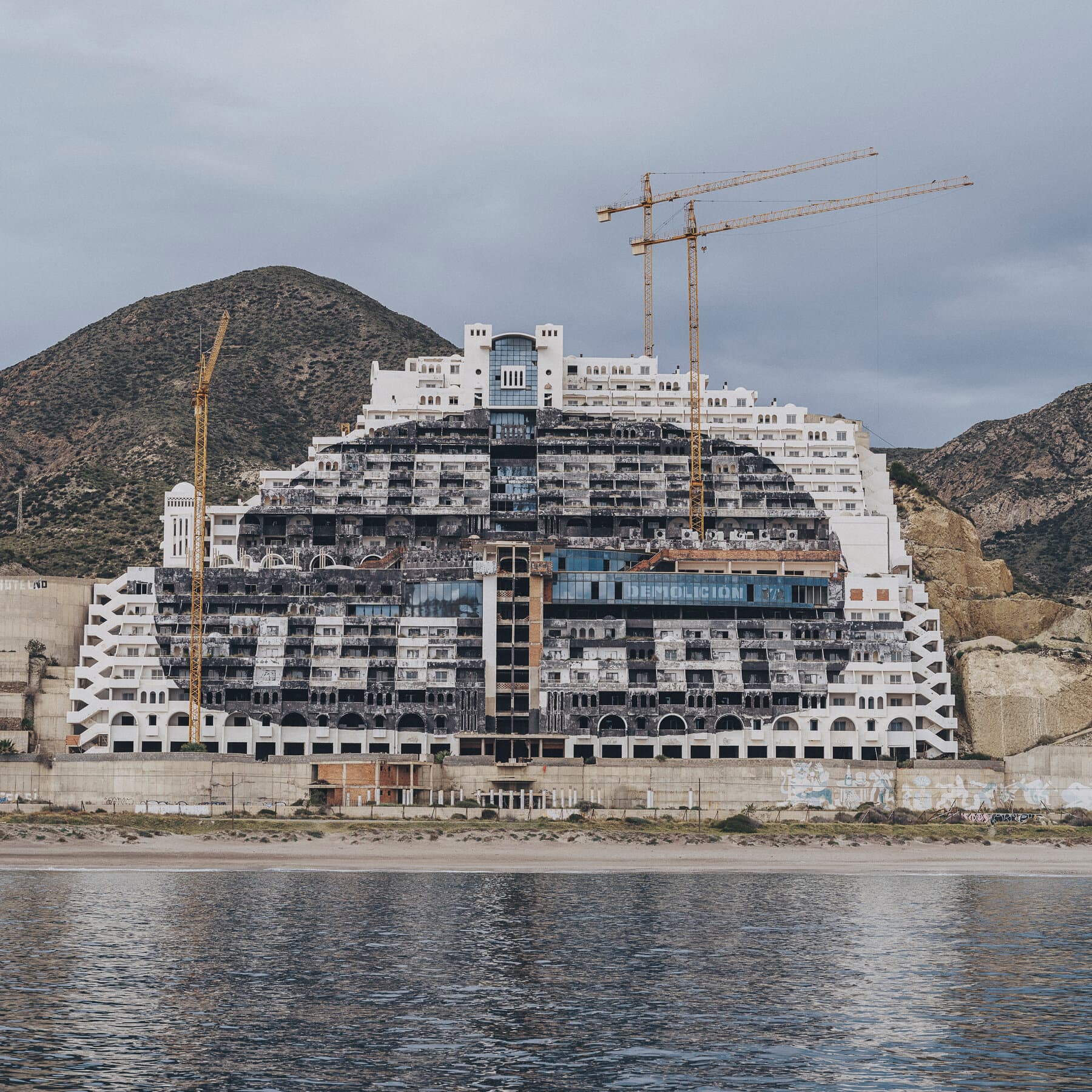
| Hotel El Algarrobico | Almería | Iconic unfinished seafront hotel | Sensitive legal and environmental context |
| Preventorio de Aigües | Alicante | Large decayed health complex | Serious structural risk |
| Colonia Santa Eulalia | Alicante / Valencia area | Semi-abandoned agro-industrial colony | Fragmented ownership |
| Rodalquilar mining settlement | Almería | Desert mining remains and stark scenery | Heritage and natural park sensitivities |
Quick summary
- Urbex in Spain is geographically diverse, not limited to Barcelona and Madrid.
- Many famous Spanish sites are best understood as historical or legal case studies, not easy visit targets.
- The most searched areas near Barcelona and Madrid often change quickly because of redevelopment and security.
- Several top places in Spain are protected ruins, memory sites, or environmentally sensitive areas.
- Responsible urbex means no trespassing, no forced access, and no publication of reckless entry advice.
- MapUrbex works best when paired with verified status checks and a preservation-first mindset.
Quick facts
- Primary search intent: informational research about urbex Spain
- Best-known site types: ghost towns, ruined villages, hotels, sanatoriums, industrial remains
- Key cities searched: Barcelona and Madrid
- Regions with strong abandoned-place interest: Catalonia, Aragón, Andalusia, Valencia, Castilla-La Mancha
- Main risk factors: unstable floors, asbestos, private security, active redevelopment, remote terrain
- Legal baseline: never enter private or restricted property without authorization
Which places stand out around Barcelona and Catalonia?
Catalonia matters because it combines industrial history, war memory, and intense urban change. For people searching urbex Barcelona, the reality is that the most meaningful places are often on the metropolitan edge or in wider Catalonia rather than in central Barcelona.
Poblenou's industrial remnants remain a key reference point in Barcelona's urbex history. The district's former factories shaped the city's abandoned aesthetic for years, but redevelopment has transformed much of the area. That makes old online lists unreliable.
Hospital del Tórax in Terrassa is one of the best-known names in Spanish urbex culture. It is often cited because of its scale, medical history, and mythology. It should be treated mainly as a historical reference point, since access conditions have long changed.
Corbera d'Ebre old village is different from a typical abandoned building. It is a Civil War ruin preserved as a place of memory. That makes it important culturally, but it also means visitors should approach it as heritage, not as a site for intrusive exploration.
If you want broader context before focusing on Catalonia, Urbex in Spain: Complete Guide to Abandoned Places and Exploration Rules explains the legal and practical basics.
Which abandoned places define the Madrid orbit and central Spain?
Around Madrid, the most cited abandoned places are usually tied to the housing bubble, unfinished development, or fast-changing peripheral infrastructure. Strictly inside Madrid, permanently abandoned landmarks are scarcer than many clickbait lists suggest.
El Quiñón in Seseña is the clearest example. It became famous as a symbol of speculative overbuilding after the real-estate boom. Its importance is not just visual decay; it also shows how economic history creates modern ghost landscapes near Madrid.
More broadly, ghost developments in central Spain matter because they changed how people imagine abandoned places in the country. These are often not classic ruins. They are half-finished or partially occupied residential zones where status can change block by block.
For background on this phenomenon, Ghost Towns in Spain: What the Housing Bubble Left Behind is the most useful companion read.
Which sites are most important in Aragón, the north, and inland Spain?
Aragón and northern Spain contain some of the most historically powerful abandoned places in the country. These sites matter less for adrenaline and more for memory, landscape, and the way abandonment intersects with war, depopulation, and folklore.
Belchite Viejo is one of Spain's most famous ruined settlements. Its damaged streets were left standing after the Civil War, giving it exceptional symbolic weight. It is not a generic urbex free-for-all; it is a protected historical context.
Ochate, in Álava, is much smaller but surrounded by legends and paranormal storytelling. That reputation attracts curiosity, yet the real issues are more practical: rural navigation, land access, changing conditions, and the ease with which myths obscure facts.
These inland sites are a good reminder that the best urbex research in Spain often starts with history rather than spectacle.
Which locations in southern and eastern Spain are most referenced by urbex researchers?
Southern and eastern Spain contain some of the country's most photogenic abandoned places, but they also raise the strongest legal, environmental, and safety concerns. That is why they are widely cited and frequently misunderstood.
Hotel El Algarrobico, on the Almería coast, is one of the most emblematic examples. Its unfinished structure became a national scandal about planning, coastline protection, and development. For deeper context, see Abandoned Hotel El Algarrobico in Spain: History, Scandal, and Urbex Context.
Preventorio de Aigües, near Alicante, is often mentioned because of its scale and advanced decay. It represents the visual side of Spanish urbex, but also the physical danger side: collapsing surfaces, exposed interiors, and uncertain ownership.
Colonia Santa Eulalia is notable because it is not just one building. It is a semi-abandoned agro-industrial colony with multiple remnants and uneven preservation. That makes it historically rich, but also complicated to evaluate responsibly.
Rodalquilar's mining landscape adds another layer. The remains there are tied to industrial extraction and desert geography, often within sensitive natural and heritage surroundings. In places like this, preservation matters more than access.
How should you research urbex places in Spain responsibly?
The safest and most accurate approach is to treat every Spanish urbex site as a status-check problem first. A place may be abandoned visually while still being protected, privately owned, monitored, partially reused, or environmentally sensitive.
Use this checklist:
- Confirm whether the site is public heritage, private property, or restricted land.
- Check whether the structure is actually abandoned or already repurposed.
- Avoid relying on old forum posts or recycled coordinates.
- Do not climb unstable roofs, stairs, or slabs.
- Never break locks, fences, windows, or seals.
- Leave every site exactly as found.
MapUrbex is built for this verification mindset. You can Browse all urbex maps when you want a curated overview instead of random, outdated lists.
FAQ
Is urbex legal in Spain?
Urbex itself is not a special legal category. What matters is property law, access restrictions, safety rules, and heritage protection. If a place is private, restricted, or protected, entering without authorization can create legal problems.
Are there good urbex places inside Barcelona and Madrid?
There are references and fast-changing sites in both urban areas, but many famous examples are gone, redeveloped, secured, or no longer truly abandoned. For reliable research, think in terms of the wider metropolitan region rather than the city center alone.
What is the most famous abandoned place in Spain?
The answer depends on the context, but Belchite Viejo and Hotel El Algarrobico are among the most widely cited. One is central to historical memory; the other is central to modern planning controversy.
Should exact coordinates of abandoned places in Spain be shared publicly?
Not by default. Publicly broadcasting exact locations can accelerate damage, theft, and unsafe visits. A preservation-first approach favors verification and responsible access over viral exposure.
What makes ghost towns in Spain different from classic industrial urbex?
Ghost towns in Spain are often linked to depopulation or the housing bubble rather than a single factory closure. That gives them a broader social and economic story.
Conclusion
The best way to understand urbex in Spain is to see it as a mix of history, economic change, war memory, failed development, and regional diversity. Barcelona and Madrid matter in search demand, but some of the country's most meaningful abandoned places lie well beyond their centers.
For MapUrbex, the real value is not hype. It is verified context, responsible research, and preservation-first decision making.
Access the free urbex map
