 MapUrbex
Explore the Provence-Alpes-Côte d'Azur urbex map with the main PACA research areas, common site types, safety rules, and responsible mapping advice.
Provence-Alpes-Côte d'Azur Urbex Map: Best PACA Urbex Areas in the South of France
PACA is one of the most varied urbex regions in France. The coastline concentrates industrial, military, transport, and leisure heritage, while the inland departments add rural estates, disused resorts, and mountain infrastructure.
A Provence-Alpes-Côte d'Azur urbex map is useful because the region is large and uneven. Some zones contain dense clusters of abandoned places, while others produce fewer but more distinctive finds. On MapUrbex, the goal is not reckless exposure. The goal is verified context, responsible research, and preservation-first exploration.
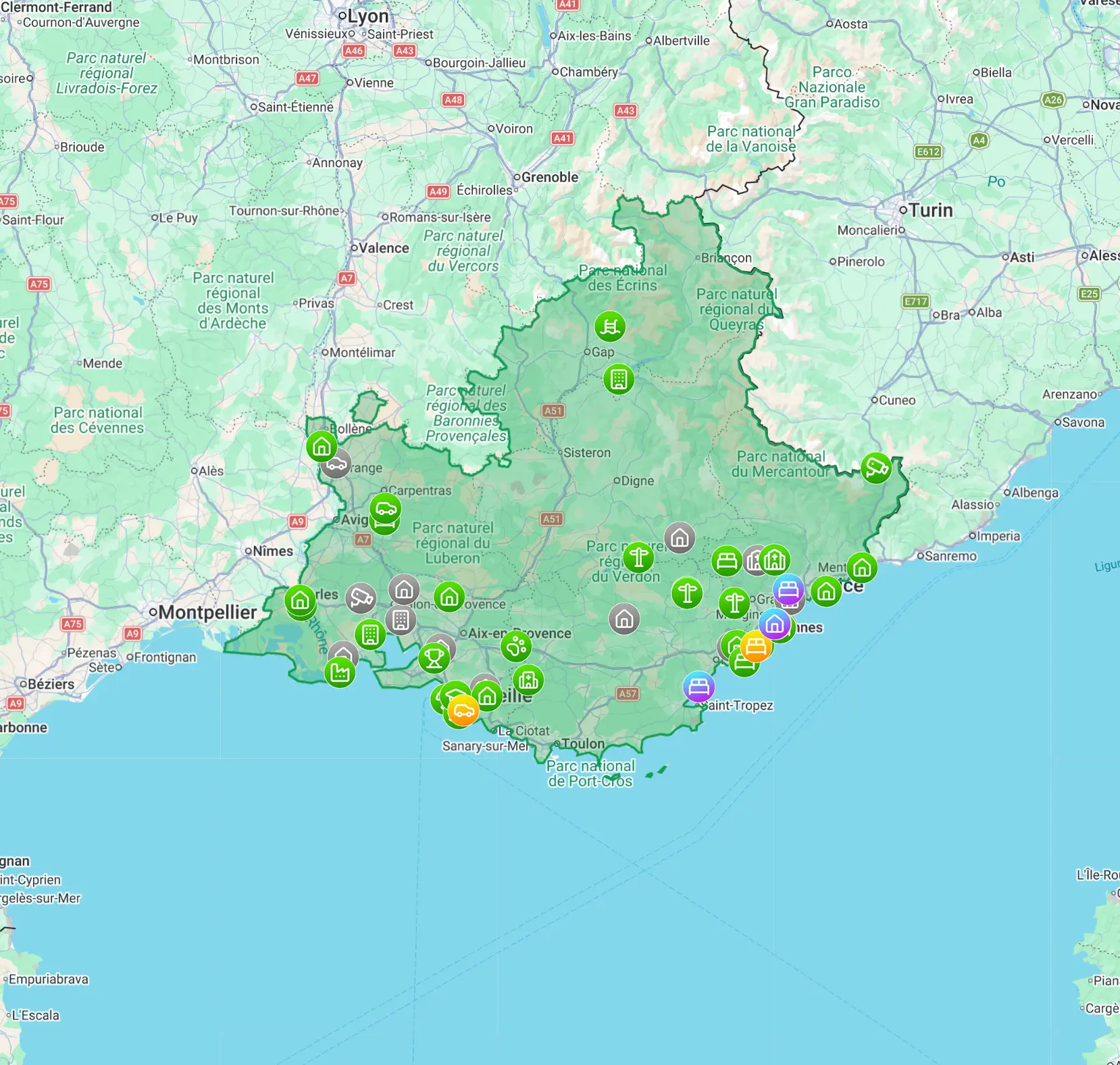
What does the Provence-Alpes-Côte d'Azur urbex map show?
The Provence-Alpes-Côte d'Azur urbex map shows curated abandoned and disused locations across PACA. It highlights the region's main research zones, the kinds of sites most often found there, and the practical context that matters for planning, such as terrain, density, and responsible access limits.
Quick summary
- PACA is one of the strongest urbex regions in southern France because it combines coast, industry, rural heritage, and mountain infrastructure.
- Bouches-du-Rhône, Var, and Alpes-Maritimes usually offer the highest density of PACA urbex spots.
- Vaucluse, Alpes-de-Haute-Provence, and Hautes-Alpes tend to be more dispersed but can be very rewarding for patient research.
- The most common abandoned places in Provence-Alpes-Côte d'Azur include industrial buildings, military remnants, old leisure sites, transport structures, and rural properties.
- A good South of France urbex map should help with context, not just coordinates.
- Responsible urbex in PACA means no trespassing, no forced entry, and no publication that increases damage or theft.
Quick facts
- Region: Provence-Alpes-Côte d'Azur, southeastern France
- Departments: Bouches-du-Rhône, Var, Alpes-Maritimes, Vaucluse, Alpes-de-Haute-Provence, Hautes-Alpes
- Best known for: Coastal industry, military heritage, transport remnants, rural estates, and mountain sites
- Research profile: Dense on the coast, more scattered inland
- Best use of a map: Compare departments, spot clusters, and prioritize field research
- Legal reminder: Visit only with authorization and always respect private property, local restrictions, and safety conditions
Why is PACA such a strong region for urbex?
PACA is such a strong region for urbex because it combines several different historical layers in a relatively compact area. Heavy industry, port logistics, Cold War defenses, tourism infrastructure, agricultural estates, and mountain transport networks all left traces across the same region.
That diversity matters for research. A single South of France urbex map can cover coastal warehouses, former military compounds, hillside sanatorium-style buildings, disused holiday facilities, and small rural structures that would belong to separate research worlds in other regions.
For method, PACA also rewards cross-checking. Comparing Browse all urbex maps with archive work and field logic is usually more reliable than chasing random social media posts. If you want a structured research process, start with Tools to Find Abandoned Places: Best Urbex Research Tools and Maps and How to Find Secret Urbex Places: Real Methods Explained.
Which departments offer the broadest range of abandoned places in Provence-Alpes-Côte d'Azur?
The broadest range of abandoned places in Provence-Alpes-Côte d'Azur is usually found in Bouches-du-Rhône, Var, and Alpes-Maritimes. These departments combine urban pressure, military history, industry, and transport infrastructure, which creates a deeper and more varied urbex landscape than the more rural northern departments.
| Department | Typical urbex profile | Why it matters on a map |
|---|---|---|
| Bouches-du-Rhône | Industrial sites, logistics, coastal infrastructure, institutional buildings | Often the densest research base in PACA |
| Var | Military remnants, coastal compounds, tourism infrastructure, rural estates | Strong mix of coast and inland terrain |
| Alpes-Maritimes | Transport heritage, hillside properties, Riviera backcountry sites | High contrast between urban coast and mountainous interior |
| Vaucluse | Rural buildings, estates, agricultural and small industrial remnants | Better for slower, selective research |
| Alpes-de-Haute-Provence | Mountain infrastructure, isolated institutions, old leisure sites | Lower density but distinctive discoveries |
| Hautes-Alpes | Scattered mountain sites, hospitality remnants, transport traces | Sparse but visually and historically unique |
This does not mean the inland departments are secondary. It means they are less dense. In practice, PACA research often works best when the coast is used for volume and the interior is used for depth.
Which areas stand out most on a South of France urbex map?
The areas that stand out most on a South of France urbex map are Marseille and the industrial coast, the Var military belt, the inland mountain departments, the rural heritage zones of Vaucluse, and the transport corridor in the Alpes-Maritimes. These zones repeatedly appear because they combine history, site variety, and workable research logic.
1. Marseille and the industrial coastline
Marseille and its wider industrial coastline are the most obvious PACA urbex core. The area concentrates port history, logistics, disused industrial land, institutional buildings, and infrastructure linked to shipping, manufacturing, and expansion around the Etang de Berre corridor.
This part of the region matters because density changes research efficiency. Even when individual sites disappear, get rebuilt, or become inaccessible, the surrounding urban-industrial fabric still produces new leads. It is one of the strongest areas for researchers who want pattern recognition rather than one isolated spot.
2. Toulon, Hyeres, and the Var military belt
Toulon and the wider Var coast stand out because military history is deeply embedded in the landscape. Former defensive systems, support buildings, coastal compounds, and disused service infrastructure create a different urbex profile from the heavily industrial parts of Bouches-du-Rhône.
The Var is also useful because it links coastal and inland research. Around the coast, you may find remnants tied to defense and tourism. Farther inland, the terrain shifts toward estates, agricultural traces, and smaller forgotten properties. That mix makes Var one of the most balanced PACA departments for mapping.
3. Alpes-de-Haute-Provence and the inland mountain valleys
Alpes-de-Haute-Provence stands out because it offers fewer sites, but often stronger atmosphere and clearer historical isolation. In these valleys, abandoned places are more likely to be detached from dense urban redevelopment and more likely to retain a visible relationship with landscape, transport routes, or seasonal activity.
This department is especially relevant for researchers interested in disused institutions, old hospitality structures, mountain service buildings, and forgotten infrastructure. The drawback is distance and lower site density. The advantage is that each lead often carries more context than a quick coastal find.
4. Vaucluse, the Luberon, and rural heritage zones
Vaucluse stands out for rural abandonment rather than heavy industrial concentration. The region is better known for estates, farm buildings, small workshops, roadside structures, and local heritage remains that sit between agriculture, village expansion, and tourism change.
That makes Vaucluse important on a Provence-Alpes-Côte d'Azur urbex map even when the total number of major spots is lower. It helps balance the regional picture. PACA is not only ports and bunkers. It is also a region of slow decline, fragmented land use, and dispersed rural abandonment.
5. Nice hinterland and the Alpes-Maritimes transport corridor
The Alpes-Maritimes stand out because they combine Riviera urban pressure with mountain geography. Near the coast, redevelopment is intense. In the interior, older transport routes, hillside properties, and overlooked service structures create a more layered research environment.
This is one of the best PACA sectors for people who study how terrain shapes abandonment. Valleys, slopes, tunnels, secondary roads, and former hospitality infrastructure all influence where sites survive. On a map, that makes the Alpes-Maritimes less about raw numbers and more about strategic reading of the landscape.
How should you use a PACA urbex map responsibly?
You should use a PACA urbex map as a research and verification tool, not as an excuse to enter restricted places. A responsible map helps you understand context, identify patterns, and prepare safely. It should never encourage trespassing, forced access, or risky behavior around unstable structures, cliffs, tunnels, or coastal hazards.
A practical approach is simple:
- check ownership and current status before any visit
- prioritize exterior observation or authorized access
- avoid sharing exact details for sensitive sites
- leave nothing behind and take nothing away
- do not visit during storms, wildfire alerts, or active restriction periods
PACA adds seasonal risks that many beginners underestimate. Summer heat, wildfire controls, unstable coastal edges, and long distances between inland services can turn a casual outing into a dangerous one. The best urbex research is patient, legal, and low impact.
Access the free urbex map
What kinds of urbex spots are most common in PACA?
The most common urbex spots in PACA are industrial buildings, military remnants, transport infrastructure, rural properties, and disused leisure sites. The exact balance changes by department, but these five categories explain most of the region's abandoned landscape.
- Industrial sites: warehouses, workshops, depots, processing buildings, and logistics infrastructure
- Military remnants: defensive structures, support compounds, storage areas, and coastal installations
- Transport heritage: stations, service buildings, tunnels, technical structures, and roadside infrastructure
- Rural abandonment: estates, farms, outbuildings, and small local industrial traces
- Leisure and hospitality sites: holiday complexes, seasonal facilities, and former accommodation buildings
No category guarantees access or survival. In PACA, redevelopment pressure is strong near the coast, while weather and neglect affect mountain and rural sites differently. A good map is useful because it tracks patterns, not because it promises permanence.
How does MapUrbex curate Provence-Alpes-Côte d'Azur locations?
MapUrbex curates Provence-Alpes-Côte d'Azur locations by prioritizing verification, context, and responsible publication. The aim is to help users understand where meaningful urbex research exists in PACA without pushing unsafe exposure or low-quality rumor-based listings.
That means looking at regional density, site types, local access context, and preservation risk. A curated map is more useful than a random list because it helps you compare departments, identify recurring patterns, and decide where deeper research is worth the effort.
If you want a broader overview before focusing on PACA, use Browse all urbex maps. If you only want a starting point, the free entry layer is enough to begin responsible planning without oversharing fragile places.
FAQ
Is Provence-Alpes-Côte d'Azur a good region for beginner urbex research?
Yes, PACA is a good region for beginner research because it offers many different site types and clear contrasts between departments. It is less suitable for careless exploration, because terrain, heat, coastal hazards, and private property issues are common. Beginners should focus on method, legality, and low-risk observation.
Are PACA urbex spots mostly on the coast?
No, PACA urbex spots are not only coastal, but coastal departments usually have higher density. Inland departments often have fewer sites, yet those sites can be more distinctive and less repetitive. A strong regional map helps you see both patterns at once.
What is the best season for researching abandoned places in Provence-Alpes-Côte d'Azur?
Spring and autumn are usually the best seasons for research in PACA. Visibility, temperature, and travel conditions are often better than in peak summer. Always check local restrictions, especially wildfire rules and weather conditions in mountain areas.
Does MapUrbex publish every abandoned place in the region?
No, MapUrbex does not aim to publish every abandoned place. The platform focuses on curated, useful, and responsibly handled information. Sensitive places, unstable locations, or low-confidence leads may be limited or excluded.
Should you rely only on one South of France urbex map?
No, one map should be a starting point, not your only source. The best results come from combining maps, public records, field observation, and historical research. That is why method matters more than chasing a single pin.
Conclusion
A Provence-Alpes-Côte d'Azur urbex map is most useful when it explains the region, not when it simply drops coordinates. PACA stands out because it compresses industrial coastlines, military history, rural decline, and mountain infrastructure into one of the richest abandoned landscapes in southern France.
For responsible researchers, the key insight is simple: use the coast for density, use the interior for depth, and always verify before you go. Careful planning protects both you and the places.
Access the free urbex map
