 MapUrbex
Use a Normandy urbex map to find abandoned places more efficiently, understand the region’s main site types, and explore with a preservation-first approach.
Normandy Urbex Map: Explore Abandoned Places in Normandy Responsibly
Normandy is one of the most varied regions in France for abandoned sites. The landscape combines coastal military remains, rural buildings, former industrial spaces, and institutional properties that have fallen out of use.
A good Normandy urbex map helps separate real leads from dead ends. It also gives context: what kind of place you are looking at, why it may be abandoned, and what legal or safety limits matter before any trip.
What is the best way to use a Normandy urbex map?
The best way to use a Normandy urbex map is to treat it as a research and planning tool, not as an invitation to enter every site. A curated map helps you identify likely abandoned places in Normandy, compare site types, reduce wasted trips, and prepare a legal, preservation-first route based on verified information.
That matters in Normandy because the region is large, rural in many areas, and full of places that look abandoned from the road but are still owned, monitored, or structurally unsafe.
Quick summary
- Normandy has a high concentration of abandoned places because of war history, rural decline, institutional closures, and industrial change.
- The most common urbex spots in Normandy include bunkers, farms, factories, schools, churches, and former care facilities.
- A curated Normandy urbex map saves time by filtering false leads and organizing places by region and category.
- Responsible urban exploration in Normandy starts with research, access checks, and preservation-first behavior.
- Coastal, military, and medical sites often involve extra risks such as unstable floors, water exposure, or contamination.
- MapUrbex focuses on verified locations, careful documentation, and safer route planning rather than reckless access.
Quick facts
- Region: Normandy, northern France
- Search intent: Informational guide for finding and understanding urbex locations
- Typical site types: Military remains, rural houses, industrial buildings, religious sites, schools, hospitals
- Best use of a map: Research, trip planning, regional filtering, and verification
- Main challenges: Ownership status, structural decay, remote access, coastal hazards
- Best approach: Use curated data, avoid forced entry, and leave every place unchanged
Why does Normandy have so many abandoned places?
Normandy has many abandoned places because several historical layers overlap in one region. War infrastructure, declining rural properties, old institutions, and obsolete industrial buildings all contribute to a dense and varied urbex landscape.
The coastline still carries the legacy of twentieth-century military construction. Inland, you find villages with unused farms, outbuildings, workshops, and manor houses that lost their economic role over time. Around former transport or industrial corridors, warehouses and factories often survive long after operations stopped.
Normandy also has a strong religious, educational, and medical heritage. When schools merge, convents close, or care facilities move to modern buildings, older structures may remain vacant for years. That is one reason the region attracts people interested in exploration urbaine Normandy research.
Which types of abandoned places appear most often on a Normandy urbex map?
The most common entries on a Normandy urbex map are military remains, rural homes, industrial sites, religious buildings, and former public institutions. These categories appear often because they reflect Normandy’s geography, history, and economic transitions.
| Site type | Where it is often found | Why it is often abandoned | Main caution |
|---|---|---|---|
| Coastal bunkers and military remains | Shoreline and defense zones | War legacy and obsolescence | Collapse, flooding, restricted land |
| Farmhouses and rural estates | Inland villages and farmland | Depopulation, inheritance issues, changing agriculture | Fragile roofs, animals, private land |
| Factories and warehouses | Former industrial towns and transport areas | Relocation, closure, modernization | Asbestos, broken floors, security |
| Churches, schools, and religious properties | Town centers and older settlements | Consolidation and declining use | Unstable interiors, heritage sensitivity |
| Hospitals and care facilities | Urban edges and institutional campuses | Newer replacements and closure | Contamination, surveillance, legal risk |
1. Coastal bunkers and military remains
Coastal bunkers are among the most recognizable urbex spots in Normandy. The region’s World War II history left a large number of defensive structures, observation posts, and underground spaces along the coast.
These places are visually striking, but they also require caution. Sea exposure, crumbling concrete, hidden shafts, and unstable access routes are common. Some sites are on protected or controlled land, so a visible ruin should never be assumed to be open for entry.
2. Farmhouses and rural estates
Abandoned farmhouses are common across inland Normandy. Agricultural modernization and demographic change have left many homes, barns, and auxiliary buildings unused.
These sites often look quiet and accessible, but they are frequently still part of an active property boundary. They may also contain unsafe flooring, wells, rusted metal, or animals. For responsible research methods, see How to Find Real Abandoned Places Near You in 2026 (Without Wasting Time).
3. Factories and warehouses
Former industrial buildings appear in port-related zones, rail corridors, and older manufacturing districts. In Normandy, they can range from agro-industrial structures to logistics buildings and workshops.
Industrial ruins are useful for photography and historical study because they preserve machinery layouts, signage, and traces of labor history. They are also among the riskiest categories because of collapsing floors, glass, asbestos, and occasional security presence.
4. Religious buildings and schools
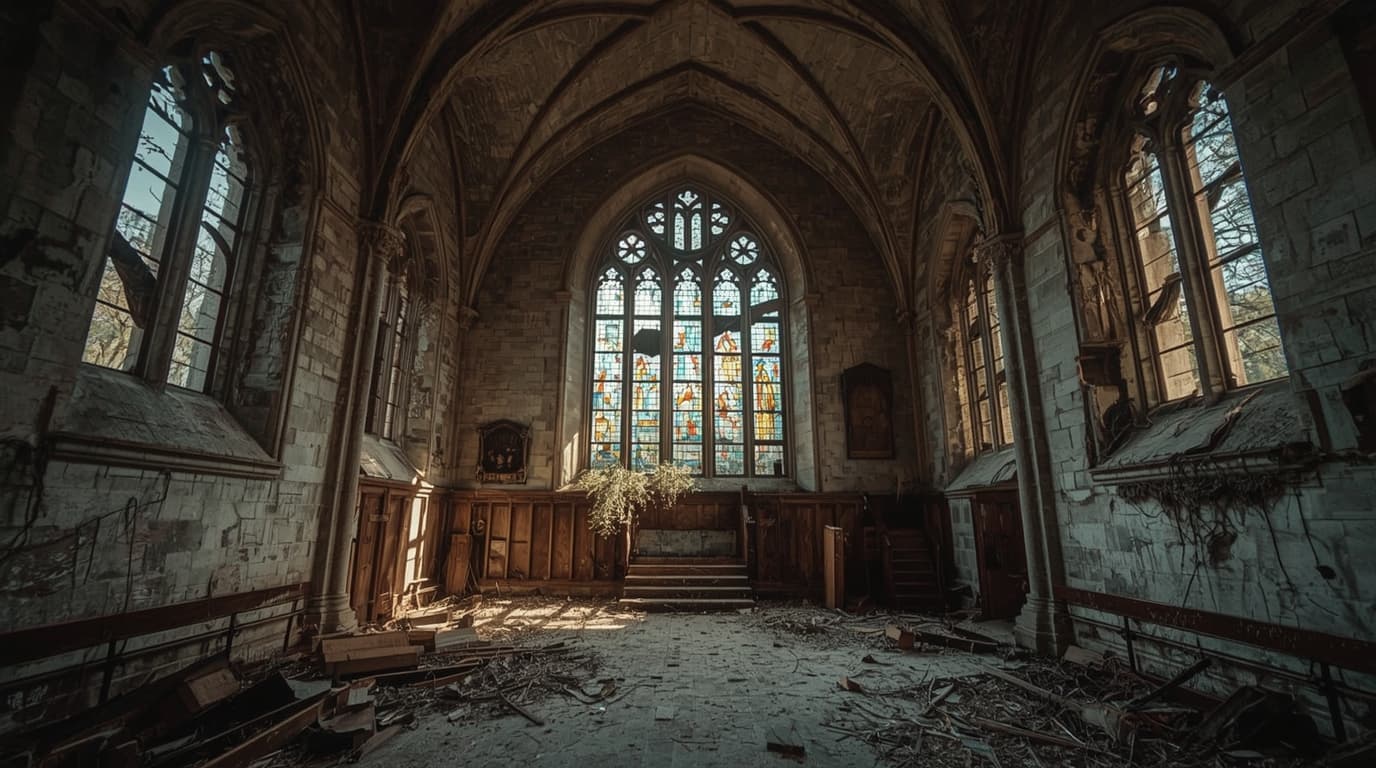
Closed churches, chapels, convents, and school buildings form another major category of lieux abandonnés en Normandie. They often survive longer than other structures because they are architecturally significant, even when they are no longer maintained.
These places deserve extra care. Decorative interiors, archives, furniture, and stained glass are easily damaged. Preservation-first urbex means documenting without removing objects, forcing doors, or publishing details that increase vandalism.
5. Hospitals, clinics, and care facilities
Former medical sites attract attention because they often contain layered interiors: corridors, technical rooms, dormitories, and administrative spaces. In Normandy, closures or relocations have left some older facilities vacant.
They are also sensitive locations. Medical buildings can contain contaminants, sharps, mold, and security systems. They should be researched more cautiously than ordinary ruins, and many are better treated as historical subjects than visit targets.
How should you research abandoned places in Normandy before visiting?
You should research abandoned places in Normandy by verifying the site’s status, ownership context, hazards, and recent activity before planning any route. Good research reduces wasted time and helps you avoid trespassing, dangerous structures, and false listings.
A simple process works well:
- Start with a curated regional source instead of random social posts.
- Compare categories, location context, and signs of current use.
- Check whether the area is coastal, agricultural, urban, or restricted.
- Look for safety indicators such as flood risk, roof failure, fencing, or surveillance.
- Drop any site that requires forced access or creates doubt about legality.
If you want a stronger method, read Tools to Find Abandoned Places: Best Urbex Research Tools and Maps and How to Find Secret Urbex Places: Real Methods Explained. Both explain why reliable urbex research depends on cross-checking evidence rather than chasing rumors.
How does a curated Normandy urbex map save time?
A curated Normandy urbex map saves time by organizing real research leads in one place and removing much of the noise found in forums, short videos, and recycled social posts. It gives structure to your search instead of forcing you to investigate every vague tip manually.
That is especially useful in a region as broad as Normandy. You may want coastal ruins one weekend, rural mansions on another, and industrial sites later. A structured map lets you compare categories and build a route that matches your interests and travel distance.
If you want broader regional options, Browse all urbex maps. If you want to start with a simpler dataset, use the free option below.
Access the free urbex map
What are the main legal and safety rules for urbex in Normandy?
The main legal and safety rules for urbex in Normandy are simple: do not trespass, do not force entry, do not damage anything, and do not underestimate structural or environmental risks. A map is a research tool, not legal permission.
Keep these rules in mind:
- Respect ownership: An abandoned building is usually still private or public property.
- Never force access: No breaking locks, fences, boards, or windows.
- Preserve the site: Do not take objects, move items, or reveal sensitive details irresponsibly.
- Assess physical risks: Watch for rotten floors, unstable stairs, mold, asbestos, and exposed metal.
- Be careful near the coast: Tides, cliff edges, water infiltration, and concrete decay can change conditions fast.
- Leave if the status is unclear: Uncertainty is a reason to stop, not to push forward.
This is the preservation-first logic behind MapUrbex. The goal is to document and understand abandoned places, not to accelerate damage or create risky behavior.
FAQ
The questions below cover the issues people most often ask about a Normandy urbex map and abandoned places in Normandy.
Is urbex legal in Normandy?
Urbex itself is not a special legal status. In practice, legality depends on access, ownership, and local restrictions. If a site is private, fenced, monitored, or clearly closed, entering without permission can be illegal.
What kinds of abandoned places are easiest to find in Normandy?
Rural outbuildings, old farm structures, and some visible military remains are often the easiest to identify from regional research. That does not mean they are safe or legal to enter. Easy to spot is not the same as open to access.
Are bunkers in Normandy always safe to explore?
No. Many bunkers are wet, unstable, partially collapsed, or located in hazardous coastal zones. Some are also on sensitive land or difficult terrain, so they should never be treated as simple beginner spots.
Why use a curated map instead of social media posts?
A curated map helps filter outdated, fake, duplicated, or misleading listings. Social media often rewards spectacle, not accuracy. For serious research, structured and verified information is more useful than viral clips.
What should I bring for responsible urbex research in Normandy?
Bring a charged phone, offline navigation, weather awareness, and enough time to turn back if conditions are unclear. For any field visit, prioritize sturdy footwear and basic safety judgment over photography gear. The most important tool is still restraint.
Conclusion
A Normandy urbex map is most useful when it helps you understand the region, not just collect coordinates. Normandy stands out because it brings together military history, rural decline, industrial change, and institutional closures in a single territory.
The best approach is to research carefully, verify what you can, and keep preservation at the center of every decision. To continue exploring responsibly, start with the free curated map.
Access the free urbex map
