 MapUrbex
A practical guide to the New York State urbex map, with the best regions, site types, safety rules, and how to find verified abandoned locations.
New York State Urbex Map: Best Urbex Locations in New York
New York State has one of the most varied urbex landscapes in the United States. The state combines Rust Belt industry, river towns, mountain resorts, military remains, institutional campuses, and coastal defense sites.
That variety is exactly why a New York State urbex map is useful. A curated map helps separate historically important places, closed landmarks, and active danger zones from low-value rumor pins. It also gives needed context on region, site type, and responsible use.
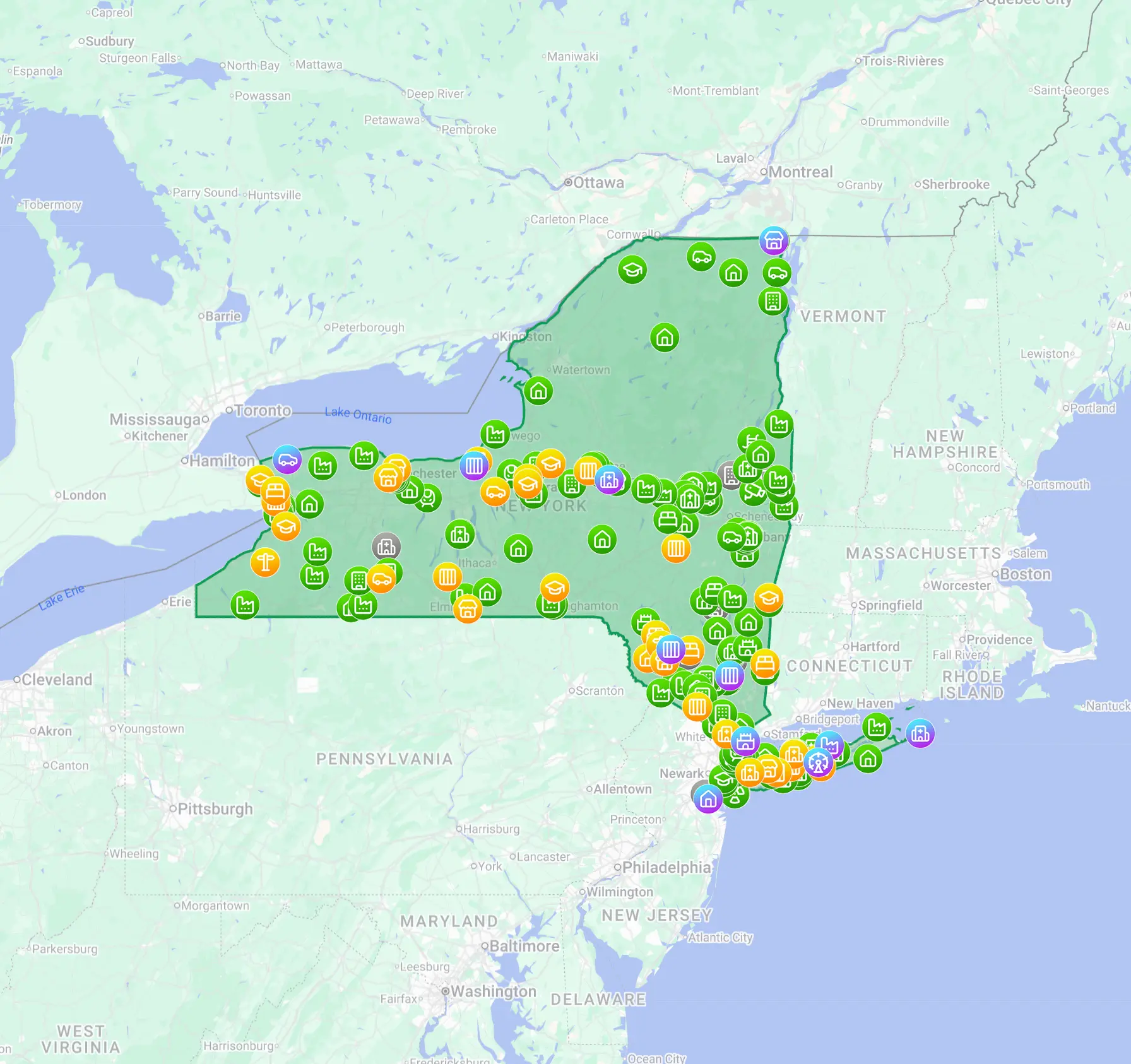
What is the best urbex map for New York State?
The best New York State urbex map is a curated, verified map that groups real abandoned and historic sites by region, type, and current context. In a large state where access conditions change quickly, a responsible map is more useful than random coordinates because it helps you identify worthwhile locations while respecting legality, safety, and preservation.
Quick summary
- New York State offers strong urbex variety, from Buffalo industry to Catskills resort ruins and Hudson Valley institutional sites.
- A verified map is more reliable than crowd-posted coordinates because status, ownership, and risk change often.
- The best urbex locations in New York State are usually clustered by region, not spread evenly across the state.
- Industrial sites, hospitals, resorts, military remnants, and infrastructure relics are the main categories on a New York abandoned places map.
- New York City is only one part of the story; upstate and western New York often hold the most distinctive large-format sites.
- Responsible urban exploration in New York means no forced entry, no trespassing, and no damage to protected places.
Quick facts
- Primary focus: New York State urbex map
- Search intent: Informational guide to the best urbex locations in New York State
- Best-known site types: industrial complexes, hospitals, resorts, military sites, transport relics
- Highest-density regions: Buffalo area, Hudson Valley, Catskills, Mohawk corridor, downstate coast
- Best use of a map: finding verified locations with context rather than relying on unconfirmed social media pins
- Important reminder: many abandoned places in New York are private, protected, unstable, or actively monitored
Why use a curated New York State urbex map instead of random coordinates?
A curated New York State urbex map is better because it adds context that raw coordinates cannot provide. For urbex in New York, the key question is not only where a place is, but also what it is, whether it still exists, whether it is protected, and whether public visibility is possible without unlawful entry.
This matters more in New York than in many smaller regions. The state contains demolished resort sites, redeveloped hospitals, landmark ruins, and industrial campuses that may look abandoned online but have changed status in the real world. That is why MapUrbex emphasizes verified locations, preservation-first research, and clear categorization. For wider context, see Best Urbex Maps in the World: Where to Find Verified Locations or Browse all urbex maps.
| Region | Typical finds | Why it stands out | Access context |
|---|---|---|---|
| Buffalo and Niagara Frontier | grain elevators, mills, warehouses, steel-era remains | large industrial scale and dense history | many sites are private, fenced, or under redevelopment |
| Hudson Valley | hospitals, factories, river infrastructure, military remnants | layered 19th and 20th century history | some sites are landmarked or partly reused |
| Catskills | resorts, bungalow colonies, seasonal leisure ruins | iconic abandoned tourism landscape | many famous locations have been demolished or tightly secured |
| Capital Region and Mohawk Valley | mills, depots, canalside industry | strong industrial corridor heritage | conditions vary sharply from town to town |
| Downstate coast and city fringe | batteries, hospitals, maritime and defense structures | highly searched and historically rich | surveillance, patrols, and legal restrictions are common |
Which parts of New York State have the best urbex concentration?
The strongest urbex concentration in New York State is usually found in western New York, the Hudson Valley, the Catskills, the Mohawk corridor, and the downstate coastal fringe. Each region has a distinct abandoned landscape, so the best map is one that helps you compare site types rather than treating the whole state as one uniform search area.
1. Buffalo and the Niagara Frontier
Buffalo and the wider Niagara Frontier form one of the most important industrial urbex zones in New York State. Grain elevators, rail infrastructure, warehouses, canal-era buildings, and steel-related remains give this region a scale that is hard to match elsewhere in the state.
What makes western New York especially notable is visibility. Even when individual sites are inaccessible, the industrial landscape is often legible from public roads, waterfront areas, and surrounding neighborhoods. A verified map is useful here because demolition, redevelopment, and private security can change conditions quickly.
2. The Hudson Valley
The Hudson Valley is one of the best regions for people interested in layered abandoned history rather than only giant factories. Former institutions, riverside industry, military remnants, and decaying estates make the area especially important on a New York State urbex map.
This region also contains several sites that are widely discussed online but not always understood correctly. Some are stabilized ruins, some are protected historic places, and some are partly redeveloped. A good map helps distinguish a landmark visible from public space from a closed property that should not be entered.
3. The Catskills and the Borscht Belt legacy
The Catskills are central to the popular image of abandoned New York. Former resorts, hotels, entertainment complexes, and seasonal vacation properties created one of the most famous ruin landscapes in the northeastern United States.
Many of the best-known Catskills ruins have changed over time. Some have been demolished, some have burned, and some are now secured or repurposed. That makes this region a clear case for using a verified map instead of outdated lists of New York urbex spots copied from old forums.
4. The Capital Region and Mohawk Valley
The Capital Region and the Mohawk Valley are strong for smaller industrial and infrastructural sites. Old mills, canalside structures, warehouses, transport remains, and river-linked industry appear across this corridor in ways that reward broad regional research.
This part of the state is often overlooked because it lacks the online fame of the Catskills or Buffalo. In practice, it can be one of the most interesting areas for responsible exploration research because many places are historically significant even when they are less visually dramatic.
5. The New York City fringe and Long Island coast
The New York City fringe and Long Island coast are among the most searched parts of any New York abandoned places map, but they are also among the most regulated. Military batteries, hospital ruins, coastal infrastructure, and maritime sites give this area strong historical interest.
The key distinction is that many downstate sites are best approached as heritage landscapes rather than classic free-roaming urbex locations. For city-specific context, legal considerations, and safety basics, read Urbex in New York: Hidden Abandoned Spots, Rules, and Safety Guide.
What kinds of abandoned places appear on a New York State urbex map?
A New York State urbex map usually includes five major categories: industrial sites, hospitals and institutions, resorts, military remains, and transport or infrastructure relics. These categories matter because they shape both the visual character of the place and the level of legal, structural, and environmental risk.
Industrial sites are especially common in western and central New York. These include mills, grain elevators, foundries, warehouses, and former manufacturing plants tied to canal, rail, and lake trade.
Hospitals and institutional campuses are another major category. In New York, these often include psychiatric facilities, sanitarium grounds, schools, or long-closed care campuses. Many are partially redeveloped, and some are protected or closely monitored.
Resorts and hotels define the Catskills image. These places are often the most famous in photos, but they are also among the least reliable if you are working from old lists because demolition and fire have removed many classic locations.
Military and coastal defense remains appear in the Hudson corridor, around New York Harbor, and on Long Island. Some are accessible only as exterior heritage features, while others sit inside managed public land with strict rules.
Transport and infrastructure sites include depots, canalside structures, tunnels, bridges, and service buildings. These places may look simple compared with hospitals or factories, but they often provide the clearest evidence of how New York's abandoned landscape developed over time.
How can you use a New York State urbex map responsibly and legally?
You should use a New York State urbex map as a research and planning tool, not as permission to enter restricted property. Responsible urban exploration means verifying ownership, respecting posted rules, avoiding forced access, and prioritizing public viewpoints, legal tours, and exterior documentation when entry is not authorized.
That approach is especially important in New York because many locations are unstable, contaminated, landmarked, or regularly patrolled. A map can tell you what a place is and why it matters, but it does not override property law or site-specific restrictions.
MapUrbex is built around verified locations and preservation-first use. The goal is to help users understand the abandoned landscape, not to encourage reckless behavior. If you want to compare regions first, start with Browse all urbex maps.
If you use exported map data, keep the workflow simple and documented. This guide explains the process clearly: How to Import Your .KML File into Google Maps.
Access the free urbex map
FAQ
Is urban exploration legal in New York State?
Urban exploration is not automatically legal in New York State. Legality depends on ownership, posted rules, local enforcement, and whether you have permission to be on the property. Public visibility from roads, parks, or legal tours is very different from trespassing inside a closed structure.
Does a New York State urbex map include New York City?
Yes, a New York State urbex map can include New York City and its surrounding fringe, but the state-level picture is much broader. Buffalo, the Hudson Valley, the Catskills, and central New York often contain the most distinctive abandoned landscapes. City sites also tend to have tighter security and more complex legal limits.
Are the best New York urbex spots mostly industrial?
Many of the most visually impressive New York urbex spots are industrial, especially in western New York. However, the state is also known for resort ruins, institutional campuses, military remains, and transport relics. The best map is one that lets you filter by type rather than focusing on one category only.
Can I open the map in Google Maps?
If the map is provided in a compatible format such as KML, you can usually import it into Google Maps. The exact steps depend on your device and account setup. The easiest reference is How to Import Your .KML File into Google Maps.
Why do verified pins matter so much in New York?
Verified pins matter because New York sites change status quickly. A well-known place may be demolished, sealed, converted, or newly monitored even if old posts still circulate online. Verification reduces wasted travel and helps users avoid inaccurate or unsafe information.
Conclusion
The best New York State urbex map is not the one with the most random pins. It is the one that explains what each place is, which region it belongs to, and how to approach it responsibly. In a state as large and changeable as New York, context is as important as coordinates.
If you want the best urbex locations in New York State, start with verified information, think region by region, and treat preservation and legality as part of the search. That is the most reliable way to explore New York's abandoned landscape without turning history into damage.
Access the free urbex map
