 MapUrbex
A practical guide to the Île-de-France urbex map, with responsible research tips, area breakdowns, and the main types of abandoned places near Paris.
Île-de-France Urbex Map: Abandoned Places Near Paris
Île-de-France is one of the most researched urbex regions in France. Around Paris, explorers look for abandoned hospitals, industrial sites, military remains, empty mansions, and forgotten infrastructure.
The problem is simple: the region is large, dense, and heavily documented in uneven ways. A good Île-de-France urbex map helps sort real leads from outdated rumors and keeps research focused on safety, legality, and preservation.
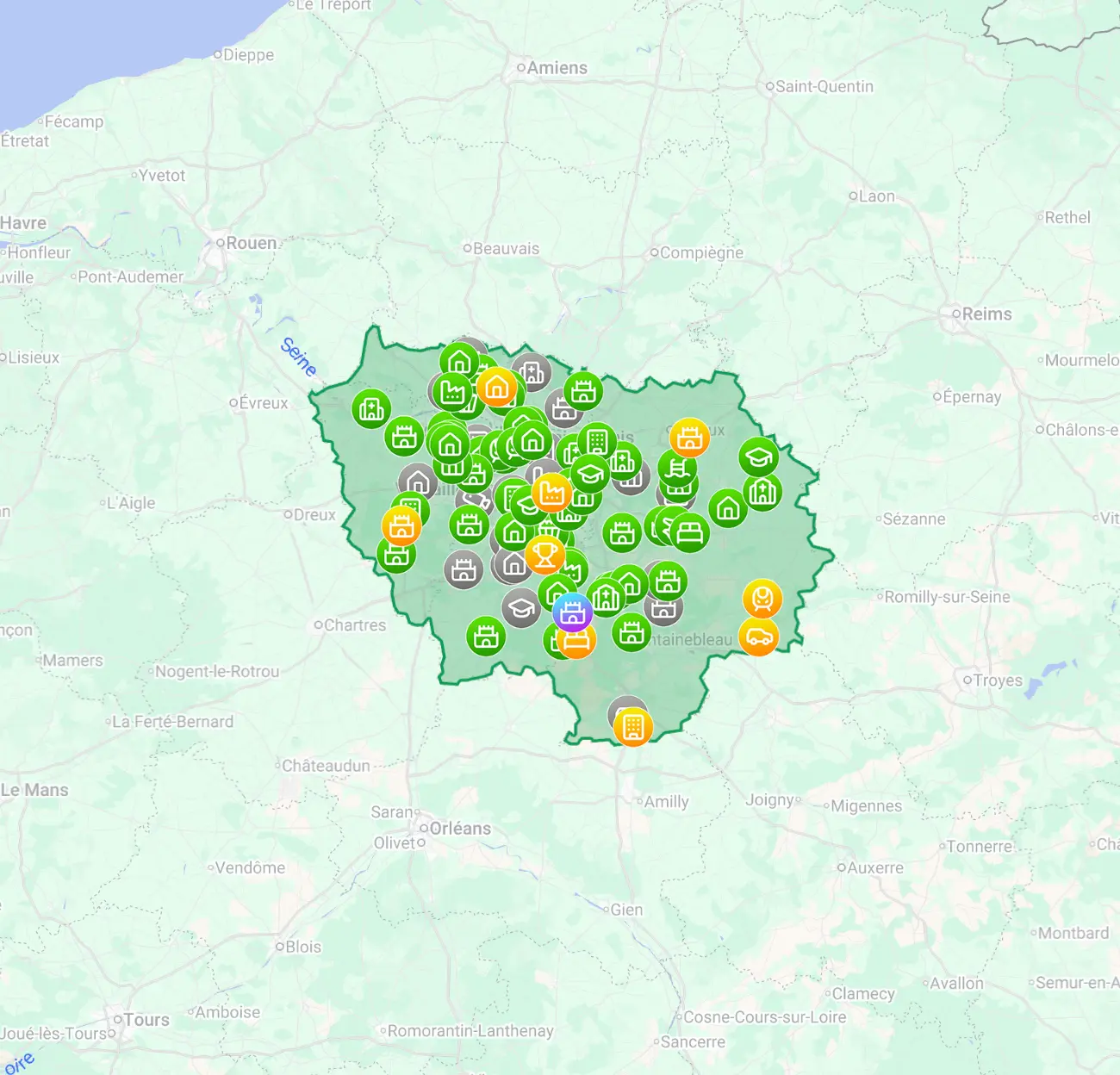
Where can you find an Île-de-France urbex map?
The best way to find an Île-de-France urbex map is to use a curated regional map that organizes abandoned places near Paris by area, type, and research value. In a dense region such as Île-de-France, a verified map saves time, reduces false leads, and helps you check context, risk, and legal status before any visit.
Quick summary
- Île-de-France offers one of the widest ranges of abandoned places near Paris.
- A curated map is more useful than scattered social posts because it groups sites by region and context.
- The most researched areas usually include outer suburban industrial belts, forest-edge estates, and old medical or military zones.
- Good urbex research starts with map review, archive checks, recent activity signals, and access-status verification.
- Responsible exploration never means forced entry, trespassing, or damage.
- MapUrbex focuses on verified locations, preservation-first guidance, and curated regional maps.
Quick facts
- Region: Île-de-France
- Main city anchor: Paris
- Search intent: informational, research-focused
- Common site types: factories, hospitals, sanatoriums, châteaux, schools, military remnants, rail and utility infrastructure
- Best use of a map: narrowing down real research leads and comparing sectors
- Important reminder: a map is not permission to enter a property
Why is a curated urbex map useful in Île-de-France?
A curated urbex map is useful in Île-de-France because the region has a high volume of outdated, duplicated, or unreliable leads. Old forum posts, recycled coordinates, and social media clips often point to places that are demolished, secured, converted, or overexposed.
A structured map helps you compare sectors instead of chasing isolated rumors. That matters near Paris, where one department can contain urban industrial ruins while another is better known for abandoned estates, hospital complexes, or military remnants.
It also improves responsible decision-making. Map-based research makes it easier to exclude sensitive places, identify obvious risks, and focus on documentation rather than impulse visits. If you want a broader overview beyond this region, you can also Browse all urbex maps.
Which areas of Île-de-France are most interesting for abandoned places near Paris?
The most interesting areas for abandoned places near Paris are usually the outer departments, where former industry, old institutions, estates, and infrastructure overlap. The exact value of each area depends on what you want to research: architecture, scale, history, or photo potential.
Below is a practical regional breakdown.
1. Seine-et-Marne for large estates and former rural institutions
Seine-et-Marne is often the first department people associate with large abandoned properties in Île-de-France. It is known for isolated estates, former manor houses, disused institutional buildings, and sites at the edge of towns or forests.
This department is useful when you want scale and atmosphere rather than dense urban proximity. Research can take longer because places are more spread out, but the variety is high. For many explorers, it is one of the strongest zones for abandoned places near Paris that still feel physically separated from the capital.
2. Yvelines for sanatorium history, estates, and suburban decay
Yvelines is often researched for former medical sites, old residences, and suburban properties with layered histories. In urbex terms, it offers a mix of architectural interest and proximity to western Paris.
The department can attract attention because many places have changed status over time. A location that was abandoned a few years ago may now be monitored, repurposed, or partially demolished. That makes a current map and recent verification especially important.
3. Essonne for military traces, technical sites, and forgotten infrastructure
Essonne is relevant when your focus is not only on classic ruins but also on technical or strategic remnants. Former military zones, research facilities, utility sites, and scattered industrial spaces make the department appealing for methodical explorers.
This is also where careful safety filtering matters most. Infrastructure and ex-military environments can involve unstable floors, open shafts, sharp debris, or contamination. A preservation-first approach means treating these sites as documentation subjects, not playgrounds.
4. Seine-Saint-Denis and Val-de-Marne for industrial and urban-edge sites
Seine-Saint-Denis and parts of Val-de-Marne are often linked to industrial abandonment and urban transition. Warehouses, workshops, logistics spaces, and former public-service buildings are the kinds of places researchers look for here.
These departments illustrate why an Île-de-France urbex map needs constant updating. Redevelopment moves quickly around Paris. A site can disappear behind fencing, renovation, or demolition with little warning, so research value changes faster than in more rural zones.
5. Val-d'Oise for mixed terrain and lesser-known leads
Val-d'Oise is useful for explorers who want a mix of suburban, semi-rural, and infrastructural environments. Depending on the sector, you may find remnants of transport, institutional buildings, neglected villas, or old industrial compounds.
Its strength is variation. It may not have the same reputation as the most famous urbex departments, but that is precisely why it can produce better research results. Lower visibility often means less recycled information and fewer dead-end leads.
What types of urbex spots can you expect on an Île-de-France urbex map?
An Île-de-France urbex map usually includes several categories rather than one dominant type of ruin. The region is historically diverse, so the map reflects administrative, industrial, medical, transport, and residential abandonment.
Here is a useful overview:
| Category | Typical examples in Île-de-France | Research note |
|---|---|---|
| Industrial sites | factories, depots, workshops, warehouses | Often change quickly because of redevelopment |
| Medical and care sites | clinics, sanatoriums, retirement facilities | Frequently sensitive and sometimes secured |
| Residential heritage | villas, mansions, small châteaux | Access status varies widely |
| Public institutions | schools, offices, administrative buildings | Many are repurposed rather than truly abandoned |
| Military and technical sites | bunkers, bases, utility structures | Higher safety risk and more legal sensitivity |
| Transport infrastructure | rail buildings, stations, service tunnels | Often active or monitored nearby |
This diversity is one reason the region remains so popular. Someone interested in architecture can focus on estates and hospitals, while someone interested in urban history may prefer industrial belts or service infrastructure.
How should you use a map of abandoned places in Île-de-France responsibly?
You should use a map of abandoned places in Île-de-France as a research tool, not as an invitation to enter everywhere. Responsible urbex starts with legal awareness, safety screening, and respect for the condition of the place.
First, separate research from access. A listed place may be demolished, privately owned, under surveillance, or unsafe. A location on a map does not create any right to enter. Never force entry, bypass security, or trespass.
Second, prioritize preservation. Do not remove objects, reveal fragile details irresponsibly, or treat abandoned buildings as disposable content. The goal is documentation and understanding, not exploitation.
Third, cross-check information before acting. Useful research methods include recent satellite review, historical records, planning documents, and local news. If you want a step-by-step method, read How to Find Real Abandoned Places Near You in 2026 (Without Wasting Time) and Tools to Find Abandoned Places: Best Urbex Research Tools and Maps.
Access the free urbex map
How does Paris urbex differ from the rest of Île-de-France?
Paris urbex is different from the rest of Île-de-France because the capital itself offers fewer stable abandoned sites than the outer region. Inside Paris, redevelopment pressure, security, and constant reuse make long-term abandonment less common.
In practice, many searches for "Paris urbex" are really searches for abandoned places near Paris. Explorers often end up targeting the wider region because it provides more variety, more surviving structures, and better research depth.
That distinction matters for search intent. If you want immediate city-center ruins, expectations should be modest. If you want broader urbex potential, the surrounding departments are where the regional map becomes most valuable.
How can you find better Île-de-France urbex spots without wasting time?
The fastest way to find better Île-de-France urbex spots is to combine a curated map with layered verification. A strong lead is not just a pin on a map; it is a place supported by recent signs, historical context, and realistic risk assessment.
A practical workflow looks like this:
- Start with a curated regional map to identify clusters.
- Check whether the place still appears abandoned in current imagery.
- Look for redevelopment or demolition signals in local planning documents.
- Compare older references with recent reports or visible changes.
- Drop any lead that looks active, residential, secured, or dangerous.
This method avoids the biggest waste of time: chasing famous locations that no longer exist in usable form. For deeper research strategies, see How to Find Secret Urbex Places: Real Methods Explained.
FAQ
Is an Île-de-France urbex map enough to plan a visit?
No. A map is only the starting point for research. You still need to verify whether the site exists, whether conditions have changed, and whether access would be legal and safe.
Are there really many abandoned places near Paris?
Yes, but they are unevenly distributed and constantly changing. The wider Île-de-France region has many former industrial, institutional, and residential sites, while central Paris has fewer stable abandoned places.
Which department is best for urbex in Île-de-France?
There is no single best department for every explorer. Seine-et-Marne is often strong for estates and isolated sites, while outer suburban departments can be better for industrial and infrastructural research.
Is Paris urbex the same thing as an Île-de-France urbex map?
Not exactly. "Paris urbex" is often used as a broad search term, but most real research extends into the surrounding departments. The regional map gives a more accurate picture than a city-only search.
How does MapUrbex approach abandoned locations?
MapUrbex focuses on verified locations, curated maps, and responsible research. The goal is to help users document places more efficiently while keeping legality, safety, and preservation at the center.
Conclusion
An Île-de-France urbex map is most useful when it is treated as a research framework for abandoned places near Paris, not as a shortcut to reckless exploration. The region is rich, but it changes fast. Good results come from verification, selective filtering, and respect for each location.
If you want to research smarter, start with curated mapping, compare departments, and keep preservation first. That approach saves time and produces better documentation.
Browse all urbex maps
