 MapUrbex
A practical guide to Cold War urbex bunkers in France: key regions, site types, research methods, and legal checks for responsible exploration.
Cold War Urbex Bunkers in France: Where to Find Them
France has a large and varied Cold War military landscape. For urbex researchers, that means former command posts, radar sites, ammunition areas, hardened shelters, and bunker complexes spread across several regions.
The challenge is not only finding these places. It is also separating Cold War sites from older wartime fortifications, checking legal access, and avoiding unsafe or sensitive locations.
MapUrbex approaches this topic with a preservation-first method: verified locations, curated maps, and responsible research rather than vague coordinates shared without context.
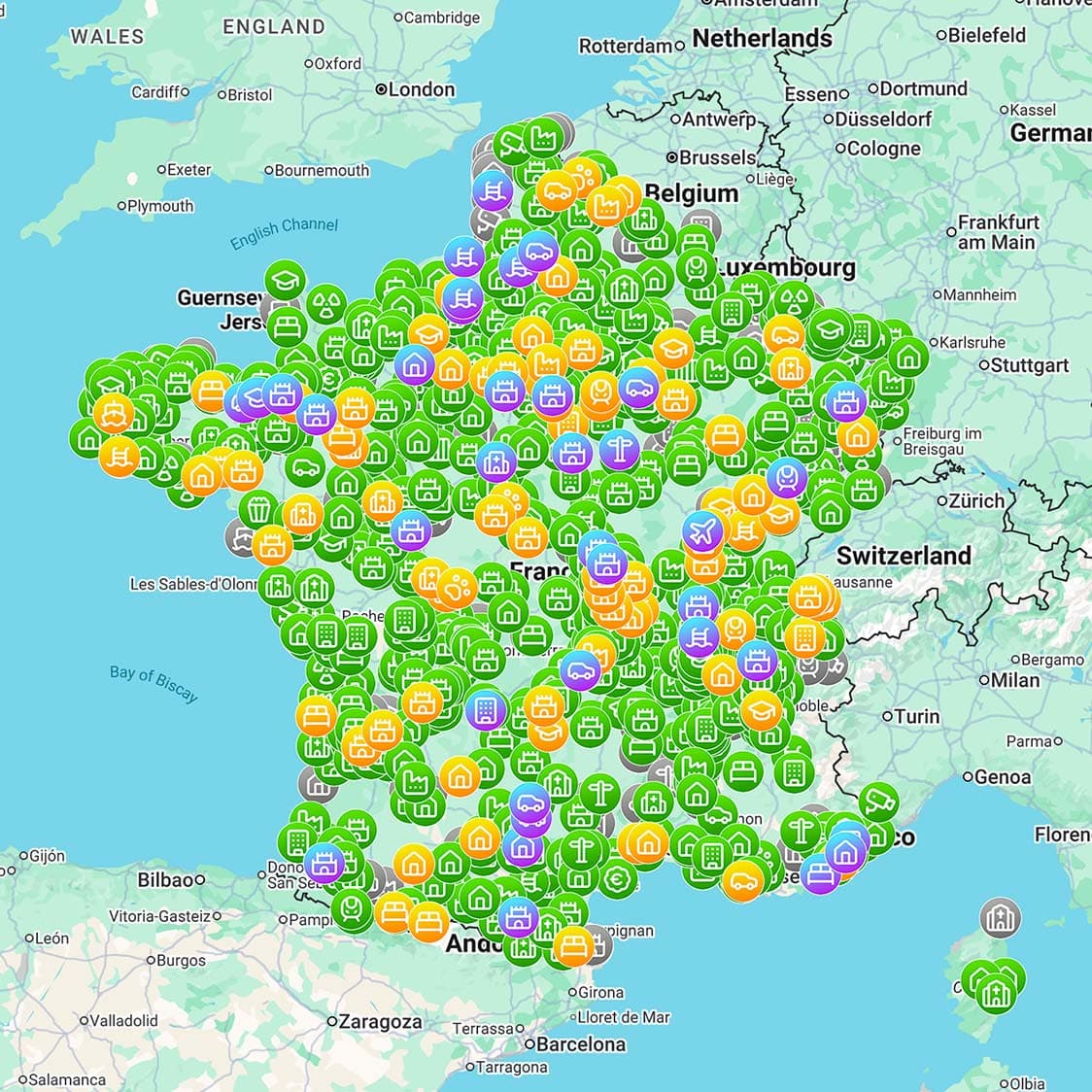
Where can you find Cold War urbex bunkers in France?
Cold War urbex bunkers in France are most often found in former air-defense sectors, military logistics areas, decommissioned command sites, border zones, and coastal defense landscapes that remained in use or were adapted after 1945. The most reliable way to identify them is through verified maps, regional research, and legal checks, not through random coordinates posted online.
Quick summary
- Cold War bunkers in France are concentrated in former military corridors, coastal zones, air-defense networks, and border regions.
- Many sites labeled as bunkers are not the same type: some are command posts, some are radar facilities, and others are storage or communications structures.
- The best search method combines historical context, regional filtering, and verified mapping.
- WWII fortifications and Cold War military sites often overlap geographically, but they are not historically identical.
- Access conditions vary widely, and many former military sites remain private, restricted, or unsafe.
- Responsible urbex means no forced entry, no removal of objects, and no publication of reckless directions.
Quick facts
- Country scope: France
- Main period: late 1940s to the 1980s
- Typical site types: command bunkers, radar installations, communications bunkers, ammunition depots, hardened support structures
- Best research approach: verified maps plus regional historical cross-checking
- Common confusion: WWII coastal bunkers versus true Cold War infrastructure
- Legal reminder: abandoned does not mean accessible or legal to enter
Why does France have so many Cold War bunkers?
France has many Cold War bunkers because it played a major strategic role in Western European defense during the second half of the 20th century. Its territory included coastlines, border corridors, air bases, communications routes, and command infrastructure that all required protected military construction.
In practice, that produced a wide range of hardened sites. Some were built specifically for Cold War use. Others were older military positions that were modernized, reused, or integrated into later defense systems.
This is why the phrase "Cold War bunkers in France" covers more than one category. It can include air-defense facilities, civil protection structures, logistics complexes, and fortified technical sites tied to surveillance or command functions.
Which regions in France have the highest concentration of Cold War military sites?
The highest concentrations are usually found in regions with historic military value: the northeast, parts of the Atlantic and Channel coast, sectors around former air bases, and some mountain border areas. These zones offered strategic depth, surveillance value, or transport links.
The table below gives a practical overview.
| Area in France | Typical Cold War site pattern | Why it matters for research | Access note |
|---|---|---|---|
| Grand Est and northeastern corridors | Command, logistics, fortified support sites | Close to major continental defense lines | Many sites are private or repurposed |
| Normandy, Brittany, and Channel sectors | Reused military zones, coastal systems, radar or support sites | Strong overlap between older fortifications and Cold War adaptation | Historical confusion is common |
| Atlantic coastal belts | Surveillance and defense-related infrastructure | Long coastline with strategic observation value | Coastal erosion and instability can be serious |
| Areas near former air bases | Hardened support buildings, technical bunkers, storage | Air-defense and aviation infrastructure were central during the Cold War | Many areas are fenced or redeveloped |
| Alpine or southeastern border sectors | Mountain defense and communications positions | Terrain created strategic observation points | Remote access increases risk |
For broader regional research, Browse all urbex maps and compare them with the regional logic explained in Map of Abandoned Places in France by Region: A Practical Urbex Guide.
What types of abandoned Cold War bunkers can urbex researchers expect in France?
The main types are command bunkers, communications structures, radar-related buildings, ammunition storage sites, and hardened facilities attached to air bases or logistics zones. Not every bunker was built for combat use.
Here are the most common categories:
- Command and control bunkers: protected spaces designed to maintain operations during crisis or attack.
- Radar and surveillance sites: technical locations connected to detection, monitoring, or air-defense systems.
- Communications bunkers: shielded infrastructure intended to preserve signal continuity and coordination.
- Ammunition or storage bunkers: semi-buried or reinforced structures built for protection and containment.
- Support bunkers near bases: technical, maintenance, or emergency-use structures around larger military compounds.
This distinction matters for both history and identification. A heavily reinforced structure in a forest is not automatically a Cold War bunker. Its shape, surroundings, road access, ventilation design, and relationship to nearby military land all help with classification.
How can you find Cold War urbex bunkers in France without relying on risky coordinates?
The safest method is to start with verified mapping, then narrow the search by region, site type, and historical function. This reduces mistakes and helps avoid dangerous or restricted places.
A practical workflow looks like this:
- Start with a curated source such as Browse all urbex maps.
- Use Access the free urbex map to understand the regional spread of abandoned sites.
- Compare bunker candidates with the larger national inventory in 100 Abandoned Places in France by Region: Complete Urbex Guide.
- Use regional logic rather than exact coordinates first.
- Check current ownership, closures, fencing, and reuse before any visit.
This approach is better than chasing social media posts. Viral coordinates are often outdated, inaccurate, or shared without legal context.
How do you tell a Cold War bunker from an older wartime fortification?
The simplest answer is historical layering. In France, many military landscapes were used across multiple eras, so a bunker may be older than its last known function.
Cold War sites often show technical adaptations linked to post-1945 defense needs. These can include updated communications spaces, later ventilation systems, links to air-defense infrastructure, or integration into larger base networks. By contrast, many WWII coastal bunkers follow earlier defensive logic and construction patterns.
The best practice is to avoid quick assumptions. Look at the wider site, not only the concrete shell. Nearby roads, antenna remains, utility corridors, and the presence of base-related infrastructure often tell more than the facade.
What legal and safety checks matter before visiting a military urbex site in France?
The essential checks are ownership, access status, structural safety, and the possibility of remaining military sensitivity. Former military sites can be unstable, contaminated, flooded, sealed, or still monitored.
Before any visit, verify:
- whether the site is on private land
- whether entry is explicitly prohibited
- whether the structure shows collapse, water, or fire damage
- whether the site may contain hazardous materials or deep shafts
- whether the area has an active military, industrial, or civil protection function nearby
Responsible urbex in France never means trespassing, forced entry, or bypassing barriers. Preservation comes first, and in many cases the correct decision is not to enter.
How does MapUrbex help you research bunkers in France more responsibly?
MapUrbex helps by organizing verified locations, map-based filtering, and practical research paths instead of rumor-driven exploration. That makes it easier to study France's Cold War and military urbex landscape without relying on unreliable posts.
If you are planning a wider trip, Urbex Road Trip in France: 7-Day Itinerary and 50 Best Abandoned Place Ideas gives national context, while Map of Abandoned Places in France by Region: A Practical Urbex Guide helps narrow the search region by region.
FAQ
Are Cold War bunkers in France always military sites?
No. Many were military, but some protected structures were linked to civil defense, communications, logistics, or mixed-use infrastructure. The label "bunker" is broad and should be checked case by case.
Are abandoned bunkers legal to explore in France?
Not automatically. A site can be abandoned and still be private, restricted, unsafe, or closed by law. Legal access must always be checked before a visit.
What is the difference between a WWII bunker and a Cold War bunker in France?
The main difference is historical function. WWII bunkers were built for wartime defense in the 1930s and 1940s, while Cold War bunkers were linked to post-1945 military strategy, command, surveillance, or continuity planning. Some sites were reused across both periods.
Which French regions are best for military urbex research?
For research, the most promising areas are usually the northeast, coastal military belts, former air-base sectors, and some border or mountain zones. Exact site quality varies widely.
Is it safe to enter old military bunkers?
Often, no. Risks include collapse, lack of oxygen, flooding, exposed metal, hidden shafts, and contamination. If legality or safety is unclear, do not enter.
Conclusion
Cold War urbex bunkers in France are best understood as a network of former military and strategic sites, not as a single bunker type. The most productive way to find them is to combine regional history, site classification, and verified mapping.
That method is also the most responsible one. It protects heritage, reduces risk, and avoids the careless sharing habits that damage sensitive places.
If you want a better starting point, use a curated map first and treat access as a legal and safety question, not just a navigation problem.
Access the free urbex map
