 MapUrbex
Discover the best urbex areas in Germany, from Berlin and Hamburg to Munich, with a responsible top 25, legal guidance and verified map planning.
Urbex Germany: Top 25 Abandoned and Restricted Places Around Berlin, Hamburg and Munich
Germany is one of the richest countries in Europe for industrial ruins, military leftovers, disused public buildings and abandoned hospitality sites. For many explorers, urbex Germany means variety: Berlin gives you hospitals and rail infrastructure, Hamburg adds port heritage, and the wider Munich region offers barracks, breweries and alpine decay.
But many abandoned places in Germany are not open sites. They are often private property, fenced spaces, active redevelopment zones or unstable structures. That is why responsible planning matters more than spontaneity.
MapUrbex focuses on verified locations, curated maps and preservation-first research. This guide gives you a practical top 25 overview without publishing sensitive coordinates or encouraging trespass.
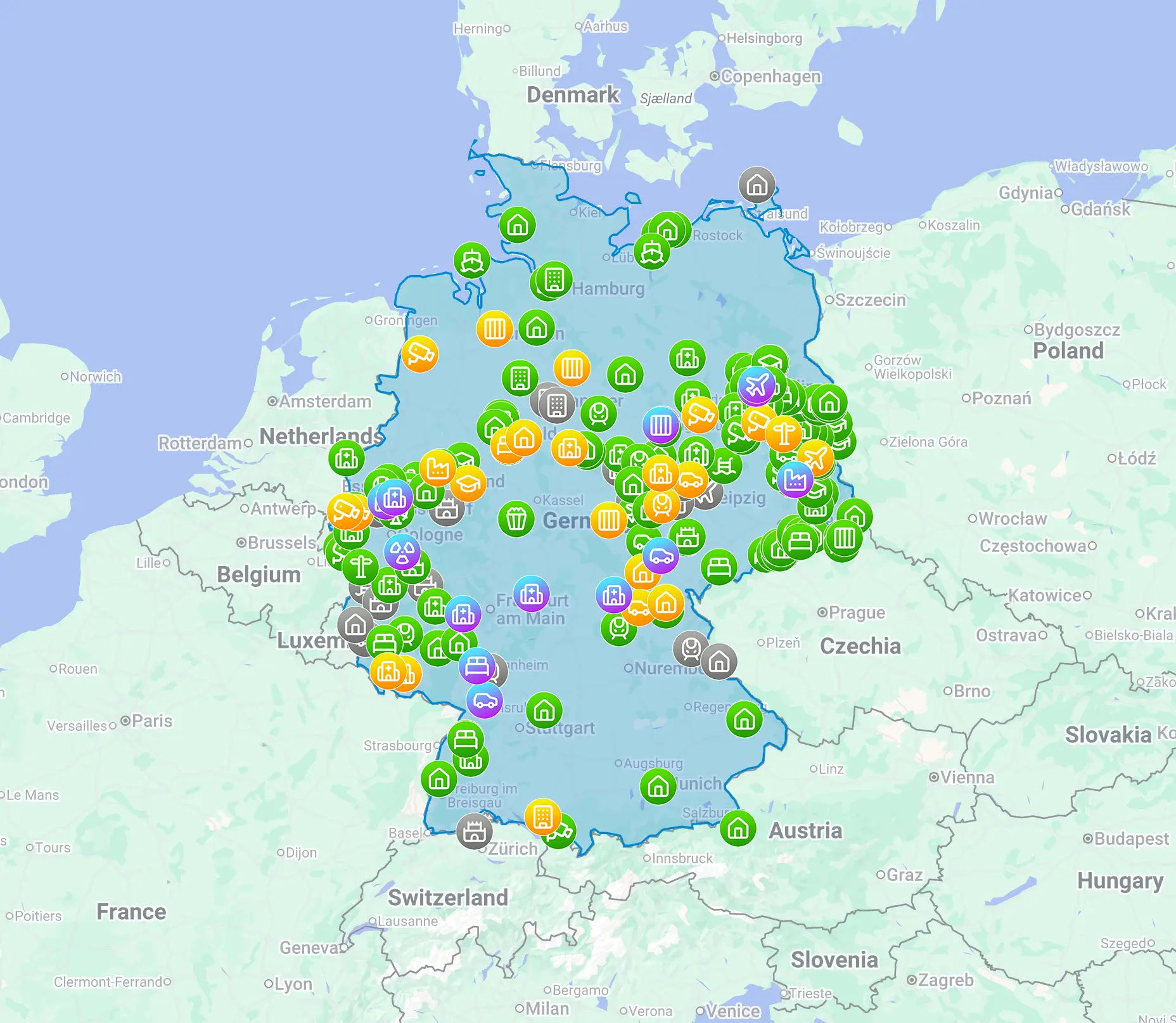
What are the best urbex places in Germany?
The best urbex places in Germany are usually former factories, hospitals, barracks, hotels, rail depots and civic buildings concentrated around Berlin, Brandenburg, Hamburg, the Ruhr, Saxony and the wider Munich region. Many restricted places in Germany still require permission or are fully sealed, so the best approach is to use verified maps, confirm status and avoid forced entry.
Quick summary
- Germany is strongest for industrial, military, medical, transport and hospitality urbex.
- Urbex Berlin is best known for hospitals, barracks, DDR-era public buildings and rail infrastructure.
- Urbex Hamburg stands out for warehouses, shipyard zones, bunkers and maritime logistics sites.
- Urbex Munich usually means wider Bavaria: barracks, breweries, clinics, hotels and airfield-related structures.
- Most restricted places in Germany are legally off-limits without permission and may be dangerous even from the outside.
- MapUrbex is most useful when you want verified locations and a preservation-first planning workflow.
Quick facts
- Country focus: Germany
- Main hubs: Berlin, Hamburg, Munich, Brandenburg, Ruhr, Saxony
- Best site families: factories, hospitals, barracks, hotels, rail sites, warehouses
- Legal reality: many sites are private, restricted or under surveillance
- Best seasons: late autumn to early spring for visibility and lighter vegetation
- Best planning method: verified maps, ownership checks and local status verification
Why is Germany one of Europe's richest urbex destinations?
Germany is a major urbex destination because it combines heavy industry, Cold War history, divided-city infrastructure, rural depopulation and large redevelopment cycles. Few countries offer this many different site types within one rail-accessible territory.
The east-west split left behind barracks, factories, border infrastructure and public buildings with distinct historical layers. The Ruhr contributes large-scale industrial heritage. Port cities add maritime decay. Spa towns and rural regions add hotels, clinics and manor houses.
This variety also explains why urbex Germany attracts photographers, historians and map-based travelers rather than only thrill seekers. The strongest trips are usually planned by region and site family, not by random viral coordinates.
Which 25 abandoned places and restricted site types stand out in Germany?
The strongest top 25 for Germany is not a public coordinate dump. It is a planning list of the site types and regional clusters that consistently matter most for responsible urbex research.
| # | Area | Site type | Why it stands out |
|---|---|---|---|
| 1 | Berlin outskirts | Former hospitals | Large campuses, long corridors, strong photo potential |
| 2 | Berlin and Brandenburg | Barracks and training grounds | Cold War layers and broad building footprints |
| 3 | Berlin region | Rail depots and workshops | Mechanical detail, platforms and industrial scale |
| 4 | Berlin | Public baths and sports halls | Distinct interiors and civic architecture |
| 5 | Brandenburg | Sanatoriums and clinics | Forest settings and medical history |
| 6 | Hamburg port belt | Warehouses and cold stores | Maritime texture and logistics heritage |
| 7 | Hamburg metro area | Shipyard infrastructure | Cranes, workshops and heavy industrial atmosphere |
| 8 | Hamburg region | Bunkers and wartime shelters | Dense history and unusual concrete forms |
| 9 | Munich wider region | Breweries and food factories | Strong Bavaria identity and processing machinery |
| 10 | Bavaria outskirts | Barracks and depots | Military footprints with large compounds |
| 11 | Bavaria | Alpine hotels and guesthouses | Luxury decay, wood interiors and resort history |
| 12 | Bavaria | Airfields and hangars | Open layouts, aviation traces and technical scale |
| 13 | Ruhr area | Steelworks and coking plants | Germany's most iconic industrial urbex landscape |
| 14 | Ruhr area | Mines and shaft buildings | Deep industrial heritage and landmark silhouettes |
| 15 | Saxony | Textile mills | Brick architecture and long production floors |
| 16 | Saxony-Anhalt | Chemical plants and power units | Massive infrastructure and strong caution value |
| 17 | Thuringia | Schools and training centers | Time-capsule classrooms and civic layouts |
| 18 | Mecklenburg-Vorpommern | Farm estates and manor houses | Rural abandonment and heritage atmosphere |
| 19 | Brandenburg and Mecklenburg | Soviet military sites | Historic overlays and large abandoned compounds |
| 20 | Harz and spa towns | Hotels and sanatoriums | Leisure architecture with medical or resort history |
| 21 | Rural Germany | Water towers and pumping stations | Compact landmarks and technical interiors |
| 22 | Former East German town centers | Department stores and cinemas | Urban memory and changing commercial history |
| 23 | Nationwide | Villas and guesthouses | Smaller-scale exploration with architectural detail |
| 24 | Former inner-German border zones | Border installations | Political history and rare surviving structures |
| 25 | Industrial suburbs nationwide | Warehouses and distribution centers | Flexible, common and often redeveloped quickly |
Where should you start with urbex Berlin?
Urbex Berlin is strongest when you think beyond the city center. The most interesting material is usually in the outer districts, satellite towns and the wider Brandenburg belt, where larger compounds survived demolition longer.
The Berlin area is especially relevant for:
- former hospitals and clinics
- barracks and training areas
- transport infrastructure and rail workshops
- swimming pools, sports halls and civic buildings
- villas, schools and former administrative sites
In practice, Berlin rewards patient filtering. Many famous sites are sealed, watched or already converted. A curated approach is more efficient than copying old forum posts. For country-wide route planning, Browse all urbex maps gives a better overview than random social media lists.
What makes urbex Hamburg different?
Urbex Hamburg is defined by maritime and logistics heritage. Compared with Berlin, the visual language is more industrial-port, more storage-oriented and often more exposed to redevelopment pressure.
The best Hamburg-area searches usually focus on warehouse belts, harbor-edge infrastructure, cold storage buildings, bunkers and former shipyard environments. Even when a site looks abandoned, ownership is often clear and security can be active.
That makes Hamburg a good city for exterior scouting, historical research and selective, status-checked visits rather than improvised entry. The urban fabric changes quickly, so verified updates matter.
Which urbex areas are worth watching around Munich?
Urbex Munich usually means the wider Bavarian region rather than the dense city core. The strongest material is often found in peripheral industrial zones, former military land, regional clinics, breweries and disused hospitality sites toward the Alps.
Around Munich, explorers often look for:
- former barracks and depots
- breweries and food production sites
- clinics and sanatoriums
- guesthouses, alpine hotels and leisure buildings
- small airfields, hangars and technical compounds
Munich is less famous internationally than Berlin for classic ruins, but Bavaria compensates with mood, architecture and landscape. If you like hospitality decay, Abandoned Hotels and Casinos: The Most Beautiful Luxury Urbex Spots adds useful context.
How can you find abandoned places in Germany legally and safely?
The safest way to find abandoned places in Germany is to start with verified mapping, then confirm legal status, current activity and physical risk before you travel. Good urbex planning is mostly research, not guessing.
A practical workflow looks like this:
- Start from a curated database instead of public coordinate dumps.
- Check whether the site is private, active, fenced or under redevelopment.
- Look for recent visual evidence, not old forum photos.
- Avoid forced entry, climbing and solo visits.
- Keep a backup plan in case the location is clearly off-limits.
For the legal framework and field method, read Urbex Germany: How to Find Abandoned Places Safely and Legally. It explains why many so-called forbidden places in Germany should be treated as no-go sites unless you have clear authorization.
Which rules matter most for responsible urbex in Germany?
The most important rule in Germany is simple: no access without permission when a site is private, restricted or clearly secured. Responsible urbex protects people, locations and future documentation.
Follow these basic standards:
- do not trespass or force entry
- do not break locks, fences, boards or windows
- do not remove objects or rearrange scenes
- do not publish sensitive coordinates publicly
- do not enter unstable roofs, shafts or flooded structures
- do not treat active infrastructure as urbex
Preservation-first urbex is more sustainable than viral exploration. If a place is fragile, secured or newly monitored, leave it undocumented rather than turn it into a damage cycle.
FAQ
Is urbex legal in Germany?
Urbex in Germany is only legal when you have lawful access. Many abandoned sites are still private property, restricted industrial land or hazardous buildings. If access is not clearly allowed, assume you should not enter.
Are abandoned places in Germany easy to access?
No. Many abandoned places in Germany look open online but are sealed, monitored, demolished or reused in reality. Old information becomes unreliable quickly, especially near major cities.
Is Berlin better than Hamburg for beginners?
Berlin is usually better for range and research depth, while Hamburg is more specialized and redevelopment-heavy. Beginners still need the same legal discipline in both cities.
What should you do when a site is marked as restricted?
Treat restricted status as a stop sign unless you have explicit permission. Do not test fences, doors or side entries. Move on to a lawful alternative.
Should you publish coordinates on social media?
Usually no. Public coordinates accelerate vandalism, theft and sealing. MapUrbex favors curated access and preservation-first sharing instead.
Conclusion
Urbex Germany is compelling because it combines scale, history and regional variety. Berlin, Hamburg and Munich each open a different part of the country: civic ruins, maritime infrastructure, military land, breweries, hotels and industrial complexes.
The best results come from verified planning, legal awareness and selective research. If a location is restricted, unstable or sensitive, document responsibly from the outside or skip it entirely.
Access the free urbex map
