 MapUrbex
Explore the Occitanie urbex map with key search areas, abandoned place types, legal reminders, and a practical method for responsible urban exploration.
Occitanie Urbex Map: Abandoned Places and Exploration Guide
Occitanie is one of the most varied regions in France for abandoned heritage. It combines large cities, former industrial corridors, mountain valleys, coastal infrastructure, and wide rural areas where disused buildings can remain visible for decades.
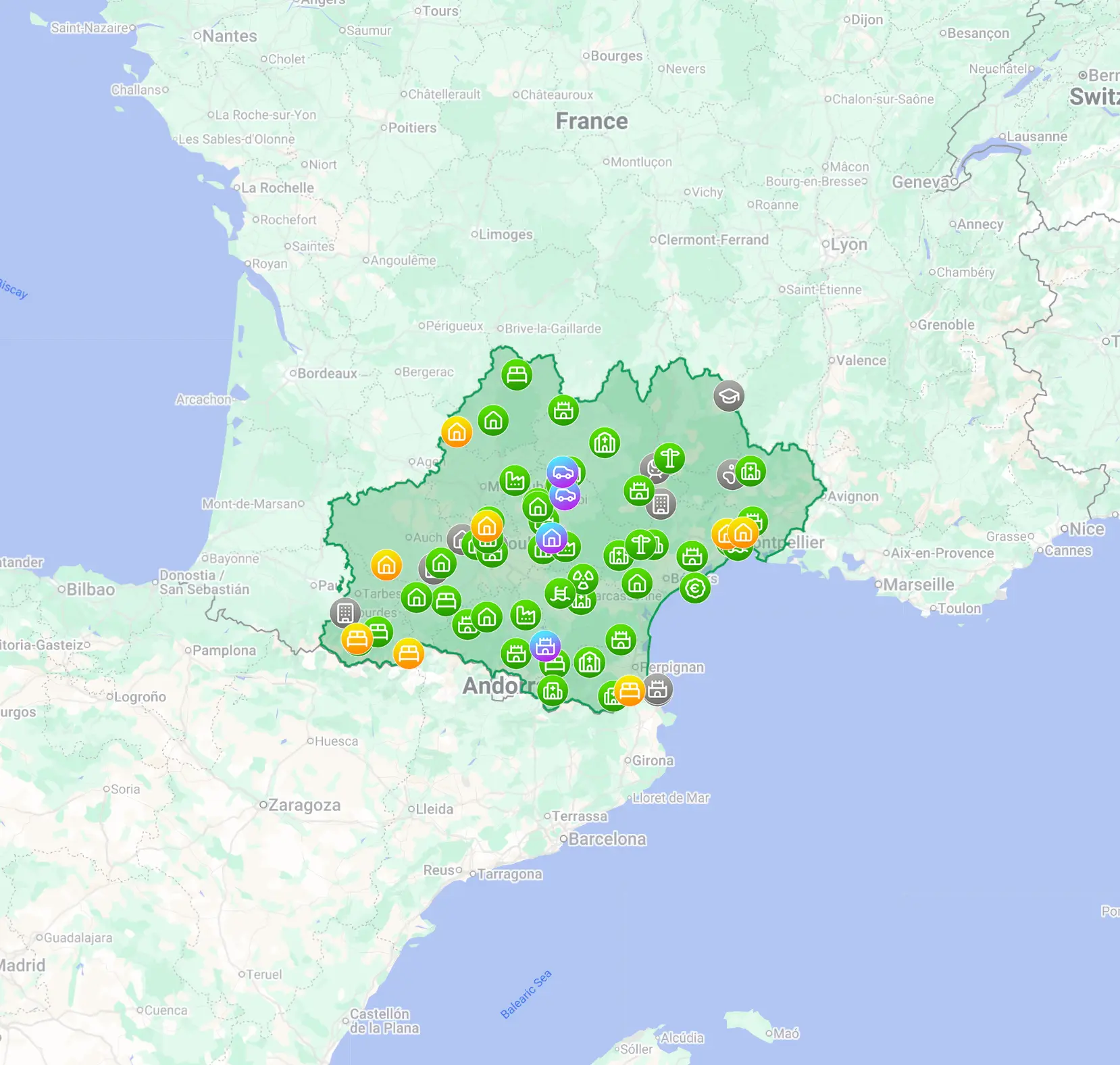
A reliable Occitanie urbex map helps separate useful leads from noise. In a region this large, responsible exploration depends on verified information, realistic driving times, and respect for property law.
What is an Occitanie urbex map?
An Occitanie urbex map is the most practical way to locate verified abandoned places in the region, sort them by department or site type, and plan a more responsible trip. Instead of relying on random coordinates, it lets you focus on documented leads, route logic, and basic legal context across Occitanie's 13 departments.
Quick summary
- Occitanie is one of the richest French regions for varied abandoned sites.
- The region mixes rural ruins, industrial remains, rail heritage, institutions, and coastal or mountain infrastructure.
- A curated map is more useful than scattered coordinates because distances are long and access conditions change.
- The most efficient research starts by department, then narrows by site type and travel time.
- Responsible urbex in Occitanie means no trespassing, no forced entry, and preservation of places.
- MapUrbex focuses on verified locations, curation, and preservation-first planning.
Quick facts about urbex in Occitanie
- Region: southern France
- Administrative scope: 13 departments
- Main urban hubs: Toulouse and Montpellier
- Typical abandoned site categories: farms, factories, rail structures, clinics, schools, hotels, military remnants
- Field reality: long driving distances are common outside major cities
- Weather factor: summer heat, storms, and mountain conditions can affect access and safety
- Legal reminder: a place can be abandoned in appearance and still be private property
Why use an Occitanie urbex map instead of random coordinates?
Using an Occitanie urbex map is better than using random coordinates because it gives structure, context, and a higher chance of starting from verified information. In a large region, that saves time and reduces the temptation to improvise around unsafe or clearly private sites.
A curated map also helps you compare departments, cluster nearby leads, and avoid building a trip around outdated rumors. If you are new to the subject, start with How to Start Urbex: A Beginner's Guide to Urban Exploration. If you want to understand digital scouting, read How to Find Abandoned Places with Google Maps.
Access the free urbex map
Which parts of Occitanie are usually the most productive to research first?
The most productive parts of Occitanie usually depend on what you want to find, but a department-based approach is the most efficient starting point. It helps you match site density, travel time, terrain, and likely building types before you commit to a route.
Occitanie is large enough that one day trip can change completely depending on whether you search around Toulouse, the Hérault plain, the old industrial valleys of the north, or the Pyrenean edges. The table below is not a list of guaranteed entries. It is a planning framework for responsible research.
| Department or area | Typical abandoned-site profile | Why it matters for planning |
|---|---|---|
| Haute-Garonne | suburban institutions, farm buildings, small industrial remnants | Easy day trips from Toulouse, but pressure on sites can be high |
| Hérault | wine-related structures, leisure buildings, institutional complexes | Dense road access and strong seasonal traffic near the coast |
| Gard | industrial remains, rail heritage, rural estates | Good variety, but conditions vary widely from town to countryside |
| Aveyron | mills, workshops, isolated hamlets, civic buildings | Longer drives and lower site density require better route planning |
| Pyrénées-Orientales | border infrastructure, hotels, agricultural ruins | Heat and wind can affect field conditions |
| Lozère and mountain sectors | remote farms, sanatorium-style buildings, minor public structures | Distances are long and mobile coverage may be weaker |
For many explorers, the best method is to begin with one department and build outward. That approach is more efficient than trying to cover the whole region at once. For a broader national view, Browse all urbex maps.
What types of abandoned places can you find in Occitanie?
Occitanie contains a broad range of abandoned places, with rural and small-town sites appearing especially often. The region is useful for explorers who want variety rather than one single site category.
1. Rural farmsteads and hamlets
Rural farmsteads are among the most common abandoned place types in Occitanie. Depopulation, changes in agriculture, and the age of village housing have left many isolated buildings, outbuildings, and partial hamlets scattered across the region.
These places are often visually striking because they preserve everyday architecture rather than monumental design. They also require care: many are unstable, exposed to weather damage, or still attached to active private land.
2. Former industrial and agricultural buildings
Former industrial and agricultural buildings are common in departments shaped by wine production, milling, workshops, extraction, or small manufacturing. In Occitanie, these sites often appear as warehouses, processing spaces, cooperatives, sheds, and utility buildings rather than giant factory complexes.
They are useful research targets because their footprints are easier to identify on aerial imagery. However, their condition varies sharply. Roof failure, broken floors, and contaminated materials are frequent issues in older industrial spaces.
3. Disused rail and transport heritage
Disused rail and transport heritage exists across several parts of Occitanie, especially where older lines, sidings, depots, or service buildings lost their original function. Even when tracks remain active nearby, supporting structures may be long abandoned.
These locations matter because they show how mobility shaped the region's economy. They also carry obvious safety limits. Active rail corridors, tunnels, and bridges can be extremely dangerous and should not be treated casually.
4. Institutional buildings such as schools, clinics, and holiday centres
Institutional buildings are some of the most memorable urbex sites in Occitanie because they often retain room layouts and traces of daily life. Former schools, clinics, convalescent facilities, and holiday centres appear in both urban edges and quieter landscapes.
From a documentation point of view, these sites offer context and history. From a safety point of view, they demand caution. Large stairwells, damaged ceilings, asbestos risk, and ownership ambiguity are common.
5. Military, border, and civil defense remnants
Military, border, and civil defense remnants appear more often in strategic or mountainous sectors of Occitanie. Depending on the area, that can include bunkers, observation positions, storage structures, or other defensive remains.
These places can be historically important, but they are not automatically safe or legal to access. Terrain exposure, hidden shafts, metal hazards, and protected status all matter. Preservation-first behavior is essential.
How should you plan a responsible urban exploration trip in Occitanie?
A responsible urban exploration trip in Occitanie should start with verification, route logic, and legal awareness. The goal is not to collect the most coordinates. The goal is to document places carefully without damaging them or putting yourself in avoidable danger.
A practical planning method looks like this:
- Choose one department or one travel corridor for the day.
- Check whether the site type matches your experience level.
- Use a curated source first, then compare with satellite imagery and recent context.
- Prepare for weather, distance, and weak network coverage in rural zones.
- Never assume that an abandoned appearance means legal access.
- Leave no trace and avoid publishing details that increase vandalism or theft risk.
If you want a repeatable research workflow, read How to Find Abandoned Places Near Me: A Step-by-Step Urbex Method. It is especially useful for turning a broad region like Occitanie into a manageable search area.
Is Google Maps enough to find abandoned places in Occitanie?
Google Maps is useful in Occitanie, but it is not enough on its own. It helps with terrain reading, route estimation, and spotting large visible structures, yet it does not verify current condition, access status, or whether a location is still standing.
That is why many explorers use Google Maps as a support tool rather than a final source. A curated regional reference reduces false leads and saves time. For a wider map directory, Browse all urbex maps. For method details, use How to Find Abandoned Places with Google Maps.
What legal and safety rules matter most in Occitanie?
The most important legal and safety rules in Occitanie are simple: do not trespass, do not force entry, and do not treat a ruin as risk-free. Responsible urbex always starts with the idea that preservation and personal safety matter more than access.
Keep these points in mind:
- Private property law still applies even when a building looks empty.
- Agricultural land, fenced grounds, and active utility sites require extra caution.
- Heat, storms, and mountain weather can change conditions quickly.
- Old industrial or institutional sites may contain asbestos, rotten floors, pits, or unstable roofs.
- Never enter mines, shafts, tunnels, or confined spaces without proper authorization and specialist competence.
- Do not remove objects, break barriers, or reveal sensitive details that increase site degradation.
MapUrbex is built around verified locations, responsible urbex, curated maps, and a preservation-first approach. That matters in a region where fragile heritage can disappear quickly once a place is overexposed.
FAQ
Is urbex legal in Occitanie?
Urbex is not a special legal exemption in Occitanie. The key issue is property access, not whether a building looks abandoned. If a site is private or restricted, entering without permission can still be illegal.
Which departments in Occitanie are easiest for beginners to research?
Beginners usually benefit from areas with simpler road access and shorter travel loops, such as parts of Haute-Garonne, Hérault, or Gard. That does not make any site automatically safe or legal. It only makes trip planning more manageable.
Are all locations on an urbex map still accessible?
No. Accessibility can change because of demolition, redevelopment, security, seasonal barriers, or ownership changes. A good map improves your starting information, but every location still needs current judgment.
What should I bring for an Occitanie exploration day?
Bring water, charged navigation tools, weather-appropriate clothing, and basic first-aid supplies. In rural or mountain sectors, fuel planning and offline maps also matter. Avoid carrying tools associated with forced entry.
How can I continue researching beyond Occitanie?
The easiest next step is to compare regions and search patterns across France. Use Browse all urbex maps to expand your research without relying on scattered forum posts or random pins.
Conclusion
The main value of an Occitanie urbex map is not just finding more places. It is finding better starting points, organizing a large region logically, and keeping exploration aligned with safety and preservation.
Occitanie rewards patient research. If you focus on verified information, department-based planning, and responsible behavior, the region offers one of the broadest abandoned-heritage profiles in southern France.
Browse all urbex maps
