 MapUrbex
Use the New Aquitaine urbex map to research abandoned places in southwest France with a curated, verification-first and responsible approach.
New Aquitaine Urbex Map: Find Abandoned Places in Southwest France
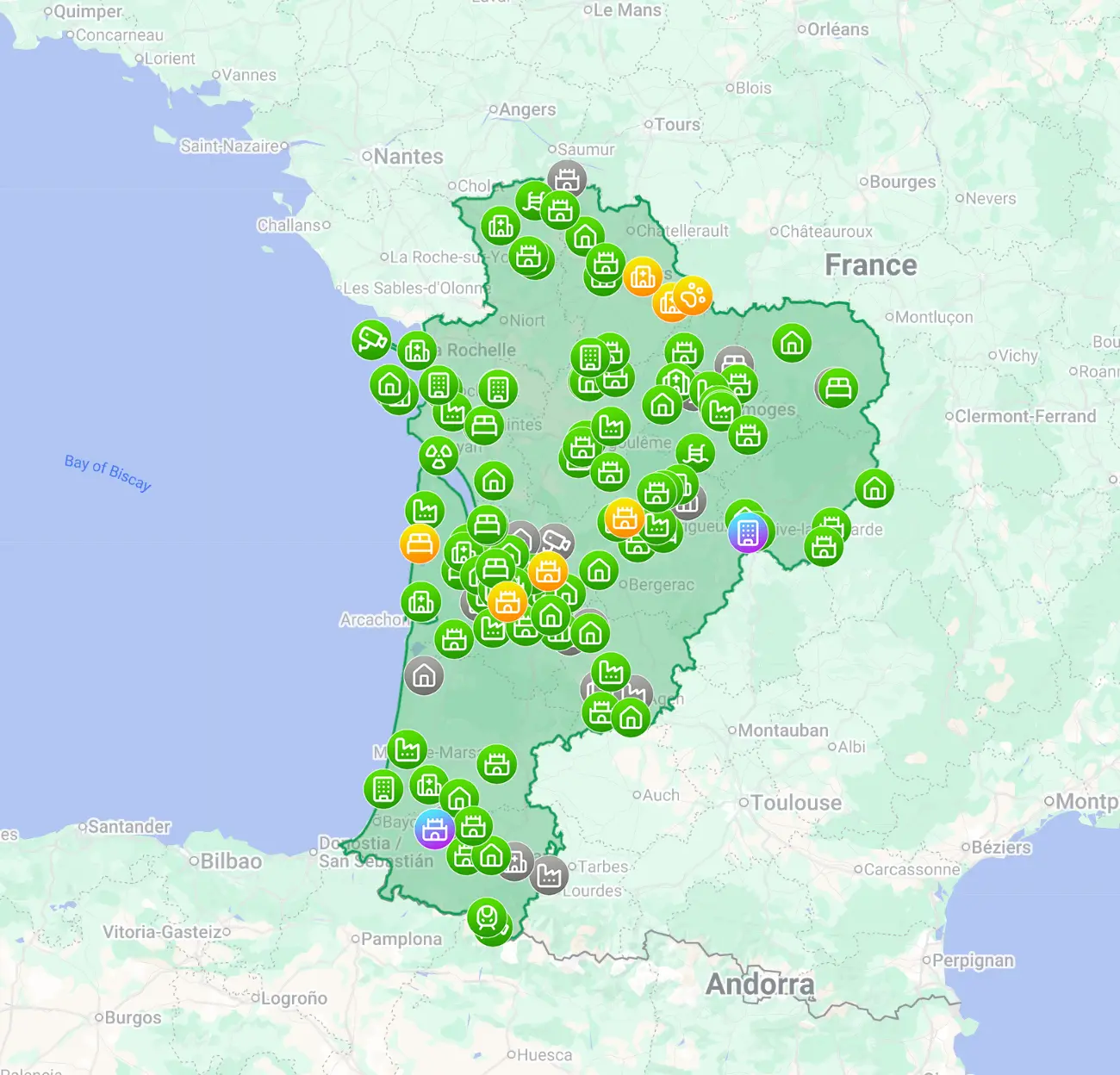
New Aquitaine is one of the broadest and most varied urbex regions in France. It combines Atlantic coastal zones, former industrial corridors, railway infrastructure, rural depopulation, and scattered institutional buildings.
A curated New Aquitaine urbex map makes that scale easier to manage. Instead of collecting random tips, you can sort abandoned places in New Aquitaine by area, context, and research value. MapUrbex follows a verification-first, preservation-first approach and does not encourage trespassing, forced access, or risky behavior.
Where can you find a New Aquitaine urbex map?
A New Aquitaine urbex map is the most practical way to find abandoned places in southwest France because it organizes research by region, building type, and reliability. Instead of relying on vague social posts, you can compare curated locations across departments such as Gironde, Dordogne, Charente-Maritime, or Haute-Vienne and plan a more responsible scouting route.
If your goal is to save time, reduce duplicate searching, and focus on higher-signal locations, a map-based workflow is usually better than scattered screenshots or unverified coordinates.
Quick summary
- New Aquitaine offers a wide mix of rural, coastal, industrial, rail, and institutional urbex environments.
- A curated map helps you sort abandoned places in New Aquitaine faster than social media or forum digging.
- The region is large, so planning by department and building type is more efficient than searching city by city.
- MapUrbex emphasizes verified locations, responsible exploration, and preservation-first research.
- Beginners should combine map research with legal checks, daylight scouting, and basic safety planning.
- You can start with the free map, then compare it with the wider regional collection.
Quick facts
- Region: New Aquitaine, southwest France
- Search intent: finding a practical urbex map for trip planning and research
- Common site families: farms, villas, factories, railway assets, institutions, leisure properties
- Best use case: organizing scouting routes across a very large region
- MapUrbex approach: curated entries, verification-first, responsible urbex
- Important reminder: always respect property law, local restrictions, and site safety conditions
Why use a curated map instead of random coordinates?
A curated map is useful because it reduces noise. In a region as large as New Aquitaine, random coordinates often lead to duplicates, demolished sites, inaccessible properties, or places with no real exploration value.
A structured database lets you compare patterns. You can see whether a department is stronger for rural abandonment, coastal remnants, or industrial heritage. That matters if you are planning a day trip, a weekend route, or a photography-focused outing.
It also improves safety and legality. Responsible urbex starts with research, not entry. If you are new to the process, read How to Start Urbex: A Beginner's Guide to Urban Exploration and How to Find Abandoned Places with Google Maps before building your route.
Browse all urbex maps
Which parts of New Aquitaine are usually the most useful for finding abandoned places?
The most useful parts of New Aquitaine depend on what you want to research. Urban belts tend to offer industrial and transport-related sites, while inland departments often produce more rural houses, farms, and small institutions.
The table below gives a practical overview for research planning.
| Area of New Aquitaine | Typical environments | What researchers often look for | Planning note |
|---|---|---|---|
| Gironde and the Bordeaux area | urban fringe, industrial land, transport corridors | warehouses, depots, workshops, former service buildings | High churn rate, so verification matters |
| Dordogne and Lot-et-Garonne | rural villages, agricultural land, isolated estates | farmsteads, manor houses, small schools, outbuildings | Distances are longer between sites |
| Charente, Charente-Maritime, Deux-Sèvres, Vienne | mixed towns and countryside | factories, rail remnants, homes, institutional buildings | Good for varied route planning |
| Haute-Vienne, Creuse, Corrèze | inland and lower-density sectors | rural abandonment, old civic buildings, industrial traces | Scouting time is often longer |
| Landes and Pyrénées-Atlantiques | coast, leisure zones, inland roads | hotels, holiday sites, villas, military remnants, utility buildings | Weather and access conditions change quickly |
This is why many people looking for New Aquitaine urbex spots start with a region-wide map first, then narrow down to a department.
What kinds of abandoned places are common in New Aquitaine?
The most common abandoned places in New Aquitaine are rural properties, small industrial sites, railway-related structures, institutional buildings, and leisure or coastal assets. The region is large enough that no single building type dominates everywhere.
1. Rural farms and agricultural outbuildings
Rural abandonment is one of the clearest patterns in southwest France. In inland departments, old farmhouses, barns, sheds, and storage buildings appear more often than large headline locations.
These sites can be visually strong because they preserve traces of local work, tools, and architecture. They also require caution. Many remain on private land, and an abandoned appearance does not mean access is lawful or safe.
2. Disused industrial and craft sites
Former workshops, depots, mills, warehouses, and small factories are common around older economic corridors. They usually attract researchers who want structure, machinery traces, or evidence of local industry rather than grand interiors.
Industrial sites also change fast. Demolition, redevelopment, fencing, and contamination risks are common. A verification-first map is useful here because old online tips can become inaccurate very quickly.
3. Railway assets and transport-related structures
New Aquitaine has a large territory and a long transport history, so rail-adjacent buildings are a recurring urbex category. Signal cabins, small station buildings, maintenance sheds, and utility spaces often appear in regional research.
Transport sites need extra caution. Active lines, monitored infrastructure, and unsafe surfaces create real risk. Responsible research means observing legal boundaries and never entering operational or restricted rail property.
4. Institutional buildings such as schools, clinics, or administrative sites
Some of the most researched abandoned places in New Aquitaine are former schools, care facilities, offices, and civic buildings. These sites are often valued for their layouts, signage, and time-capsule details.
They are also among the most sensitive. Records, hazardous materials, and unstable interiors are more likely in this category. Preservation-first exploration means leaving documents, fixtures, and rooms exactly as found.
5. Coastal and leisure properties
Along the Atlantic side of the region, researchers often track abandoned hotels, holiday camps, villas, restaurants, and coastal utility structures. These places draw interest because they combine architecture, tourism history, and rapid landscape change.
Coastal locations are heavily affected by weather, erosion, redevelopment, and seasonal visibility. A site that was visible one year may be sealed, removed, or fully repurposed the next.
How does MapUrbex help verify locations in southwest France?
MapUrbex helps by organizing locations into a curated research system rather than a rumor stream. That means the goal is not just to show pins on a map, but to support better decisions about relevance, condition, and responsible planning.
For a large region such as New Aquitaine, verification matters because information ages badly. Posts are deleted. Coordinates are copied without context. Demolitions happen. Site status changes. A curated map reduces that uncertainty by focusing on maintained entries and practical filtering.
If you want to compare national coverage, start with Browse all urbex maps. If you want a lighter starting point, use the free resource below.
Access the free urbex map
How can beginners prepare for urbex in New Aquitaine without taking unnecessary risks?
Beginners should prepare by treating the map as a research tool, not as an invitation to enter every site. The safest workflow is to study the area, verify legal context, scout in daylight, and skip any location that looks occupied, secured, unstable, or clearly restricted.
A simple preparation checklist works well:
- check road distance and parking options before leaving
- confirm whether the building appears private, active, or monitored
- avoid solo visits in isolated rural sectors
- wear basic protective clothing suitable for broken surfaces and weather
- never force entry, climb unstable floors, or tamper with barriers
- leave immediately if a site is occupied or access is clearly unlawful
For a broader method, read How to Find Abandoned Places Near Me: A Step-by-Step Urbex Method. New explorers should also review How to Start Urbex: A Beginner's Guide to Urban Exploration.
What is the best workflow for finding New Aquitaine urbex spots efficiently?
The best workflow is to start wide, filter by area and site type, then validate locally. This saves time because New Aquitaine is too large to search effectively with only random town names.
A practical sequence looks like this:
- Start with a region-level map to identify departments worth prioritizing.
- Filter by the kind of site you want to photograph or document.
- Cross-check the surrounding area using How to Find Abandoned Places with Google Maps.
- Build a route with backup options in case a site is gone, occupied, or inaccessible.
- Keep expectations realistic. In urbex southwest France research, the best day often comes from several average sites rather than one famous location.
This method is especially useful for long driving days. It helps you avoid overcommitting to one uncertain point and gives you a more consistent research yield.
FAQ
Is a New Aquitaine urbex map useful if I already use Google Maps?
Yes. Google Maps is useful for satellite review and route planning, but it does not organize abandoned places in New Aquitaine by exploration value or verification status. A curated map narrows the search first, then mapping tools help refine the details.
Does MapUrbex publish forced-entry methods or risky access tips?
No. MapUrbex is built around responsible urbex and preservation-first research. The platform does not encourage trespassing, breaking barriers, or sharing instructions that increase damage or legal risk.
Is New Aquitaine better for rural urbex or urban urbex?
It supports both, but rural research is especially strong because the region is large and geographically diverse. Urban and peri-urban sectors still matter, especially for industrial, transport, and service buildings around larger population centers.
Are New Aquitaine urbex spots suitable for beginners?
Some are, but beginners should stay selective. Large isolated properties, industrial ruins, rail infrastructure, and unstable interiors are not good entry-level choices. Start with research, legal awareness, and simple daylight scouting habits.
Can I start with the free map before choosing a larger collection?
Yes. The free map is a good way to understand how MapUrbex structures research. It is also useful if you want to test the workflow before exploring broader regional coverage.
Conclusion
A New Aquitaine urbex map is valuable because the region is too large and too varied for random searching to be efficient. A curated approach helps you identify better leads, compare departments, and focus on abandoned places in New Aquitaine with more context and less noise.
The strongest results usually come from a simple method: start wide, verify locally, respect the law, and prioritize preservation over access. That is the most reliable way to research urbex in southwest France over time.
Access the free urbex map
