 MapUrbex
A practical guide to finding abandoned places in France with safer methods, regional tips, and curated MapUrbex maps.
How to Find Abandoned Places in France
Finding abandoned places in France is easier when you use a structured method instead of random searches. The country has a wide range of disused factories, sanatoriums, military sites, villas, hotels, farms, and transport infrastructure, but most places are hard to identify reliably with a simple search engine query.
The real challenge is not spotting a ruin on a photo. It is confirming that the place still exists, that the information is current, and that your research does not push you toward trespassing or unsafe access. That is why curated urbex maps are useful for planning, comparison, and responsible exploration.
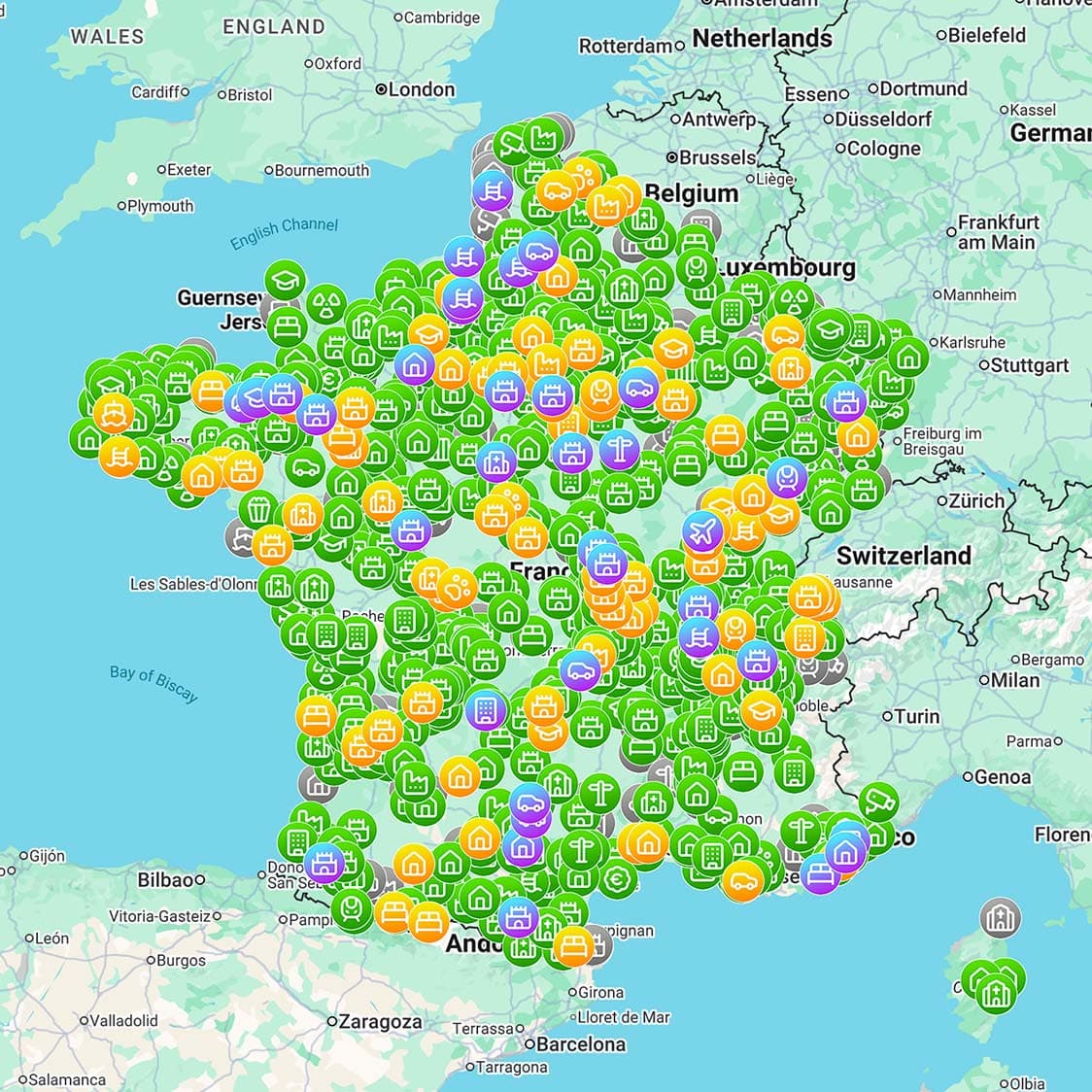
How can you find abandoned places in France?
The fastest way to find abandoned places in France is to combine a curated France urbex map with basic verification steps such as recent updates, map cross-checking, and legal access checks. This method is more reliable than random forum posts because it saves time, reduces outdated leads, and supports responsible urbex research focused on preservation rather than forced entry.
Quick summary
This guide explains the most effective way to find abandoned places in France without relying on outdated lists.
- Start with a curated map instead of random social posts.
- Focus on regions with dense industrial and military history.
- Verify each site with recent signals before visiting the area.
- Never assume a site is legal to enter just because it looks abandoned.
- Use updated resources such as Browse all urbex maps and Explore abandoned places in France.
- If you want a starting point, use the free tool first and then move to complete MapUrbex maps.
Quick facts
These reference points help frame the search process in France.
- Country: France
- Intent: Finding abandoned places for responsible urbex research
- Best tool type: Curated and updated urbex maps
- Common site categories: Factories, chateaux, hospitals, military sites, schools, farms, transport infrastructure
- Main difficulty: Outdated coordinates and changing site status
- Best first step: Access the free urbex map
- Safety rule: Never force access or trespass
Why is a curated urbex map the fastest method in France?
A curated urbex map is the fastest method in France because it reduces three major problems at once: scattered information, outdated posts, and poor geographic filtering. Instead of searching city by city, you can compare zones, categories, and density patterns from one interface.
France is large, and abandoned places are unevenly distributed. Industrial belts, mining areas, military corridors, and old rural zones produce very different urbex landscapes. A general search engine rarely shows that pattern clearly. A dedicated map does.
MapUrbex is built around verified locations, responsible urbex, and preservation-first research. If you want a broader view first, you can Browse all urbex maps. If your goal is specifically France, the most direct route is to Explore abandoned places in France.
Access the free urbex map
Which search methods actually work beyond Google Maps?
The methods that work best are curated maps, satellite comparison, historical context research, and recent verification signals. Google Maps alone is not enough because many abandoned places are not labeled, are misidentified, or have already been demolished or secured.
A useful workflow is to begin with a curated source, then confirm details using visual and contextual checks. This is faster than trying to discover every place from scratch.
| Method | Best use | Main limit | Reliability |
|---|---|---|---|
| Curated urbex map | Finding clusters and saving time | Requires a specialized source | High |
| Satellite view | Checking surroundings and site scale | Does not confirm current legal status | Medium |
| Street-level imagery | Confirming exterior condition when available | Often outdated or missing | Medium |
| Public historical research | Understanding former use and context | Slow if used alone | Medium |
| Random forum posts or social media | Occasional lead generation | Often vague, old, or inaccurate | Low |
The key point is simple: use open research for context, but use curated data for discovery efficiency. That is why many readers start with Top 5 Best Urbex Maps in France in 2026 before choosing a more complete research tool.
Which French regions are the best starting points for finding abandoned places?
The best regions to start with are usually the ones with strong industrial, military, rail, or demographic transition history. In France, that often means northern and eastern regions first, then major metropolitan belts and selected southern corridors.
1. Île-de-France
Île-de-France is one of the easiest starting areas because it combines dense urban history, transport infrastructure, former hospitals, schools, industrial edges, and disused institutional buildings. Research is efficient because many sites sit within a relatively compact network.
The main challenge is rapid change. Sites in and around Paris can be redeveloped, secured, or demolished quickly. For regional filtering, Île-de-France Urbex Map 2026 gives a useful overview before a deeper France-wide search.
2. Hauts-de-France
Hauts-de-France is a strong urbex region because of its mining legacy, textile history, old factories, military remnants, and shrinking industrial zones. This creates a high density of abandoned places compared with many other regions.
It is also a region where outdated information is common. Some well-known sites disappear quickly, while others remain undocumented for years. A regional starting point such as Hauts-de-France Urbex Map 2026 helps narrow your first searches.
3. Grand Est
Grand Est is one of the most productive regions for finding abandoned places linked to border history, industry, military infrastructure, and small-town decline. Former barracks, warehouses, workshops, and institutional buildings are common research targets.
The region is broad, so the challenge is distance rather than lack of sites. A map-based approach is useful here because it helps group searches by corridor instead of treating the region as one large undifferentiated area.
4. Auvergne-Rhône-Alpes
Auvergne-Rhône-Alpes offers a mix of urban industrial sites, mountain hospitality buildings, rural farms, and former medical or educational facilities. The variety is high, which makes the region useful for explorers who want several categories of locations.
The downside is dispersion. Many places are spread across valleys, secondary roads, and smaller towns. A curated map is especially helpful when you want to avoid long trips built around weak leads.
5. Provence-Alpes-Côte d'Azur
Provence-Alpes-Côte d'Azur is less uniform than northern industrial regions, but it still contains abandoned villas, tourism infrastructure, agricultural sites, military remnants, and former institutional buildings. The search is often more selective rather than high-volume.
This region requires stronger verification because seasonal activity, private ownership, and redevelopment can change site status quickly. Exterior observation and legal caution matter even more here.
How do you verify that a place is still abandoned and suitable for legal viewing?
You verify a place by checking whether the information is recent, whether the structure still appears on maps or imagery, and whether there is any clear legal basis for access. If that is not clear, treat the place as view-only from public space and do not enter.
Use a simple verification checklist before traveling:
- Check whether the source was updated recently.
- Compare the site on at least two mapping views.
- Look for signs of demolition, redevelopment, fencing, or active use.
- Confirm whether the surrounding roads and approaches are public.
- Assume private property rules apply unless you know otherwise.
This matters because abandoned does not mean ownerless. Many sites in France remain private, monitored, or structurally unstable. Responsible urbex begins with accurate information and ends before trespassing begins.
What should you avoid when looking for abandoned places in France?
You should avoid vague lists, old coordinates, social posts that reward secrecy games, and any method that pushes you toward illegal entry. Fast research is useful only when it remains lawful, safe, and preservation-focused.
Do not rely on a single source. A place that looked empty two years ago may now be a worksite, a private renovation project, or a secured property. Do not climb fences, bypass barriers, or follow directions that involve forced access.
A reliable urbex process is based on verification, respect for property, and preservation of the site. MapUrbex is designed for research and planning, not for trespassing.
If you are comparing options, start with the free tool, then move to the fuller country product when you need more depth. That path is usually more efficient than collecting fragmented lists from multiple platforms.
Explore abandoned places in France
Are complete MapUrbex maps worth it if you already use free sources?
Yes, complete MapUrbex maps are worth it when you want to save time, reduce dead leads, and search at country scale. Free sources can help you start, but they rarely offer the same consistency, filtering, or verification value.
The practical difference is not only the number of places. It is the quality of the search workflow. When you can compare regions, categories, and updated records in one system, you spend less time hunting unreliable clues and more time evaluating realistic options.
That is why a common progression is simple: test the platform with Access the free urbex map, compare the range through Browse all urbex maps, then move to Explore abandoned places in France if France is your main target.
FAQ
Is urbex legal in France?
Urbex itself is not a legal permission. In France, entering private property without authorization can be illegal even if a building is abandoned. The safest rule is simple: never trespass and never force access. Research and public-space observation are not the same as entry.
What is the safest way to find abandoned places in France?
The safest way is to use updated, curated information and limit yourself to legal access conditions. Verify whether the place still exists, whether the area is active, and whether access is clearly authorized. If the legal status is unclear, do not enter.
Are free lists enough to find abandoned places in France?
Free lists can help with discovery, but they are often incomplete or outdated. They also tend to lack verification context and regional structure. For regular research, curated maps are usually more efficient.
How often do abandoned places change status in France?
They can change quickly. A site may be demolished, renovated, fenced, monitored, or partially reused within months. That is why recent updates matter more than old popularity.
Why use MapUrbex instead of random social media posts?
Random posts are often vague, old, or designed around secrecy rather than accuracy. MapUrbex focuses on verified locations, curated maps, and responsible planning. That makes it more useful for serious research in France.
Conclusion
If your goal is to find abandoned places in France efficiently, the best approach is to start with a curated map, verify recent signals, and keep your research strictly legal and preservation-first. That method is faster than scattered searching and more reliable than outdated lists.
For most readers, the practical path is clear: begin with the free tool, compare the wider map range, and use the France product when you want a deeper country-level search process.
Access the free urbex map
