 MapUrbex
A clear guide to Craco in Basilicata: why this Italian ghost town was abandoned, what remains on site, and how to visit responsibly.
Craco Abandoned Town in Italy: History, Visits, and What to Know
Craco is one of the best-known abandoned towns in Italy. Perched on a hill in Basilicata, its empty streets, stone houses, and damaged skyline have made it a reference point for anyone researching ghost towns in Europe.
It is also a place where history, geology, and preservation meet. Craco is not just a dramatic ruin. It is a documented case of how landslides, depopulation, flooding, and seismic risk can push an entire settlement toward evacuation.
Is Craco really an abandoned town in Italy?
Yes. Craco is a real abandoned hill town in Basilicata, southern Italy. Its historic center was progressively evacuated after a major landslide in 1963, with later flooding and seismic concerns reinforcing the move. Today, Craco is widely known as one of Italy's most famous ghost towns and is approached mainly as a heritage site with regulated access.
Quick summary
- Craco is a historic hill town in Basilicata, in the province of Matera.
- The old town was abandoned mainly because of landslides, ground instability, flooding, and later seismic risk.
- It is one of the most famous ghost towns in Italy.
- Craco is known for its medieval urban form, stone buildings, and striking skyline.
- Visits are typically managed with safety and preservation rules, not treated as unrestricted free exploration.
- For MapUrbex, Craco is a preservation-first site: research carefully, respect barriers, and never enter restricted structures.
Quick facts
- Location: Craco, province of Matera, Basilicata, southern Italy
- Type: Abandoned historic hill town
- Context: Long-term depopulation followed by geological instability
- Main abandonment factors: Landslides, erosion, flooding, seismic risk
- Current identity: Heritage landmark, ghost town, film setting
- Best known for: Dramatic hilltop silhouette and intact urban ruins
Why was Craco abandoned?
Craco was abandoned because the town became unsafe. The decisive factor was a landslide in 1963, but the crisis had deeper roots in long-term depopulation, unstable terrain, and later damage from flooding and earthquakes.
Craco had already been weakened by emigration and economic change before the major emergency. Like many rural communities in southern Italy, it lost residents over time as people moved elsewhere for work and stability. That meant the town entered the 1960s with a more fragile social and economic base.
Then geology became impossible to ignore. The settlement stands on a steep hill in an area affected by erosion and ground movement. When the 1963 landslide struck, evacuation accelerated. Later flooding in 1972 and the 1980 Irpinia earthquake further confirmed that the historic center was too risky for normal residential life.
| Period | Event | Why it mattered |
|---|---|---|
| Before the 1960s | Rural depopulation and economic pressure | Reduced the town's resilience |
| 1963 | Major landslide | Triggered large-scale evacuation |
| 1972 | Flooding | Increased instability and relocation pressure |
| 1980 | Earthquake impact and seismic concern | Reinforced the abandonment of the old center |
What can you still see in Craco today?
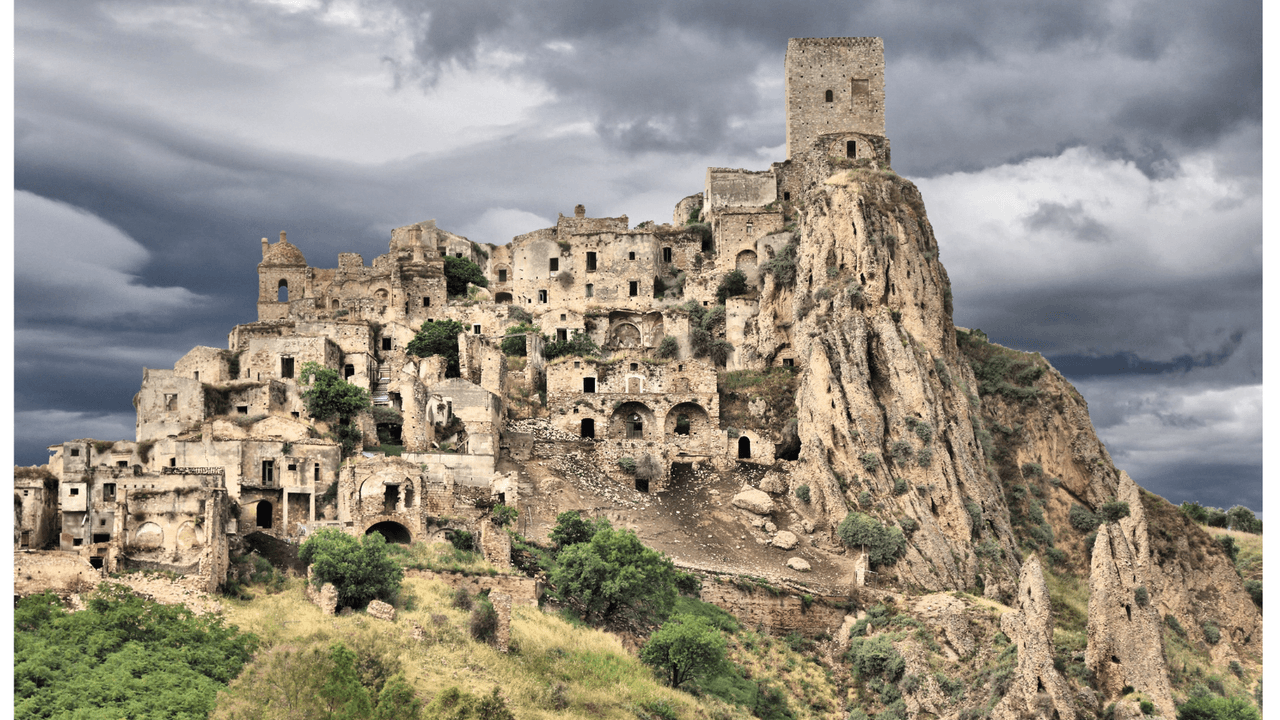
You can still see a remarkably legible abandoned townscape in Craco. The street pattern, many stone houses, religious buildings, and defensive skyline remain visible, which is why the site is so often cited in discussions of Italian ghost towns.
1. The hilltop skyline
The first thing most visitors notice is the silhouette. Craco rises sharply above the surrounding landscape, and that position makes the town look almost theatrical from a distance.
This skyline matters because it shows how older settlements used topography for defense, visibility, and identity. Even in ruin, Craco reads clearly as a complete settlement rather than a scattered ruin field.
2. The tower and fortified crest
The upper part of Craco is dominated by its defensive profile, including the well-known tower on the crest. This element helps explain why the site is so visually distinctive.
From a heritage point of view, the tower is important because it anchors the whole urban composition. It also reminds visitors that Craco was not built only for beauty. It was built to occupy and control a strategic hill position.
3. The church area and religious buildings
Craco also preserves the remains of important religious architecture, especially the church area commonly associated with San Nicola. These structures help identify the old civic and spiritual center of the town.
For historians, this matters because churches usually mark how public life was organized. In abandoned towns, religious buildings often remain among the most readable spaces, even when houses have suffered heavier structural damage.
4. Empty stone houses and narrow streets
One of Craco's strongest features is the continuity of its domestic fabric. Rows of stone houses, lanes, stairways, and openings still make the town understandable at human scale.
This is also why Craco is so powerful visually. It does not look like a single monument left behind. It looks like an entire community interrupted, with everyday life suddenly removed from a still-recognizable urban frame.
5. The surrounding eroded landscape
Craco is inseparable from its setting. The surrounding clay hills and eroded terrain are part of the explanation for both its beauty and its vulnerability.
That landscape gives Craco its cinematic quality, but it also explains the town's instability. In practical terms, the land around the site is not just background scenery. It is one of the central reasons the town became unsafe.
Can you visit Craco legally and safely?
Yes, but only within current local rules and safety conditions. Craco should be approached as a controlled heritage site, not as a place for illegal entry, climbing, or unsupervised exploration.
Access rules can change over time. Some areas may be visitable only through authorized or guided formats, while others remain closed for structural reasons. That is the correct approach. Old masonry, unstable ground, and weather exposure create real risks.
For responsible urbex research, the key principle is simple: never cross barriers, never force access, and never enter restricted buildings. Preservation comes first. If you are researching other locations with verified information, you can start by exploring Browse all urbex maps.
Browse all urbex maps
Why is Craco, the abandoned town in Basilicata, important for urbex and heritage?
Craco matters because it is both an urbex reference point and a heritage case study. It shows abandonment at town scale, but it also shows why preservation and access control are necessary.
Many abandoned sites are fragments: one factory, one villa, one hospital wing. Craco is different. It presents an entire urban organism shaped by geology, migration, religion, and infrastructure. That makes it unusually useful for historians, photographers, geographers, and researchers.
It also helps clarify an important MapUrbex principle. Not every abandoned place should be treated as a casual exploration target. Some sites are too fragile, too exposed, or too significant. Craco belongs in that category.
What should you know before planning a trip to Craco?
You should plan around legality, weather, and current access conditions. Craco is best visited as part of a broader Basilicata route, with realistic expectations about closures, walking conditions, and heritage protection.
A few practical points make a big difference:
- Check current local access conditions before you go.
- Expect uneven ground, sun exposure, and limited shelter.
- Wear stable shoes and bring water.
- Respect every sign, fence, and restricted zone.
- Treat the site as cultural heritage, not a playground.
If you want to build a more efficient research process for abandoned places, read How to Find Real Abandoned Places Near You in 2026 (Without Wasting Time). For a broader overview of verified places, use Browse all urbex maps.
FAQ
Is Craco open to the public?
Craco can be visitable, but access is not the same as unrestricted entry. Conditions depend on safety rules and local management at the time of your visit. Always verify current access before traveling.
Where is Craco in Italy?
Craco is in Basilicata, in the province of Matera, in southern Italy. It stands on a hill in a rural landscape that is part of its identity. The location is one reason the town feels so visually isolated.
Was Craco abandoned because of an earthquake?
Not only because of an earthquake. The main turning point was a landslide in 1963, with later flooding and seismic concerns reinforcing the evacuation. The abandonment was a process, not a single-event story.
Is Craco a good urbex destination?
Craco is important for urbex culture, but it should not be treated like an open-access exploration playground. It is a fragile and regulated heritage site. Responsible visitors focus on legal access, documentation, and preservation.
Why is Craco so famous?
Craco is famous because it preserves the image of a whole abandoned hill town. Its skyline, stone architecture, and dramatic setting make it one of the most recognizable ghost towns in Italy. It has also been used as a film location, which increased its visibility.
Conclusion
Craco is one of the clearest examples of an abandoned town in Italy. Its story is not just about ruins. It is about how unstable terrain, demographic change, and disaster can empty a settlement while leaving its structure visible.
For travelers, photographers, and researchers, the main lesson is simple: Craco rewards careful observation, not reckless access. Respect the site, verify current rules, and keep preservation first.
Access the free urbex map
