 MapUrbex
A practical guide to the Centre-Val de Loire urbex map, with the best abandoned site categories, regional patterns, safety tips, and verified planning advice.
Centre-Val de Loire Urbex Map: Best Urbex Spots in the Region
Centre-Val de Loire is one of the most varied urbex regions in central France. It combines industrial corridors, railway heritage, rural estates, former public institutions, and isolated agricultural structures spread across six departments.
That variety is exactly why a reliable map matters here. Distances are real, site status changes quickly, and many abandoned places in Centre-Val de Loire are either partially reused, privately owned, or more fragile than they appear from older online posts.
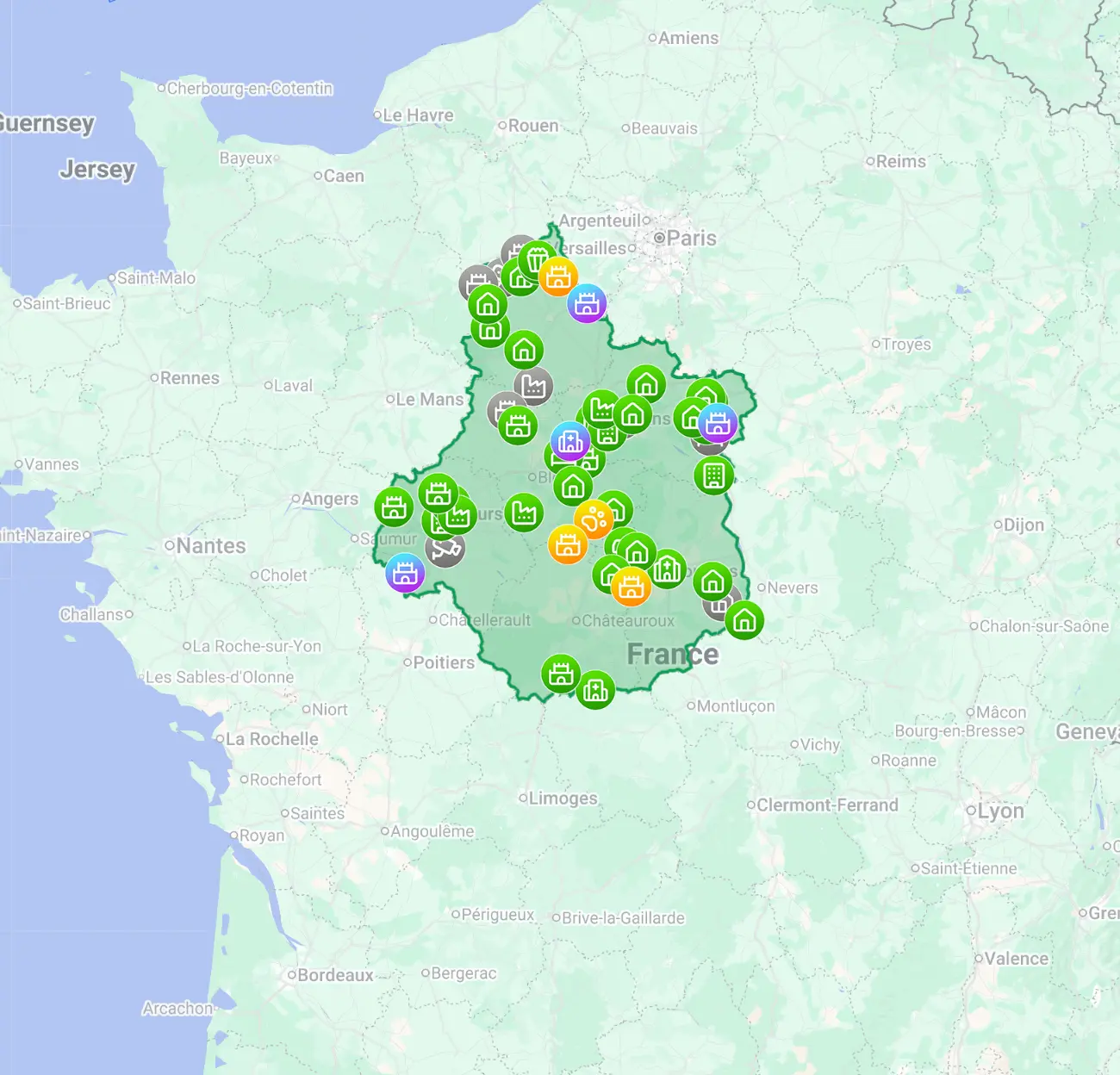
If you are looking for a practical guide urbex Centre-Val de Loire readers can actually use, this article focuses on verified planning, not random coordinates. The goal is simple: help you understand where the strongest urbex clusters are, what types of places define the region, and how to prepare responsibly.
Where can you find the best urbex spots in Centre-Val de Loire?
The best way to find urbex spots in Centre-Val de Loire is to use a verified Centre-Val de Loire urbex map that sorts locations by type, region, and recent status checks. The most promising areas are usually around Tours, Orléans, Bourges, Blois, Chartres, and Châteauroux, where industrial, railway, military, and institutional heritage overlap with rural abandoned estates.
Quick summary
- Centre-Val de Loire offers a wide mix of industrial, railway, military, agricultural, and institutional abandoned places.
- The densest urbex interest usually sits near the Tours, Orléans, and Bourges corridors, with rural finds across Loir-et-Cher, Indre, and Eure-et-Loir.
- A verified map is useful because closures, redevelopment, surveillance, and occupancy change faster than old forum posts suggest.
- Rural sites often look easier on paper but require more planning because of distance, access uncertainty, and structural decay.
- The best urbex spots in Centre-Val de Loire are not just photogenic; they are also the ones that can be assessed responsibly before any trip.
- MapUrbex is most useful when you want curated, preservation-first planning rather than unverified pin dumps.
Quick facts
- Region: Centre-Val de Loire
- Departments: Cher, Eure-et-Loir, Indre, Indre-et-Loire, Loir-et-Cher, Loiret
- Common site types: factories, depots, railway infrastructure, schools, hospitals, farm complexes, manor outbuildings, military remnants
- Main urban anchors: Tours, Orléans, Bourges, Blois, Chartres, Châteauroux
- Best use of a map: checking concentration zones, comparing site types, and avoiding outdated or duplicated location lists
- Safety reminder: abandoned does not mean open or legal to enter; always respect property, hazards, and preservation rules
Access the free urbex map
Why use a Centre-Val de Loire urbex map instead of random pin lists?
A Centre-Val de Loire urbex map is more useful than random pin lists because the region changes too quickly for static coordinates to stay reliable. The same location can be demolished, converted, fenced, occupied, or monitored within a short period.
This matters even more in Centre-Val de Loire than in dense metropolitan regions. Many abandoned places are dispersed across secondary roads, small towns, industrial fringes, or forest edges. A low-quality list can easily send you to the wrong village, to a sealed site, or to a property that is no longer abandoned.
A curated map also helps you work by category. Instead of chasing rumors, you can compare factories, institutional sites, transport infrastructure, and rural estates in a structured way. If you want a broader view beyond this region, Browse all urbex maps is the best starting point, and Best Urbex Maps in the World: Where to Find Verified Locations explains why verification is essential for serious planning.
Which parts of Centre-Val de Loire have the highest concentration of abandoned places?
The highest concentration of abandoned places in Centre-Val de Loire is usually found around the main urban and industrial corridors, especially near Tours, Orléans, and Bourges. Rural departments also contain many abandoned locations, but they are more scattered and need more route planning.
The region is not uniform. Some departments are stronger for industrial and railway heritage, while others stand out for estates, agricultural complexes, or former public buildings. That is why a map-based approach is more efficient than searching by a single city name.
| Area | Typical urbex profiles | What to verify first |
|---|---|---|
| Orléans and the Loiret corridor | warehouses, factories, logistics edges, transport sites | fencing, redevelopment, occupancy |
| Tours and Indre-et-Loire | industrial buildings, institutions, rail-related structures | conversions, demolition status, neighborhood sensitivity |
| Bourges and Cher | military-industrial remnants, workshops, depots | restricted zones, surveillance, legal status |
| Blois and Loir-et-Cher | rural estates, farm complexes, manor outbuildings | private ownership, instability, vegetation |
| Chartres and Eure-et-Loir | small industrial sites, schools, agricultural buildings | access changes, sealed entries, active reuse |
| Châteauroux and Indre | isolated institutions, farms, former care sites | long approach distances, weather, structural decay |
In practice, the best abandoned places in Centre-Val de Loire are often found where older economic layers overlap. Industrial belts, rail lines, military functions, and depopulated rural properties create that overlap. The region rewards careful filtering more than fast searching.
What are the best urbex spot categories in Centre-Val de Loire?
The best urbex spot categories in Centre-Val de Loire are former industrial sites, railway infrastructure, rural estates, military remnants, and closed public institutions. These categories appear repeatedly across the region and give the clearest picture of its abandoned heritage.
What makes the region interesting is not one single iconic site. It is the combination of medium-sized city decay and deep rural abandonment. That mix creates a broader range of atmospheres than many people expect from central France.
1. Former industrial sites around Tours and Orléans
Former industrial sites are among the most consistent urbex finds in Centre-Val de Loire. Around Tours and Orléans, the strongest patterns include warehouses, workshops, factory shells, and logistics buildings linked to older transport and manufacturing zones.
These places often photograph well because they combine scale and repetition: long corridors, loading bays, broken glazing, machine rooms, and concrete frames. They also change quickly. Some are partially reused, some are under redevelopment pressure, and some sit next to active businesses, which makes status verification essential.
2. Disused rail and transport infrastructure across Loiret and Cher
Railway and transport remnants are another major category in the region. Disused sidings, depots, service buildings, and small line infrastructure appear across Loiret and Cher, especially where historical freight or military logistics once mattered.
These sites are valuable because they preserve the technical side of regional history. They also carry obvious risk factors: unstable platforms, exposed metal, vegetation cover, and proximity to active lines or restricted areas. A responsible guide urbex Centre-Val de Loire should always treat rail-related sites with extra caution.
3. Abandoned châteaux, manor houses, and estate outbuildings in rural Loir-et-Cher and Indre
Rural estates are one of the most visually distinctive categories of abandoned places in Centre-Val de Loire. In Loir-et-Cher and Indre, you can find neglected manor houses, service buildings, farm courtyards, orangery remains, and estate outbuildings linked to older landholding patterns.
These locations attract attention because they combine architecture with landscape. The problem is that they are often heavily exposed to weather damage, collapse, theft, and private ownership issues. Many are also easier to romanticize than to assess accurately, so a verified map is much safer than relying on old photographs.
4. Military and logistics remnants near Bourges and Châteauroux
Military and logistics remnants are especially relevant near Bourges and Châteauroux because both areas have long administrative, industrial, and defense-related histories. The result can include depots, bunkered edges, technical sheds, training-related remnants, and large service compounds.
This is one of the most sensitive categories in the whole region. Some locations may be adjacent to active zones, controlled land, or sites with surveillance. That is exactly why MapUrbex emphasizes preservation-first research and legal awareness instead of reckless spot chasing.
5. Closed schools, care facilities, and hospital-type complexes in medium-sized towns
Closed public institutions are often the most narratively rich urbex category in Centre-Val de Loire. Former schools, boarding facilities, care homes, and hospital-type buildings often preserve signage, room sequences, chapel spaces, kitchens, or administrative areas that make the abandonment highly legible.
They are also among the most fragile. Water damage spreads fast, floors can be deceptive, and many of these buildings are either in transition or monitored. For photographers and researchers, they are often rewarding from a documentary perspective, but only when approached with caution and respect.
How should you plan a responsible urbex route in Centre-Val de Loire?
A responsible urbex route in Centre-Val de Loire should be planned around verification, distance, weather, and legal context. The region is large enough that poor planning can waste a full day or push visitors toward rushed decisions.
Start by grouping locations by department or travel corridor rather than by aesthetics alone. That usually means building separate plans for the Tours axis, the Orléans axis, the Bourges area, or the more rural sectors of Loir-et-Cher and Indre. A shorter, well-checked route is more useful than a long list of uncertain pins.
Then review the practical basics:
- recent status of the site
- whether the building appears genuinely abandoned or simply disused for storage
- surrounding land ownership and sensitivity
- weather, daylight, and road conditions
- mobile signal and emergency options in rural areas
- whether the structure is too unstable to justify a visit
If you use exported location files, How to Import Your .KML File into Google Maps is the simplest way to prepare mobile navigation. You can also compare the regional selection with Free Urbex Map 2026 if you want a wider overview before narrowing down your Centre-Val de Loire route.
When is the best time to use a Centre-Val de Loire urbex map?
The best time to use a Centre-Val de Loire urbex map is usually from late autumn to early spring, when vegetation is lower and architectural visibility improves. Shorter foliage makes rural structures easier to identify and helps you assess whether a site is truly abandoned or simply hidden.
Summer has advantages too, especially for long daylight hours. But heavy vegetation can hide hazards, rural paths can be misleading, and some properties are more active during agricultural periods. In every season, the safest rule is the same: check status recently, do not force access, and leave no trace.
Access the free urbex map
FAQ
Is Centre-Val de Loire a good region for urbex?
Yes, Centre-Val de Loire is a strong urbex region because it combines urban-industrial history with scattered rural abandonment. It is especially good for explorers who prefer variety over one single famous landmark. The main challenge is distance and changing site status, which makes verified planning important.
What types of abandoned places are most common in Centre-Val de Loire?
The most common categories are factories, warehouses, depots, railway buildings, farm complexes, closed schools, care facilities, and rural estates. The exact mix changes by department. Urban corridors are usually stronger for industrial sites, while rural sectors produce more estates and agricultural structures.
Do you need a verified map for rural sites in Centre-Val de Loire?
Yes, a verified map is especially useful for rural sites. Many rural locations are harder to confirm from public imagery, and older coordinates can be inaccurate or outdated. A curated map reduces wasted travel and helps avoid sensitive or no-longer-abandoned properties.
Is it legal to explore abandoned places in France?
Not automatically. A building being abandoned does not remove private property rights, local restrictions, or safety rules. Always respect the law, never force entry, and avoid any site where access status is unclear or where your presence could create risk or damage.
How can I use MapUrbex locations on my phone?
The easiest method is to export your data and open it in a mobile mapping app. How to Import Your .KML File into Google Maps gives the step-by-step process. That setup is useful for route planning, but it should always be paired with recent status checks.
Conclusion
The Centre-Val de Loire urbex map is most valuable when you use it to understand patterns, not just to collect pins. The region stands out for its mix of industrial remains, railway infrastructure, institutional buildings, rural estates, and logistics history spread across a large and varied territory.
If you want the best urbex spots in Centre-Val de Loire, start with verified information, realistic routes, and a preservation-first mindset. That approach saves time, reduces risk, and protects the places that still remain.
Access the free urbex map
