 MapUrbex
A practical guide to buying urbex coordinates safely: how to verify listings, spot scams, and choose a reliable urbex map before paying.
Buying Urbex Coordinates: What to Check Before You Pay
Buying urbex coordinates can save research time, but it also creates new risks. A paid pin is only useful if the place is real, recent, and described with enough context to assess safety and legality.
Many disappointing purchases follow the same pattern: a vague screenshot, no update date, no proof of visit, and no explanation of access conditions. In practice, that means you may pay for an outdated location, a demolished site, or a place that cannot be entered legally or safely.
MapUrbex takes a preservation-first approach. Verified locations, curated maps, and clear context matter more than secretive hype.
What should you check before buying urbex coordinates?
Before buying urbex coordinates, check whether the location was genuinely visited, whether the information is recent, and whether the seller explains legal and physical access limits. A reliable listing shows proof, update dates, and practical context. If a seller offers only a pin, pressure, and no verification, the risk is high.
Quick summary
- Verify that the seller has recent, first-hand evidence of the location.
- Check whether the spot is still standing, reachable, and relevant.
- Avoid listings that sell mystery, urgency, or “exclusive” claims without proof.
- Prefer a reliable urbex map with context, updates, and responsible notes.
- Remember that correct coordinates do not guarantee legal access or safe conditions.
- Treat refund terms and update policies as part of the product quality.
Quick facts
- Coordinates alone are not enough; context is what makes them useful.
- The most common failure is outdated information, not fake GPS data.
- Screenshots from social media are weak evidence unless they are recent and specific.
- A curated map is often more valuable than a one-off spot purchase.
- Responsible urbex never means forced entry, trespassing, or damage.
Why is buying urbex coordinates risky?
Buying urbex coordinates is risky because a map pin can be technically accurate but practically useless. A site may have been sealed, demolished, converted, guarded, or made too dangerous since the last visit.
Another risk is information asymmetry. The seller knows how little proof they are showing, while the buyer often sees only a teaser image and a promise. That gap makes urbex scams easy: low-cost data can be resold many times with almost no accountability.
There is also a legal risk. Even when a place is real, entering without authorization may be prohibited. Coordinates are not permission.
Safety reminder: never force access, bypass security, or enter unstable structures. Responsible exploration starts with legality, risk assessment, and respect for the site.
How can you verify urbex coordinates before paying?
You can verify urbex coordinates before paying by asking for dated proof, checking recent map imagery, comparing the listing with public clues, and confirming that the seller describes the site beyond a simple pin. The goal is not secrecy. The goal is reliability.
| Check | Why it matters | What to ask for |
|---|---|---|
| Recent proof of visit | Confirms the site still exists in similar condition | A dated photo set, recent description, or timestamped update |
| Specific site context | Shows the seller knows the location directly | Building type, surrounding landmarks, current condition |
| Update date | Old data loses value quickly | Date of last verification |
| Access limitations | Helps assess whether the listing is actually usable | Notes on barriers, closures, patrols, or visible hazards |
| Refund or correction policy | Separates serious sellers from disposable listings | Replacement spot, update promise, or refund terms |
| Map format | Reveals whether you are buying a system or just a pin dump | Curated map, notes, filters, region coverage |
A good method is to cross-check what you are told with satellite imagery, street context where available, and public signs of activity or redevelopment. If the area clearly shows recent demolition or construction, the coordinates may already be obsolete.
If you want to compare paid listings with open research methods, read How to Find Abandoned Places Near You.
What does a reliable urbex map usually include?
A reliable urbex map usually includes more than coordinates. It should provide classification, update status, context, and a clear signal that the locations were curated rather than copied in bulk.
Useful features often include:
- region or country filters
- categories such as factory, villa, hospital, bunker, or industrial site
- brief condition notes
- update logic or verification status
- responsible-use framing instead of reckless promises
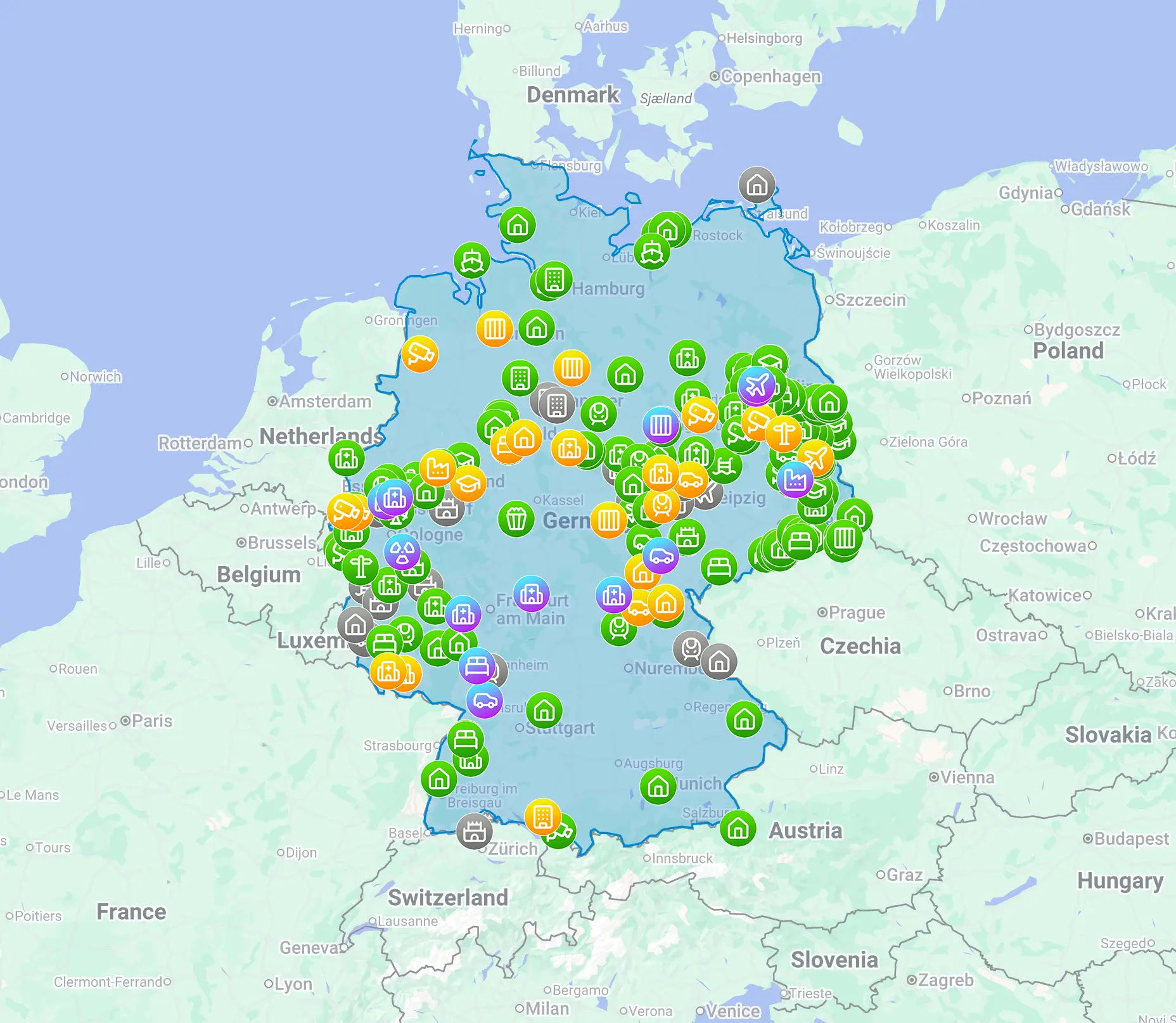
That is the difference between buying isolated spots and using a reference tool. You can Browse all urbex maps to see how curated collections are structured.
Which red flags often signal an urbex scam?
The clearest red flags are pressure, vagueness, and zero accountability. Scam-like offers usually avoid detail because detail can be checked.
Watch for these warning signs:
- “Secret list” marketing with no sample quality
- no date on photos or claims
- recycled images that could come from anywhere
- promises of “guaranteed access”
- no mention of closures, hazards, or legal limits
- payment requested only through irreversible methods
- no correction, replacement, or support policy
A seller who never discusses uncertainty is often less trustworthy than one who explains limits clearly.
Should you buy a single spot or use a curated map?
In most cases, a curated map is the better buy because it spreads risk across multiple listings and gives you context. A single spot purchase can make sense only if the seller has strong proof and the site matches a specific project or region you are targeting.
Single coordinates are vulnerable to fast obsolescence. Curated maps are more resilient because even if one place changes, the overall resource may still hold value.
If you are just starting, compare scope before paying. A broader tool often teaches you how to evaluate locations, not only how to collect them.
How do legality and safety affect the value of coordinates?
Legality and safety directly affect value because usable information is not the same as actionable access. Coordinates for a sealed, monitored, collapsing, or prohibited site may be accurate, but that does not make them a good purchase.
A responsible seller should at least acknowledge obvious constraints. MapUrbex emphasizes preservation-first exploration: no vandalism, no forced entry, and no encouragement to break the law.
The best urbex data helps you decide when not to go. That is a feature, not a flaw.
FAQ
Can urbex coordinates ever be guaranteed?
No. Conditions change too quickly. The most a seller can realistically guarantee is that the information was verified on a certain date and documented honestly.
What proof should a seller provide?
Recent, specific proof is best. Look for dated photos, clear site descriptions, or update notes that show first-hand knowledge of the location.
Are social media screenshots enough?
Usually not. A screenshot may prove that a place existed at some point, but it rarely proves the current state, exact position, or present accessibility.
Is a refund policy important?
Yes. A refund, replacement, or correction policy shows that the seller accepts responsibility for data quality. No policy usually means the risk is entirely on the buyer.
What if the coordinates are correct but access is impossible?
Then the listing may still be poor value. Correct coordinates do not guarantee a worthwhile urbex opportunity if the site is sealed, unsafe, occupied, or legally off-limits.
Conclusion
Buying urbex coordinates is not just about getting a pin. It is about judging whether the information is recent, verifiable, and useful in real conditions.
The safest rule is simple: pay for context, not mystery. A reliable urbex map, transparent update logic, and responsible guidance are worth more than a dramatic sales pitch.
Access the free urbex map
