 MapUrbex
Explore the top 50 abandoned places in Île-de-France with a responsible urbex guide focused on verified locations, safety, and preservation-first planning.
Top 50 Abandoned Places in Île-de-France: Complete Guide for Responsible Urbex
Île-de-France is one of the richest regions in France for industrial ruins, empty villas, former medical sites, rural compounds, and forgotten transport infrastructure. It combines dense history, fast access from Paris, and strong variation between urban fringe and countryside.
This guide explains where the most interesting abandoned places in Île-de-France are concentrated, what types of sites are common, and how to approach urbex responsibly. It does not publish forced-entry advice, trespassing tips, or unsafe access details.
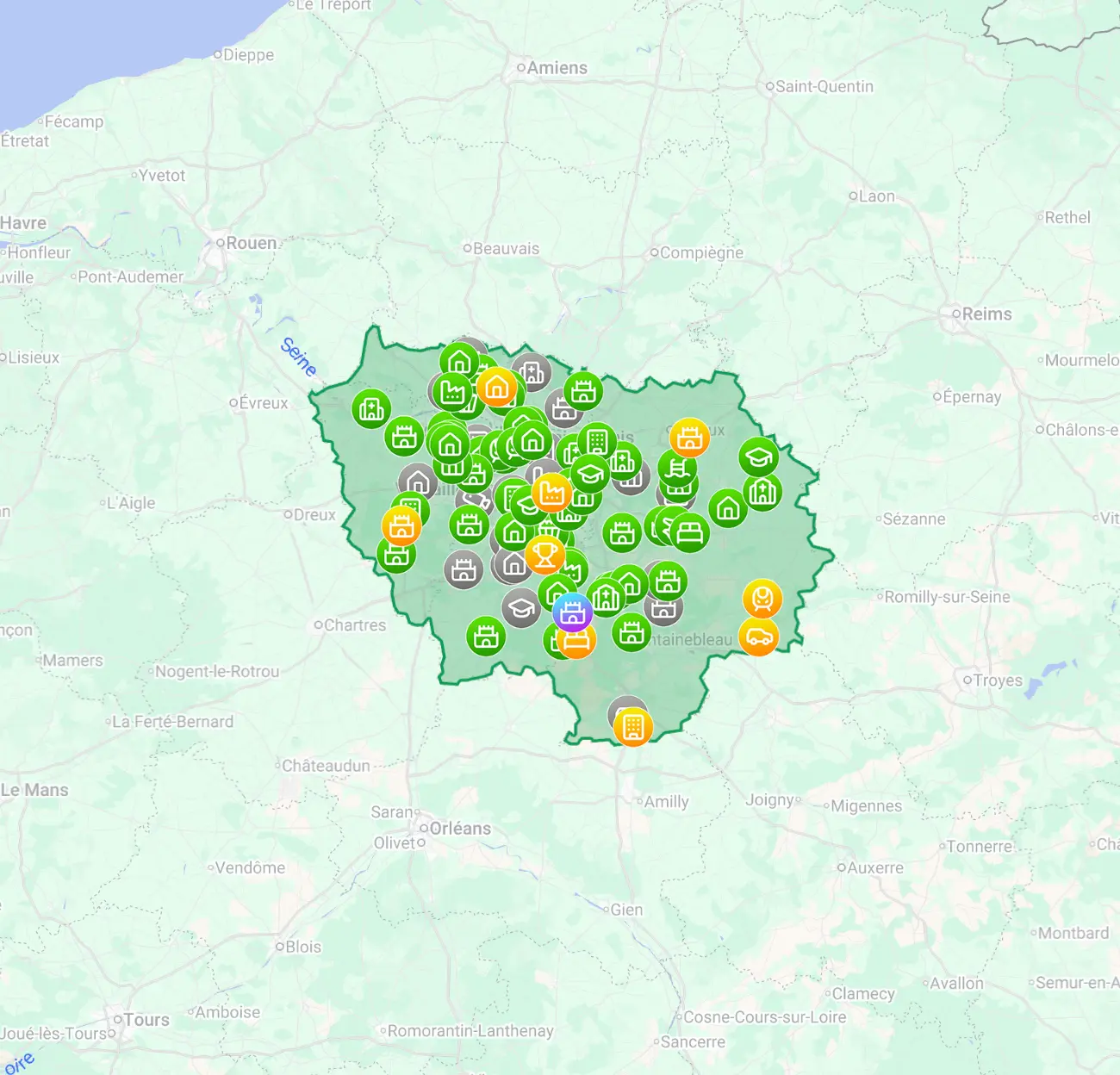
What are the best abandoned places in Île-de-France?
The best abandoned places in Île-de-France are usually verified sites that combine architectural interest, manageable risk, and clear heritage value. In practice, the strongest urbex spots in the region include industrial shells, old manor houses, medical facilities, farm estates, and rail-related structures spread mainly across the outer departments near Paris.
Quick summary
- Île-de-France offers one of the widest mixes of urbex sites in France.
- The most consistent abandoned places are found in the outer ring around Paris, not only in the capital itself.
- Industrial sites, rural estates, abandoned care facilities, and transport relics dominate the region.
- Responsible urbex means checking legal status, avoiding forced entry, and leaving sites untouched.
- Verified maps are more useful than random lists because site conditions change quickly.
- MapUrbex focuses on curated, preservation-first location discovery.
Quick facts
- Region: Île-de-France
- Best-known urbex zones: Seine-et-Marne, Essonne, Yvelines, Val-d'Oise, and the outer Paris belt
- Most common site types: factories, châteaux, hospitals, farms, depots, schools, and military remnants
- Best use case: photography, architecture research, local history, and route planning
- Main caution: never force access, trespass, vandalize, or share sensitive details carelessly
- Map approach: verified locations, curated maps, responsible exploration
Why is Île-de-France such a strong region for urbex?
Île-de-France is strong for urbex because it concentrates two centuries of industry, transport, healthcare, military logistics, and suburban expansion in a relatively compact area. That historical density creates many different abandoned place profiles.
Another reason is contrast. Near Paris, you find former depots, schools, workshops, and institutional buildings. Farther out, especially in Seine-et-Marne, Essonne, and Yvelines, the landscape shifts toward farms, manor houses, industrial plants, and larger estates.
For searchers looking for abandoned places to visit, this matters because the region is not limited to one style of exploration. It supports photography, texture hunting, architectural documentation, and heritage-focused visits.
Which kinds of abandoned places can you find in Île-de-France?
You can find almost every classic urbex category in Île-de-France, but industrial sites and semi-rural estates are the most common. The region is especially attractive if you want variety without crossing several French regions.
| Area | Common site types | Why it stands out | Responsible note |
|---|---|---|---|
| Seine-et-Marne | Factories, farms, manor houses, depots | Large spaces and strong rural-industrial contrast | Access conditions vary widely; verify before any visit |
| Essonne | Medical sites, schools, industrial buildings, military traces | Good mix of institutional and technical ruins | Perimeters often change after redevelopment work |
| Yvelines | Estates, villas, agricultural compounds, workshops | Strong photographic value and decorative interiors | Heritage sites can be fragile even from the exterior |
| Val-d'Oise | Warehouses, care facilities, transport-linked buildings | Good density near outer commuter corridors | Do not assume old entries remain legal or safe |
| Seine-Saint-Denis and Val-de-Marne | Urban factories, service buildings, rail structures | Fast access and dense industrial history | Security and ownership status can change very quickly |
| Greater Paris fringe | Smaller forgotten sites, utility spaces, isolated compounds | Useful for short scouting sessions | Public visibility is high, so discretion and legality matter |
Where are the 50 most interesting abandoned places in Île-de-France concentrated?
The 50 most interesting abandoned places in Île-de-France are concentrated in the outer departments, where land pressure, industrial decline, and old estates overlap. The shortlist below is intentionally thematic and non-invasive: it highlights the kinds of verified spots worth tracking, without publishing sensitive access details.
- Seine-et-Marne factory shell - Large brick volumes and strong exterior geometry.
- Seine-et-Marne paper mill remains - Good industrial textures and layered decay.
- Seine-et-Marne abandoned grain complex - Silos, conveyors, and broad open views.
- Seine-et-Marne disused farm estate - Barns, courtyards, and rural atmosphere.
- Seine-et-Marne manor house exterior - Elegant facades with preservation interest.
- Seine-et-Marne workshop cluster - Small technical buildings with dense detail.
- Seine-et-Marne former school block - Institutional corridors and symmetrical layouts.
- Seine-et-Marne rail-side warehouse - Good lines for industrial photography.
- Seine-et-Marne abandoned mill residence - Domestic ruins linked to local industry.
- Seine-et-Marne rural service station - Modest site, strong forgotten-road mood.
- Essonne medical pavilion group - Repetitive architecture and historical value.
- Essonne abandoned training center - Classroom layouts and intact planning logic.
- Essonne suburban factory unit - Compact industrial shell near commuter belts.
- Essonne former research building - Technical rooms and office decay.
- Essonne disused warehouse yard - Useful for exterior-focused photo sets.
- Essonne agricultural compound - Sheds, machinery traces, and open land.
- Essonne abandoned caretaker villa - Smaller scale, often visually striking.
- Essonne utility building cluster - Functional architecture with strong textures.
- Yvelines country house shell - High visual appeal from exterior approaches.
- Yvelines abandoned stable complex - Heritage atmosphere and repetitive forms.
- Yvelines old greenhouse property - Fragile structures, strong light conditions.
- Yvelines workshop row - Compact series of industrial interiors.
- Yvelines roadside motel remains - Rare hospitality-related urbex profile.
- Yvelines small private clinic - Institutional architecture on a human scale.
- Yvelines disused estate outbuildings - Good details without needing large footprints.
- Yvelines former leisure center - Recreational decay and unusual layouts.
- Val-d'Oise abandoned care facility - Long corridors and repeated room patterns.
- Val-d'Oise warehouse belt - Strong industrial repetition and exterior mass.
- Val-d'Oise service tunnel complex - Technical heritage with limited-access interest.
- Val-d'Oise old factory offices - Paper-era interiors and administrative remains.
- Val-d'Oise transport outbuilding - Small but historically useful site type.
- Val-d'Oise rural manor annexes - Decorative details in a quieter setting.
- Val-d'Oise former school campus - Multi-building site with clear structure.
- Seine-Saint-Denis urban workshop block - Dense textures close to infrastructure.
- Seine-Saint-Denis disused depot building - Classic industrial-edge atmosphere.
- Seine-Saint-Denis factory courtyard site - Exterior compositions and brick detail.
- Val-de-Marne abandoned logistics hall - Wide-span interiors and urban access.
- Val-de-Marne former service building - Modest site, often overlooked.
- Val-de-Marne rail-linked warehouse - Strong geometry and transport history.
- Hauts-de-Seine utility remainder - Rare small urban ruin category.
- Outer Paris forgotten school wing - Short-format exploration with historical interest.
- Outer Paris disused office block - Post-industrial urban decay profile.
- Outer Paris abandoned sports facility - Unusual spaces and faded signage.
- Outer Paris boiler house - Mechanical heritage and industrial textures.
- Outer Paris maintenance yard - Exterior-focused site with documentary value.
- Regional abandoned chapel annex - Small heritage ruin with delicate context.
- Regional estate gatehouse - Compact structure, strong atmosphere.
- Regional pumping station - Technical architecture and robust materials.
- Regional forgotten nursery site - Light structures and overgrowth patterns.
- Regional mixed-use ruin cluster - Best for comparing several site types in one zone.
How should you choose an urbex spot in Île-de-France responsibly?
You should choose an urbex spot in Île-de-France by prioritizing verified status, low legal ambiguity, safe conditions, and preservation value. A site is not automatically worth visiting just because it appears in an old forum thread or social media post.
Use this filter before planning:
- Prefer verified locations over recycled lists.
- Check whether the site is still abandoned, partially active, demolished, or secured.
- Avoid places that clearly require trespassing or forced access.
- Favour exterior documentation if the legal status is uncertain.
- Do not publicize fragile interiors or easy entry points.
- Leave every object exactly where it is.
For more curated discovery, you can Browse all urbex maps. If you want a narrower shortlist, read Top 10 Abandoned Places in Île-de-France for Responsible Urbex and Île-de-France Urbex Map: 30 Verified Abandoned Places Near Paris. For broader context, see Urbex in Paris and Île-de-France: the complete guide.
How can you plan a legal and low-impact visit?
A legal and low-impact visit starts before you leave home. The goal is to reduce uncertainty, avoid conflict, and protect the site.
A simple planning checklist works well:
- Confirm the latest status from a reliable source.
- Check ownership, redevelopment signals, and public restrictions.
- Go in daylight and avoid solo risk when possible.
- Wear basic protective gear suited to lawful observation.
- Do not climb unstable structures or enter sealed areas.
- Keep your visit discreet, brief, and non-destructive.
- Never take objects, break locks, or move barriers.
In practice, the best urbex guide is not the one with the most hype. It is the one that helps you make better decisions with less impact.
FAQ
Is urbex legal in Île-de-France?
Urbex is not automatically legal. Legality depends on ownership, access permission, local restrictions, and the exact condition of the site. If entry requires trespassing, bypassing a barrier, or forcing access, it should be avoided.
What types of abandoned places are most common near Paris?
Near Paris, the most common profiles are industrial buildings, depots, service structures, schools, small institutional sites, and logistics spaces. Larger estates and farm compounds become more common as you move farther into the outer departments.
Should exact coordinates of abandoned places be shared publicly?
In most cases, no. Publicly sharing exact coordinates can accelerate vandalism, theft, arson, and unsafe traffic to fragile sites. A preservation-first approach favors verified, controlled sharing rather than open exposure.
What makes a verified urbex map more useful than open lists?
A verified urbex map is more useful because abandoned places change fast. Sites get demolished, redeveloped, fenced, or re-secured. Curated maps help reduce wasted trips and lower the risk of relying on outdated information.
Are abandoned places in Île-de-France good for photography?
Yes, especially for industrial textures, repetitive corridors, weathered facades, and contrasts between urban and rural decay. The best photography comes from patience, lawful positioning, and respect for the site rather than risky entry.
Conclusion
Île-de-France remains one of the best French regions for anyone researching abandoned places, urbex spots, and heritage-focused exploration. Its main strength is variety: industrial ruins, estates, care facilities, and transport relics all exist within a relatively compact travel radius.
The best approach is also the simplest one: use verified information, respect property and safety limits, and treat each site as fragile cultural evidence rather than consumable content.
Access the free urbex map
