 MapUrbex
Explore a New Aquitaine urbex map with 9 unusual spot types around Bordeaux, La Rochelle, and the wider region, with legal and safety guidance.
New Aquitaine Urbex Map: 9 Unusual Spots Around Bordeaux and La Rochelle
New Aquitaine is one of France's richest regions for urban exploration research. Bordeaux, La Rochelle, the Atlantic coast, and the inland departments all contain very different kinds of abandoned places.
That variety is exactly why a New Aquitaine urbex map matters. A curated map helps you sort railway sites, former industrial buildings, coastal structures, hospitals, schools, and rural complexes without relying on random social posts.
MapUrbex follows a preservation-first approach. The goal is to document verified locations, reduce risky guesswork, and remind explorers to respect property, safety limits, and local rules.
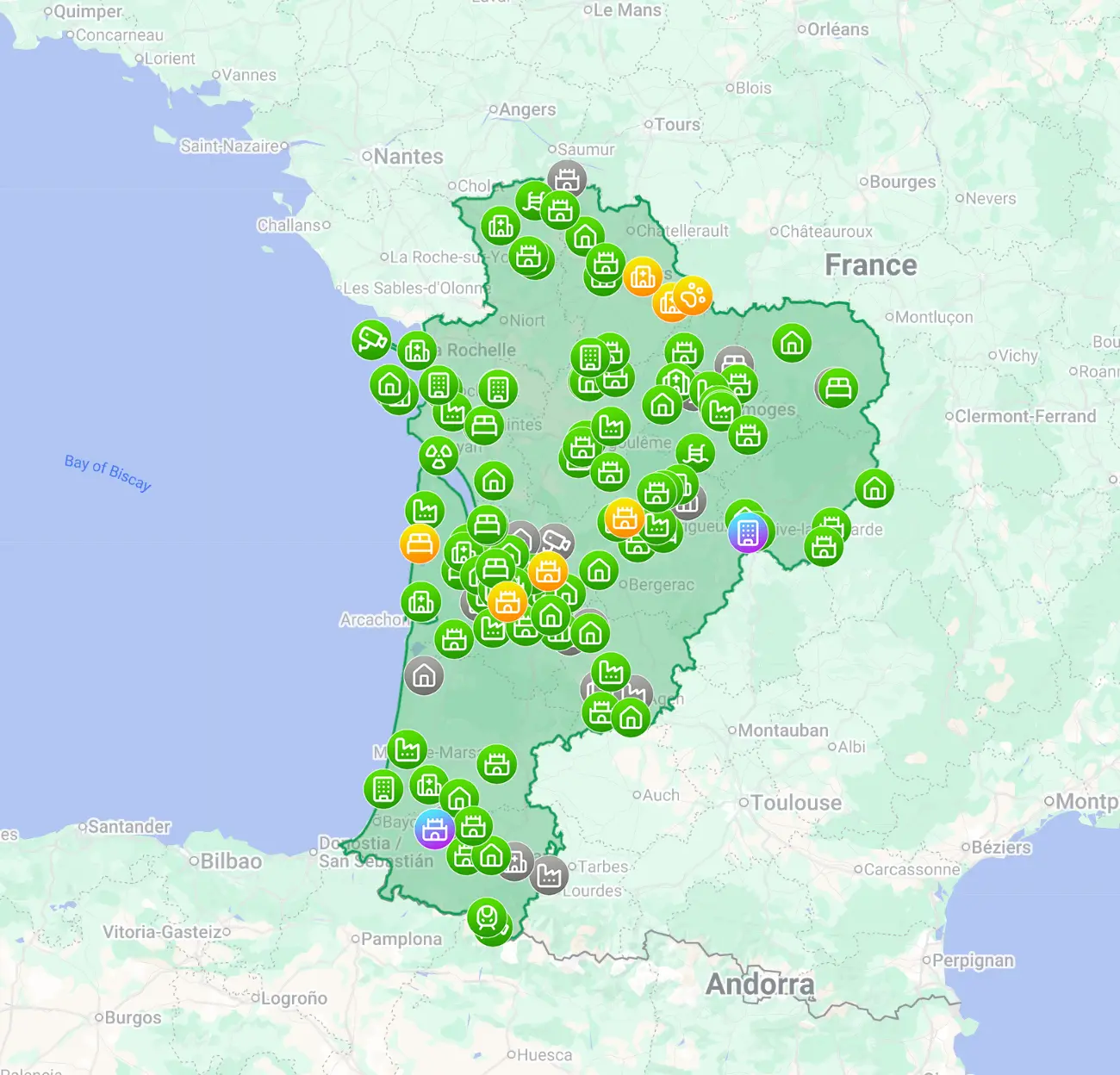
If you want a broader regional overview, read New Aquitaine Urbex Map: Find Abandoned Places in Southwest France.
What does the New Aquitaine urbex map include?
A good New Aquitaine urbex map brings together verified leads across Bordeaux, La Rochelle, the Atlantic coastline, and inland departments. It usually includes former warehouses, railway infrastructure, maritime buildings, care facilities, schools, farm-industrial sites, and leisure properties, while helping users compare condition, access context, and preservation risks before planning any visit.
Quick summary
- The region mixes port heritage, rail sites, rural institutions, and coastal abandonment.
- Bordeaux and La Rochelle are major search hubs, but many interesting places sit outside the big cities.
- A curated map is more useful than scattered coordinates because it adds context and filtering.
- The most interesting spot types in New Aquitaine are often industrial, maritime, medical, agricultural, or leisure-related.
- Responsible urbex means no forced entry, no trespassing, no vandalism, and no public sharing of fragile exact coordinates.
- You can Browse all urbex maps or Access the free urbex map if you want to compare regions.
Quick facts
| Zone | Common abandoned places | Why it stands out |
|---|---|---|
| Bordeaux area | Wine warehouses, depots, riverside workshops | Dense industrial and transport heritage |
| La Rochelle area | Maritime service buildings, port structures, old storage blocks | Strong coastal atmosphere |
| Atlantic coast | Holiday camps, closed hotels, leisure sites | Seasonal architecture and weathered decay |
| Estuary and rural belts | Fishing buildings, oyster sheds, farm-industrial sites | Mix of water, agriculture, and logistics |
| Inland departments | Schools, care homes, manor outbuildings, small factories | More isolated and often less documented |
Which 9 unusual urbex spots stand out on the New Aquitaine map?
The most useful New Aquitaine urbex maps usually highlight recurring site families rather than one viral location. In this region, the strongest patterns are found in Bordeaux's industrial belt, La Rochelle's maritime edge, coastal leisure architecture, and inland institutional buildings.
-
Former wine warehouses in Bordeaux Old wine storage buildings are among the most characteristic abandoned places near Bordeaux. Their scale, loading bays, brickwork, and logistics layout make them visually distinct.
-
Disused riverside workshops on the Garonne Riverside industrial units often combine decaying machinery spaces with flood marks, service yards, and transport infrastructure. They are valuable for photography, but structural condition can change quickly.
-
Closed railway depots and maintenance sheds Railway heritage is a major urbex theme in southwestern France. Depots, signal buildings, and maintenance halls often survive long after passenger use has ended.
-
Abandoned maritime service buildings around La Rochelle La Rochelle attracts interest because maritime utility buildings age differently from inland sites. Salt air, metal corrosion, and exposed concrete create a distinct visual texture.
-
Vacant port-side storage blocks and fishery structures Around coastal logistics zones, explorers often search for former cold storage, small fishery buildings, and service warehouses. These places are historically interesting because they connect trade, labor, and shoreline infrastructure.
-
Closed holiday camps and seaside leisure properties Along the Atlantic coast, some of the most unusual abandoned places are former holiday sites. These include leisure centers, camps, and small hotels left behind by changing tourism patterns.
-
Disused hospitals, clinics, and care facilities inland Medical and care-related sites are frequently searched because they preserve room layouts and institutional details. They are also among the most sensitive sites, so discretion and legality matter even more.
-
Shuttered farm-industrial complexes in Dordogne, Landes, or the wider rural belt New Aquitaine has many hybrid sites where agriculture and industry overlap. Silos, storage sheds, workshops, and processing buildings can form large abandoned compounds.
-
Forgotten schools, manor annexes, and small civic buildings in quieter departments Some of the most photogenic places are not giant factories but modest local buildings. Former schools, outbuildings, and municipal sites often show slower decay and more traces of everyday regional history.
Where are the main urbex zones in New Aquitaine?
The main urbex zones in New Aquitaine cluster around major transport corridors, port cities, estuaries, and older industrial towns. Bordeaux and La Rochelle are the best-known names, but the broader map matters because many strong leads sit in secondary towns or rural areas.
A practical way to think about the region is this:
- Bordeaux and its outskirts for warehouses, depots, workshops, and transport heritage.
- La Rochelle and the nearby coast for maritime buildings and service infrastructure.
- The Atlantic shoreline for holiday architecture and weather-exposed leisure sites.
- Gironde estuary areas for mixed fishing, storage, and industrial traces.
- Inland New Aquitaine for schools, clinics, farm complexes, and smaller institutional buildings.
How should you use a map of urbex places in New Aquitaine safely and legally?
You should use a map of urbex places in New Aquitaine as a research and planning tool, not as a shortcut to risky entry. Verify ownership, respect closures, avoid forced access, and leave immediately if a site is occupied, secured, or clearly off-limits.
A few rules matter more than the location itself:
- Check whether the site is private property or an active work zone.
- Never cut fences, break locks, or enter through damaged openings.
- Avoid unstable floors, roofs, basements, and fire-damaged structures.
- Do not go alone in remote or coastal areas.
- Do not remove objects or publish fragile exact coordinates publicly.
- Respect wildlife, especially in estuary and coastal environments.
If you are new to the subject, read How to Start Urbex: A Beginner's Guide to Urban Exploration. If you want to improve your research method, How to Find Abandoned Places with Google Maps explains a useful starting workflow.
Why use a curated urbex map instead of random coordinates?
A curated urbex map is better than random coordinates because context is often more important than the pin itself. Verified regional mapping helps you understand what a place is, how recent the information is, what kind of risks apply, and whether the site fits a responsible exploration plan.
That is the core value of MapUrbex. The platform is designed around verified locations, responsible urbex, and preservation-first discovery instead of viral location dumping.
FAQ
Is urbex legal in New Aquitaine?
Urbex itself is not a blanket legal category, and legality depends on the specific site. Entering private property without permission, bypassing security, or ignoring closure notices can be illegal.
Are Bordeaux and La Rochelle the only urbex areas worth checking?
No. They are the best-known search hubs, but many notable abandoned places in New Aquitaine are located in smaller towns, coastal belts, estuary zones, and inland departments.
What kinds of abandoned places are most common in New Aquitaine?
The most common categories are industrial buildings, warehouses, railway structures, maritime service sites, care facilities, schools, and rural agricultural-industrial complexes.
Should you share exact coordinates of abandoned places publicly?
In most cases, no. Publicly sharing precise coordinates can accelerate vandalism, theft, and unsafe visits, especially at fragile or partially preserved sites.
When is the best time to research urbex spots in New Aquitaine?
Autumn and winter often make site visibility easier because vegetation is lower, but coastal weather can also make conditions more dangerous. Research quality and safety checks matter more than season alone.
Conclusion
A New Aquitaine urbex map is most useful when it helps you understand patterns, not just chase a single abandoned building. Bordeaux and La Rochelle are strong entry points, but the wider region offers a broader mix of industrial, maritime, rural, and institutional sites.
For responsible explorers, the best map is one that combines verified information with safety context and preservation standards. That approach leads to better research and fewer bad decisions.
Access the free urbex map
