 MapUrbex
A practical guide to using a Switzerland urbex map to research abandoned places, reduce risk, and explore responsibly.
Switzerland Urbex Map: How to Find Abandoned Places Safely
Swiss urbex research works best when it starts with verification, not guesswork. A good Switzerland urbex map helps you sort real locations from rumors, outdated coordinates, and places that are no longer standing.
That matters even more in Switzerland. Distances can look short on a screen but involve mountain roads, rail access limits, snow, private land, or unstable structures. A map is useful only when it supports careful decisions.
MapUrbex approaches this with verified locations, curated maps, and a preservation-first mindset. The goal is not to push entry at any cost. The goal is to help people research abandoned places in Switzerland more responsibly.
What is the safest way to use a Switzerland urbex map?
The safest way to use a Switzerland urbex map is to treat it as a research tool, not as permission to enter. Verify whether the place still exists, check ownership and access restrictions, review terrain and weather, and avoid any site that requires forced entry, trespassing, or unnecessary risk.
Quick summary
- A curated map of abandoned places helps filter false leads, demolished sites, and duplicate listings.
- In Switzerland, access conditions depend on ownership, signage, terrain, weather, and local context.
- Abandoned does not mean legal to enter. A map never overrides property rights or safety rules.
- The best urbex planning combines mapping, recent verification, route checks, and a backup plan.
- Swiss spots often include hotels, industrial buildings, infrastructure remnants, and abandoned hamlets.
- MapUrbex focuses on verified locations and responsible urbex rather than reckless exposure.
Quick facts
- Primary keyword: Switzerland urbex map
- Search intent: informational guide
- Best use of a map: research, route planning, and risk reduction
- Common Swiss location types: hotels, factories, sanatoriums, alpine villages, infrastructure
- Main safety issues: unstable floors, hidden shafts, snow, remote access, weak signal
- Legal baseline: if access is restricted or unclear, do not enter
Why use a curated map of abandoned places instead of random coordinates?
A curated map of abandoned places is more useful because it reduces noise. Random coordinates from forums, reposted social media content, or old videos often point to places that are demolished, converted, fenced off, or impossible to reach safely.
A structured map gives you context. That includes the type of site, rough condition, regional placement, and whether the location is worth researching further. It also helps you avoid building a route around unreliable information.
MapUrbex is built around verified locations and selective inclusion. That does not remove all risk, but it makes the research process more dependable. If you want to compare regions and categories first, you can Browse all urbex maps.
How can you find urbex spots in Switzerland without taking unnecessary risks?
The safest way to find urbex spots in Switzerland is to narrow your search before you travel. Start with a map, then confirm whether the site is still present, whether access appears lawful, and whether the approach is realistic for the season and terrain.
A practical workflow looks like this:
- Start with a curated map rather than isolated pins.
- Check whether the site is described consistently across recent sources.
- Review satellite view, terrain, roads, and nearby public access points.
- Look for signs of redevelopment, demolition, fencing, or active use.
- Check weather, daylight, and network coverage.
- Skip the site if safe and lawful access is uncertain.
This is especially important in Switzerland because many sites sit in valleys, on slopes, or near infrastructure that changes by season. Snow cover, rockfall risk, and road closures can matter more than driving distance.
For a deeper research method, see Comment trouver des lieux abandonnés en Suisse.
Which abandoned places in Switzerland appear most often on urbex maps?
The most common abandoned places in Switzerland are former hotels, industrial buildings, small transport or utility sites, and some abandoned villages or hamlets. Each category requires different expectations for access, safety, and photographic value.
| Type of place | What makes it attractive | Main limits | Best responsible use |
|---|---|---|---|
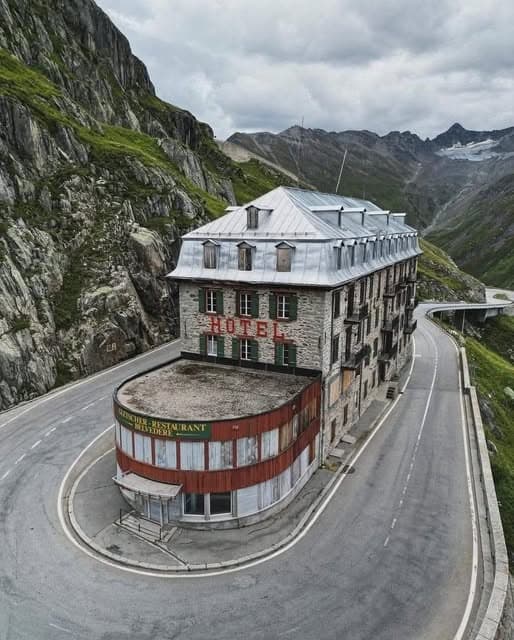
| Former hotels and sanatoriums | Strong architecture, visible decay, mountain settings | Often private, unstable interiors, redevelopment risk | Exterior research and public-view photography |
| Factories and warehouses | Large spaces, machinery traces, industrial history | Hidden hazards, broken floors, contamination | Careful pre-research only |
| Railway or utility remnants | Strong historical interest | Active infrastructure nearby, restricted zones | Historical documentation from lawful viewpoints |
| Abandoned villages and hamlets | Rare rural atmosphere, landscape value | Remote access, weather exposure, unclear ownership | Route planning and public-path observation |
| Military or technical sites | Concrete structures, unusual layouts | High legal sensitivity, barriers, hidden dangers | Avoid entry unless clearly authorized |
Swiss abandoned villages deserve separate research because distance, elevation, and ownership can be misleading. For that topic, see Die Verlassenen Dörfer und Geistersiedlungen der Schweiz (2025).
How do Swiss laws and access rules affect urbex mapping?
Swiss laws and access rules affect urbex mapping directly because a map can show a location, but it cannot grant entry rights. If a place is private, fenced, signed, actively monitored, or dangerous, you should not enter.
The key point is simple: an abandoned building is not automatically open to visitors. Ownership still exists even when use has ended. In practice, access questions may depend on the property, local signage, active works, and how you approach the site.
That is why responsible urbex in Switzerland starts with restraint. Do not force doors, climb barriers, move boards, or bypass locks. Preservation-first behavior protects both the site and the people around it.
For a more detailed overview, read Urbex en Suisse - Lois, amendes 2025.
What makes a Switzerland urbex map different from a generic map?
A Switzerland urbex map is different from a generic map because location quality depends heavily on terrain, seasonality, and local context. A simple pin does not tell you whether a mountain road is closed, a building has been converted, or a valley loses signal after sunset.
Switzerland also combines dense transport networks with surprisingly complex micro-access conditions. A place that seems close by car may still require a long detour, a train connection, or a legal access point far from the structure itself.
Language is another factor. Information about abandoned places in Switzerland may appear in French, German, Italian, or English. A curated map helps bring that fragmented research into one clearer workflow.
How should you evaluate a site before adding it to your route?
You should evaluate a site by checking four things first: whether it still exists, whether access is lawful, whether the structure appears stable enough to approach from public space, and whether the route is realistic for the conditions.
Use this checklist before you travel:
- Confirm the site has not been demolished or redeveloped.
- Check whether roads, paths, or viewpoints are publicly accessible.
- Review recent weather, snow, fog, and sunset timing.
- Assume interior hazards even if photos look calm.
- Avoid remote sites without communication backup.
- Never rely on a single source or a single coordinate.
In short, the best map of abandoned places is not the one with the most dots. It is the one that helps you say no to weak leads.
FAQ
Is there a public map of abandoned places in Switzerland?
Yes, public and semi-public resources exist, but their quality varies a lot. The safest option is a curated map that prioritizes verification and context over raw volume.
Are all abandoned places in Switzerland legal to visit?
No. Abandoned status does not make a place public. Private ownership, warning signs, fencing, active redevelopment, or safety hazards can make a visit inappropriate or unlawful.
Can a map tell me whether a location is safe?
No map can guarantee safety. A map can help you research location type, access context, and route planning, but structural stability and on-site conditions can change at any time.
What should I check before visiting a remote Swiss spot?
Check access legality, weather, daylight, mobile signal, terrain, and exit options. In alpine or rural areas, the route itself may be the main risk.
Is responsible urbex in Switzerland mainly about secrecy?
No. Responsible urbex is mainly about preservation, legality, and risk control. Keeping sensitive places protected matters, but so does knowing when not to go.
Conclusion
A Switzerland urbex map is most useful when it helps you make better decisions before you leave home. The strongest approach is simple: use verified information, expect conditions to change, and never confuse location data with permission or safety.
That is the value of a curated map. It saves time, filters weak leads, and supports a more careful way to research abandoned places in Switzerland.
Access the free urbex map
