 MapUrbex
A complete guide to urbex in Paris and Île-de-France: departments 75, 77, 78, 91, 92, 93, 94 and 95, responsible planning, verified maps, and how to explore abandoned places near Paris more safely.
Urbex in Paris and Île-de-France: the complete guide
Urbex in Paris and Île-de-France attracts people because the region combines dense urban history, industrial fringes, old institutional sites, transport heritage, and rural edges within a short radius of the capital. Search demand is high, but reliable information is often fragmented, outdated, or shared without any safety context.
This guide explains how to approach urbex around Paris in a more responsible way. It focuses on regional logic, department differences, planning methods, and verified map-based research rather than risky spot dropping.
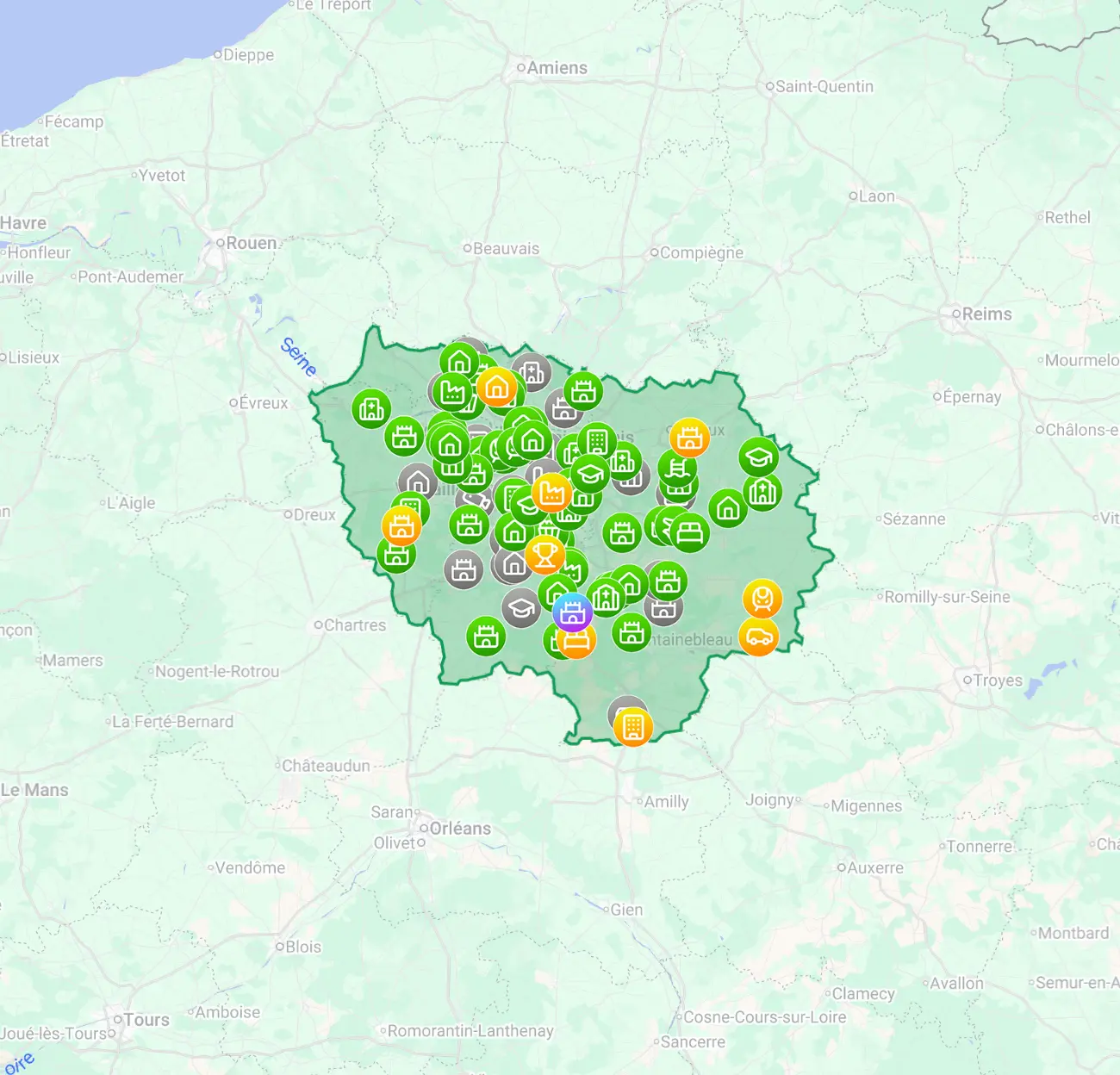
What is the best way to do urbex in Paris and Île-de-France?
The best approach to urbex in Paris and Île-de-France is to plan by department, use verified and updated sources, avoid random coordinates from social media, and prioritize lawful access, safety, and preservation. In practice, that means comparing departments 75, 77, 78, 91, 92, 93, 94, and 95, checking site status before any trip, and never forcing entry.
Quick summary
- Paris urbex is usually more complex than suburban or outer-ring exploration because access pressure is higher and site turnover is faster.
- Île-de-France offers varied site types, from industrial relics and estates to hospitals, military traces, and transport infrastructure.
- The most searched departments are 75, 77, 78, 91, 92, 93, 94, and 95 because they cover both central and peripheral zones near Paris.
- A verified map is more useful than scattered forum posts because conditions change quickly in the Paris region.
- Responsible urbex means no trespassing, no forced access, no vandalism, and no publication that increases site degradation.
- MapUrbex focuses on curated, preservation-first location research rather than sensational spot sharing.
Quick facts
- Region covered: Île-de-France
- Departments in this guide: Paris 75, Seine-et-Marne 77, Yvelines 78, Essonne 91, Hauts-de-Seine 92, Seine-Saint-Denis 93, Val-de-Marne 94, Val-d'Oise 95
- Primary search intent: finding abandoned places near Paris with a practical planning framework
- Best use case: comparing departments before choosing a day trip
- Recommended method: verified map + recent checks + responsible on-site behavior
- Safety reminder: only enter where access is lawful and conditions are safe
Why do people search for urbex in Paris and the Paris region?
People search for urbex Paris and urbex Paris region because Île-de-France concentrates many layers of history in a relatively small area. Old factories, disused institutional buildings, forgotten estates, tunnels, railway heritage, and peri-urban ruins all exist within reach of Paris.
Another reason is logistics. Many explorers want a day trip without leaving the capital region. That makes queries like abandoned places Île-de-France, urbex 75 77 78 91 92 93 94 95, and Paris urbex guide especially common.
The challenge is that visibility does not equal stability. A place that was accessible six months ago may now be secured, renovated, demolished, or occupied. That is why a current research workflow matters more here than in slower-changing regions.
Which departments matter most for urbex in Île-de-France?
The key departments for urbex in Île-de-France are 75, 77, 78, 91, 92, 93, 94, and 95 because together they cover the full range of central urban heritage, industrial belts, suburban transitions, and outer-ring abandoned sites near Paris.
| Department | Area | Typical urbex profile | Why people search it |
|---|---|---|---|
| 75 | Paris | Rare, high-pressure urban sites | Prestige, proximity, historic interest |
| 77 | Seine-et-Marne | Large rural and semi-rural sites | Space, variety, easier day trips by car |
| 78 | Yvelines | Estates, military traces, institutions | Strong heritage mix west of Paris |
| 91 | Essonne | Industrial edges, technical sites, fringe zones | Accessible south of Paris |
| 92 | Hauts-de-Seine | Dense urban remains, small hidden sites | Near-central convenience |
| 93 | Seine-Saint-Denis | Industrial heritage, warehouses, infrastructure | Major historical industrial belt |
| 94 | Val-de-Marne | Hospitals, depots, suburban relics | Practical access east and southeast |
| 95 | Val-d'Oise | Forts, rural edges, scattered complexes | Good diversity north of Paris |
Where can you find urbex around Paris by department?
You can find urbex around Paris by thinking in department profiles rather than by chasing a single viral place. Each department has its own building stock, transport logic, redevelopment pace, and risk level.
Paris 75
Paris itself is the most famous and often the most misunderstood urbex target. The city has strong historical appeal, but truly viable abandoned places are limited, unstable, quickly secured, or heavily exposed online.
For most people, Paris is better treated as a research base than as the only destination. If your goal is variety, the wider region often offers better conditions than the city center.
Seine-et-Marne 77
Seine-et-Marne is one of the most searched areas for abandoned places near Paris because it combines distance from the core with large surface area. Explorers often associate 77 with estates, industrial shells, agricultural relics, and larger compounds.
It is attractive for day trips because the department offers scale. Distances are longer, but the range of site types is often broader than in inner suburbs.
Yvelines 78
Yvelines stands out for historic estates, institutional buildings, technical heritage, and former military environments. The western side of the region often attracts people looking for a stronger architectural atmosphere.
This department can be especially interesting for photographers who prefer exterior ambience, landscapes, and history-heavy settings rather than purely industrial decay.
Essonne 91
Essonne often appears in searches for urbex region parisienne because it mixes suburban belts with industrial and technical zones. It sits in a useful position for explorers coming from southern Paris.
The department is best understood as a transition space. You may see less iconic imagery than in Paris itself, but often more practical exploration opportunities across a wider perimeter.
Hauts-de-Seine 92
Hauts-de-Seine is densely built and close to Paris, so abandoned places here are usually smaller, more discreet, and more vulnerable to redevelopment. That makes good information especially important.
It is relevant for convenience, not abundance. People search 92 because they want short travel times from central Paris, but site turnover can be very fast.
Seine-Saint-Denis 93
Seine-Saint-Denis is central to the industrial history of the Paris region. Old warehouses, production sites, depots, and infrastructure-related remains explain why this department appears frequently in urban exploration searches.
It is also one of the departments where exposure can damage places quickly. Preservation-first behavior matters here because fragile industrial heritage disappears fast once over-shared.
Val-de-Marne 94
Val-de-Marne is often searched for practical suburban urbex. Its profile includes institutional remains, logistics-related spaces, old workshops, and scattered urban relics.
Because it sits close to Paris while still offering broader suburban fabric, it is useful for short outings. The trade-off is that closures and repurposing can happen quickly.
Val-d'Oise 95
Val-d'Oise attracts explorers looking for more spread-out environments north of Paris. The department is associated with rural edges, forts, former institutions, and larger isolated complexes.
For many people, 95 offers one of the better balances between heritage atmosphere and distance from the densest redevelopment pressure of inner Paris.
How should you prepare a responsible urbex outing in Île-de-France?
A responsible urbex outing in Île-de-France starts with verification, not with movement. In a region where closures are frequent, pre-trip research saves time and reduces risky decisions.
Use this checklist:
- Check whether the place still exists and whether its status has changed.
- Prefer verified map sources over old screenshots or reposted reels.
- Review transport, daylight, weather, and surrounding context.
- Do not force entry, climb unsafe structures, or enter clearly restricted zones.
- Avoid going alone in unstable environments.
- Leave no trace and do not publish details that accelerate vandalism or theft.
A legal reminder is important here: urban exploration does not override property rights, access rules, or safety restrictions. Responsible urbex always means respecting the law, the site, and your own limits.
Why is a verified urbex map better than random social media posts?
A verified urbex map is better because it gives structure, context, and filtering. Random posts usually show aesthetics, not current status, safety concerns, or regional coverage.
In Île-de-France, this difference matters because the turnover of abandoned places is high. A place may be demolished, sealed, repurposed, or monitored shortly after it appears online.
Map-based planning helps you compare sectors and prioritize your time. If you want a starting point, you can Access the free urbex map or Browse all urbex maps.
If you want a dedicated regional resource, see Urbex locations in Île-de-France. For additional reading, Île-de-France Urbex Map: 30 Verified Abandoned Places Near Paris, Top 10 Abandoned Places in Île-de-France for Responsible Urbex, and Free Urbex Map: Download the Updated PDF and Google Maps Version provide more context.
Access the free urbex map
Which MapUrbex resources help you plan faster?
The fastest planning workflow is to start broad, then narrow down. That means first reviewing the region, then focusing on one department, then validating shortlists before travel.
A simple sequence is:
- Start with Browse all urbex maps.
- Open the regional product page for Urbex locations in Île-de-France.
- Read Île-de-France Urbex Map: 30 Verified Abandoned Places Near Paris for an overview.
- Compare with Top 10 Abandoned Places in Île-de-France for Responsible Urbex.
- Keep Free Urbex Map: Download the Updated PDF and Google Maps Version as your entry-level resource.
This approach is especially useful if you are choosing between Paris itself and the wider region.
FAQ
Is urbex in Paris legal?
Urban exploration is not automatically legal. Access depends on property rights, restrictions, and site status. You should never trespass, force entry, or ignore safety barriers.
Which department is best for abandoned places near Paris?
There is no single best department for everyone. Paris 75 has prestige, 77 has scale, 78 has heritage appeal, 93 has industrial history, and 95 often offers strong variety north of the capital.
Is Paris itself better than the suburbs for urbex?
Usually not. Paris is more famous, but the suburbs and outer departments often offer more variety and more realistic planning options.
Do I need a paid map to plan urbex in Île-de-France?
Not always. A free map is a useful starting point, but a dedicated regional map can save time if you want a more curated and structured overview.
Why do people search for urbex 75 77 78 91 92 93 94 95?
Because those department codes cover the main urban and suburban zones around Paris. They are a practical way to search by area when comparing travel time, heritage type, and density of abandoned sites.
Conclusion
Urbex in Paris and Île-de-France is best approached as a regional project, not just a Paris city search. The strongest strategy is to compare departments, use verified resources, and stay flexible because site conditions change fast.
If you want better planning and fewer dead ends, rely on curated information, preserve fragile places, and keep legality and safety at the center of every outing.
Access the free urbex map
