 MapUrbex
A practical guide to urbex in New York, including well-known abandoned places, legal realities, safety limits, and smarter research methods.
Urbex in New York: 5 Abandoned Places, Rules, and Research Tips
New York is one of the most searched cities for urban exploration. The reason is simple: few places combine industrial ruins, island institutions, hospital remains, and transport history at the same scale.
At the same time, urbex in New York is often misunderstood. Many famous abandoned buildings in New York are fenced, protected, unstable, or illegal to enter, so the real skill is not forcing access. It is knowing which places matter, how to document them responsibly, and how to research them with verified sources.
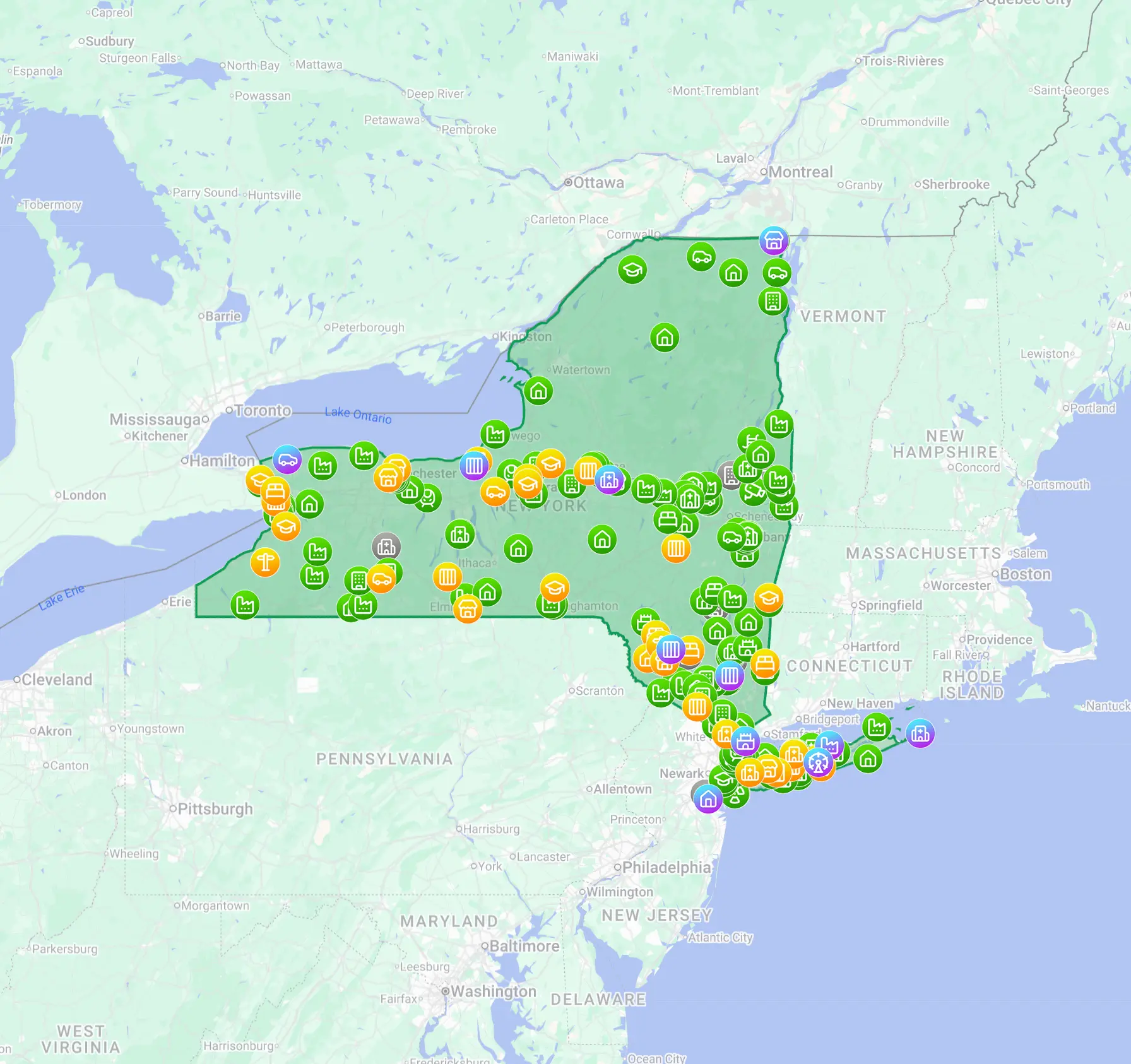
Where can you actually do urbex in New York?
Urbex in New York is mostly about researching industrial waterfronts, abandoned hospitals, island ruins, and forgotten institutional sites rather than casually entering sealed buildings. Most headline locations are restricted, unsafe, or both. The responsible approach is to focus on verified information, legal viewpoints, official tours where available, and exterior documentation that does not require trespassing.
Quick summary
- New York has a strong urbex culture because of its industrial, medical, maritime, and transport history.
- Most famous abandoned places in New York are not legal open-entry sites.
- North Brother Island, Red Hook Grain Terminal, Roosevelt Island's Smallpox Hospital, Ellis Island Hospital, and Staten Island ruins are key reference points.
- The best New York urbex research combines archival work, current access checks, and on-site legal awareness.
- Responsible exploration means no forced entry, no damage, and no interference with protected or active property.
- MapUrbex focuses on verified locations, curated maps, and preservation-first documentation.
Quick facts
- City: New York City, United States
- Primary keyword: urbex in New York
- Common site types: industrial structures, hospitals, island institutions, transport remnants, waterfront infrastructure
- Main challenge: many abandoned buildings in New York are fenced, monitored, landmarked, or structurally unsafe
- Best approach: prioritize legal observation points, historical research, and verified map data
- MapUrbex position: curated maps, responsible urbex, and preservation-first guidance
Why is New York such a major urbex city?
New York is a major urbex city because it accumulated more than a century of dense infrastructure, immigration facilities, medical campuses, warehouses, docks, and military or institutional sites. When parts of that system closed, it left behind layers of abandoned architecture rather than one single industrial district.
That variety is what makes exploration urbaine in New York so distinctive. In one metro area, you can study quarantine islands, grain terminals, ruined hospitals, shoreline infrastructure, and former welfare institutions. Many of these places also changed quickly due to redevelopment, demolition, or security upgrades, which is why old location lists become outdated fast.
If you want a broader starting point for curated research, Browse all urbex maps to compare regions and site types before narrowing your New York search.
Which abandoned places define urbex in New York today?
The best-known abandoned places in New York are North Brother Island, Red Hook Grain Terminal, Roosevelt Island's Smallpox Hospital ruins, Ellis Island Hospital, and Staten Island's Seaview and Farm Colony remains. These are important because they represent the city's medical, maritime, industrial, and institutional history, even though their legal access situations are very different.
1. North Brother Island
North Brother Island is one of the most iconic abandoned places associated with New York urbex. Located in the East River between the Bronx and Rikers Island, it once housed Riverside Hospital, a quarantine facility later used for other medical and rehabilitation functions.
Today, the island is closed to the public and protected for environmental reasons as well as safety. For researchers, it matters less as an entry target and more as a benchmark site in the history of abandoned hospitals in New York.
Its reputation comes from isolation, dense overgrowth, and the remains of multiple institutional buildings. Because of those conditions, it is a strong example of why responsible urbex in New York starts with legality and preservation, not access attempts.
2. Red Hook Grain Terminal
The Red Hook Grain Terminal is one of the most recognizable industrial ruins in Brooklyn. The massive concrete structure on the waterfront became a symbol of post-industrial New York and is often cited in discussions about abandoned buildings in New York.
What makes it important is scale. It shows how port logistics, grain handling, and shipping infrastructure once shaped the harbor. Even from a distance, it is an unusually clear case study in industrial decline and waterfront transformation.
It is also a reminder that visual fame does not equal public access. The site has long been associated with private property concerns, hazards, and changing redevelopment pressures, so it should be treated as a research and exterior-observation subject rather than a casual entry spot.
3. The Smallpox Hospital ruins on Roosevelt Island
The Smallpox Hospital ruins on Roosevelt Island are one of the easiest abandoned landmarks in New York to understand from a legal and historical perspective. The ruins, also known as the Renwick Ruin, are visible from public paths and can be appreciated without crossing barriers.
This site matters because it combines abandonment, preservation, and public interpretation. Built in the nineteenth century, it is one of the city's most recognizable medical ruins and a rare example of an abandoned structure that can still be documented responsibly from legitimate public access points.
For many people, this is the clearest example of how New York urbex does not always mean entry. Exterior-only study can still be historically rich, visually strong, and fully aligned with preservation-first practice.
4. Ellis Island Hospital Complex
The Ellis Island Hospital Complex is one of the most significant abandoned medical sites in the New York area. It served immigrants who needed treatment or medical inspection and later stood empty for decades, creating one of the region's best-known hospital ruins.
Its importance goes beyond aesthetics. The complex documents immigration policy, public health history, and adaptive reuse debates. That makes it unusually valuable for photographers, historians, and urbex researchers alike.
Unlike many hidden spots urbex communities talk about, Ellis Island is also a useful example of legal access through structured visits. When official hard-hat or guided access is available, it shows the ideal balance between documentation, education, and site protection.
5. Seaview Hospital and the Farm Colony ruins
Staten Island's Seaview Hospital area and the Farm Colony ruins are among the most discussed abandoned institutional landscapes in New York City. These sites reflect former tuberculosis treatment, welfare infrastructure, and the broader history of public institutions built away from Manhattan's core.
What makes them notable is the campus scale. Instead of one isolated building, the area historically contained multiple structures with different uses, which is why it appears so often in lists of New York urbex spots.
Access conditions vary, and parts of the broader landscape have been managed, preserved, redeveloped, or fenced over time. That makes current verification essential. It is exactly the kind of place where old urbex claims can be inaccurate if they are not checked against recent information.
| Site | Area | Type | Why it matters | Access reality |
|---|---|---|---|---|
| North Brother Island | East River | Quarantine hospital island | Iconic abandoned medical landscape | Closed and protected |
| Red Hook Grain Terminal | Brooklyn waterfront | Industrial grain facility | Major post-industrial ruin | Restricted and hazardous |
| Smallpox Hospital ruins | Roosevelt Island | Historic medical ruin | Best known exterior-view site | Viewable from public areas |
| Ellis Island Hospital | New York Harbor | Hospital complex | Historic immigration and medical site | Sometimes accessible through official tours |
| Seaview and Farm Colony | Staten Island | Institutional campus ruins | Large-scale welfare and medical history | Conditions vary and must be verified |
How can you find abandoned places in New York without relying on random pins?
The most reliable way to find abandoned places in New York is to combine old records, current property context, and recent access verification instead of depending on recycled social media coordinates. New York changes fast, so a location that was open years ago may now be secured, demolished, or actively reused.
A strong research workflow starts with historical maps, public imagery, permit history, and local reporting. For a systematic breakdown, read Tools to Find Abandoned Places: Best Urbex Research Tools and Maps.
The next step is filtering for reality. Ask whether the building still exists, whether it is active, whether legal exterior observation is possible, and whether your information is recent. For deeper methods, see How to Find Secret Urbex Places: Real Methods Explained.
Access the free urbex map
What rules matter most for urban exploration in New York?
The most important rule for urban exploration in New York is simple: if access requires trespassing, bypassing security, damaging a barrier, or entering an unsafe structure, do not do it. New York sites often involve private property, active redevelopment zones, landmark restrictions, transit infrastructure, or serious structural hazards.
A practical safety and legal checklist includes:
- Do not force doors, climb fences, or bypass locks.
- Do not enter active rail, subway, tunnel, bridge, or utility infrastructure.
- Do not assume an abandoned appearance means public access.
- Do not remove objects, disturb wildlife, or damage historic fabric.
- Do verify whether the site is protected, managed, or part of a legal tour program.
For a focused city-level breakdown, read Urbex in New York: Hidden Abandoned Spots, Rules, and Safety Guide. That article is useful if you want rules and site context in one place.
Which New York spots are best for responsible exterior-only documentation?
The best New York urbex spots for responsible exterior-only documentation are protected ruins, visible waterfront industrial sites, and locations with legal public sightlines. In practice, that means places like the Smallpox Hospital ruins, harbor-side industrial landmarks, and officially interpreted historical complexes.
This approach is often better than chasing secret entry points. You get cleaner documentation, better historical context, and lower risk. It also respects the preservation-first principle that matters in a city where abandoned structures are often fragile, monitored, or politically sensitive.
For many researchers, the goal is not entry but evidence: architecture, layout, context, timeline, and current status. That is a more durable method than treating New York urbex as a hunt for unsafe access.
When is a New York urbex location worth adding to your map?
A New York urbex location is worth adding to your map when it is historically meaningful, currently verifiable, and documentable without encouraging illegal entry. Good mapping is not about collecting the most pins. It is about filtering for reliable, responsible information.
Use these criteria before saving a spot:
- The place still exists in its current form.
- The abandonment or partial abandonment is verifiable.
- The legal status is clear enough to avoid risky assumptions.
- There is some legitimate way to study, view, or document the site.
- The location adds historical or typological value to your map.
If you want a broader curated database beyond this city guide, Browse all urbex maps to compare New York with other U.S. regions and research styles.
FAQ
Is urbex legal in New York?
Urbex is not automatically legal in New York. The key issue is access, not appearance. If a site is on private property, secured, or closed to the public, entry can become trespassing very quickly.
Are there still real abandoned buildings in New York City?
Yes, but they are less straightforward than online lists suggest. Some are protected ruins, some are in redevelopment, and some are visible only from a distance. The number of truly untouched, openly accessible sites is very small.
What is the safest kind of New York urbex location for beginners?
The safest starting point is a site that can be viewed legally from public space or through an official tour. Roosevelt Island's Smallpox Hospital ruins and Ellis Island's structured access model are good examples. They offer strong historical value without encouraging risky behavior.
How do researchers verify a New York site before visiting?
They compare multiple recent sources. That usually includes current aerial imagery, street-level context, local news, property clues, and recent community reports. If the information is old or contradictory, the site should not be treated as reliable.
Can you legally enter any abandoned hospital in New York?
Usually, no. Most abandoned hospital sites in New York are restricted, unsafe, preserved, or tightly managed. Legal access tends to exist only through official tours, permissions, or clearly public exterior areas.
Conclusion
Urbex in New York is real, but it rarely works the way viral lists imply. The city's best-known abandoned places are historically important and visually powerful, yet many are closed, protected, or only appropriate for exterior study.
The smartest way to approach New York is to treat it as a research-heavy urbex city. Verify the site, respect legal limits, protect the location, and use curated tools instead of rumor-based coordinates.
Browse all urbex maps
