 MapUrbex
Use a Spain urbex map to understand the country's abandoned hotels, ghost developments, industrial ruins, and depopulated villages. This guide explains where to look, which site types appear most often, and how to plan responsibly.
Spain Urbex Map: Complete Guide to Abandoned Places in Spain
Spain has one of the most varied abandoned landscapes in Europe. A single countrywide map can include unfinished seaside resorts, empty housing developments, industrial ruins, military remains, and depopulated villages.
That is why a Spain urbex map is useful. It helps you see national patterns, compare regions, and plan responsibly instead of relying on random coordinates or outdated social posts.
Where can you find a reliable urbex map of Spain?
You can find a reliable urbex map of Spain on MapUrbex, where locations are curated for planning, historical context, and responsible exploration. A good Spain urbex map should help you identify site types, regional clusters, and access status without pushing risky or illegal entry. It is a research tool first, not an invitation to trespass.
Quick summary
- Spain's abandoned places reflect several different stories: mass tourism, rural depopulation, industrial decline, and the post-2008 property crash.
- The most common entries on a Spain urbex map are resort projects, ghost developments, factories, mines, and abandoned villages.
- Andalusia, Aragón, the Mediterranean coast, interior Castile, and the industrial north are the main regions to study.
- Many famous places in Spain are visible from public land, but visibility does not mean legal access.
- A reliable map is most useful for research, routing, and context, not for risky last-minute entry attempts.
- MapUrbex focuses on verified locations, preservation-first planning, and responsible urbex practice.
Quick facts about urbex in Spain
- Country: Spain
- Main site types: hotels, resort projects, housing developments, villages, factories, mines, rail infrastructure, military remains
- Best-known contexts: housing bubble, coastal overdevelopment, rural depopulation, industrial restructuring, war heritage
- Typical terrain: coastlines, dry inland plateaus, mountain regions, former industrial belts
- Best use of a map: route planning, context research, access checks, regional comparison
- Safety note: site status varies widely, and many locations are private, protected, or structurally unsafe
Why does Spain have so many abandoned places?
Spain has many abandoned places because several historical and economic waves left built environments behind. The main causes are rural depopulation, industrial change, speculative construction during the property boom, and high-profile coastal projects stopped by finance or legal disputes.
The result is unusually diverse. In one itinerary, you might move from an unfinished hotel on the Mediterranean coast to a disused mine in the north or a shrinking village in the interior. That variety is what makes a map of abandoned places in Spain especially useful.
| Driver | What it left behind | Typical areas |
|---|---|---|
| Rural depopulation | Empty hamlets, schools, farm buildings | Interior Spain, Aragón, Castile |
| Property boom and crash | Unfinished suburbs, empty apartment blocks, stalled projects | Mediterranean coast, Castilla-La Mancha, outskirts of growing cities |
| Industrial decline | Mines, factories, depots, rail sites | Asturias, northern industrial corridors, older extraction zones |
| Coastal overdevelopment | Hotels, leisure complexes, resort shells | Andalusia, Valencian coast, other tourism corridors |
| War and military history | Bunkers, batteries, damaged settlements, training remains | Aragón, coastal defenses, strategic routes |
What kinds of abandoned places appear most often on a Spain urbex map?
The most common entries on a Spain urbex map are stalled resort projects, housing-bubble developments, industrial remnants, depopulated villages, and military remains. These categories explain most of the abandoned landscape that attracts urbex research in Spain.
1. Coastal hotel and resort projects
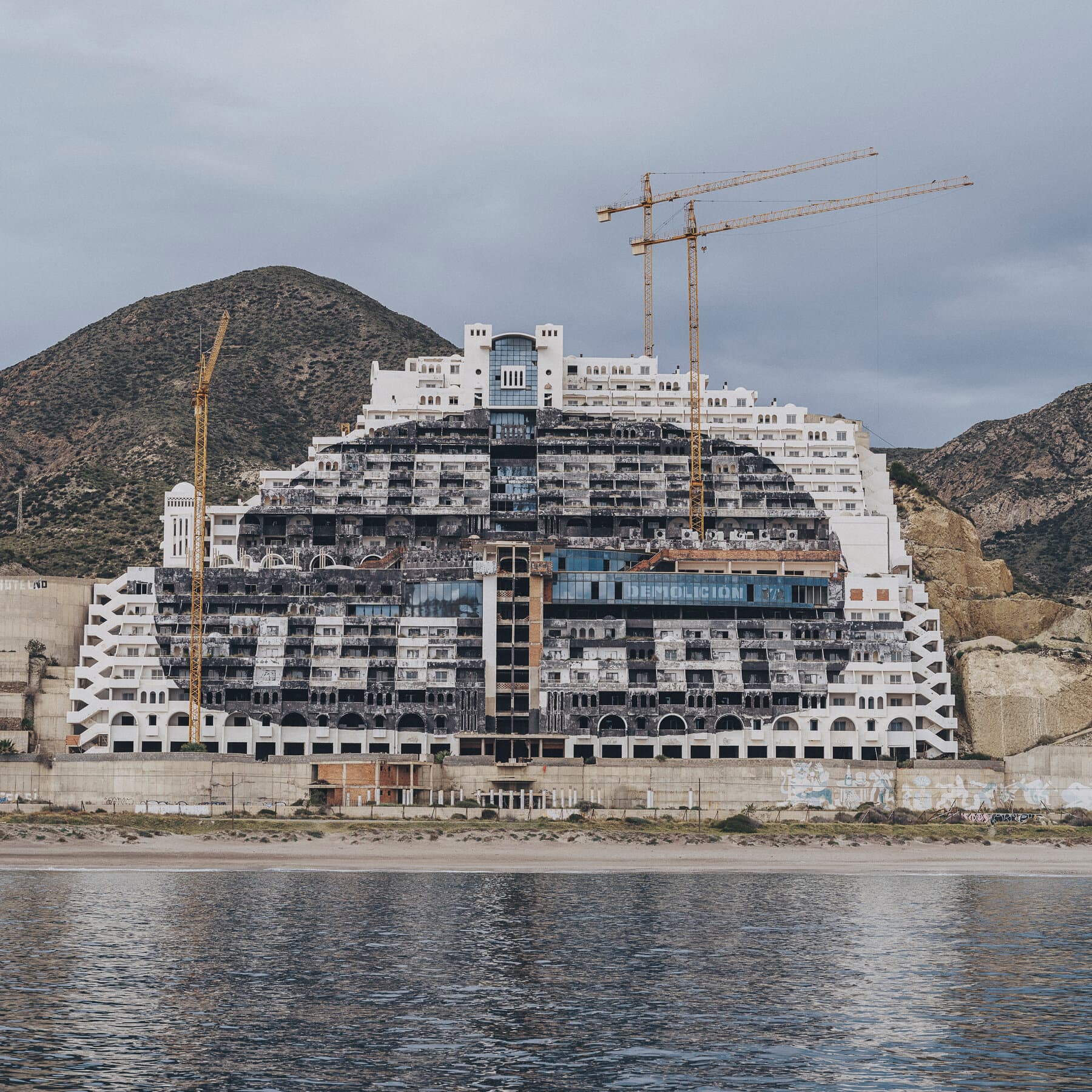
Spain's coastline includes some of its most visible abandoned structures. These are often large hotel shells, incomplete apartment complexes, or leisure projects halted by legal disputes, environmental controls, or financial collapse.
The best-known example is the abandoned Hotel El Algarrobico in Andalusia, which became a national symbol of overdevelopment on the coast. Large coastal sites are often easy to see from public viewpoints, but that visibility does not mean entry is allowed or safe.
2. Ghost suburbs and housing-bubble developments
The 2008 property crash left unfinished or underused developments across parts of Spain. On an urbex map, these places often appear as empty streets, skeletal apartment blocks, or near-complete neighborhoods that never became fully inhabited.
This is the context behind many Spanish ghost developments. For background, see Ghost Towns in Spain: What the Housing Bubble Left Behind. The most useful way to study them is usually as evidence of an economic cycle, not as a shortcut to illegal access.
3. Mines, factories, and rail infrastructure
Industrial abandonment is especially important in the north and in older mining belts. Former mines, workshops, silos, depots, and rail yards show how Spain's economic geography changed during the twentieth century.
These sites can be extremely hazardous. Shafts, asbestos, broken flooring, unstable roofs, and unsecured machinery are common risks. A map is valuable here because it helps you research context and legal viewing options before you travel.
4. Rural villages and depopulated hamlets
Large parts of interior Spain experienced long-term rural depopulation. The result is a scattered landscape of semi-abandoned hamlets, empty schools, closed churches, and collapsing farm buildings.
These places are historically rich but sensitive. Some still have seasonal residents, active owners, or partial use. A curated map helps distinguish heritage interest from assumptions about public access.
5. Military and civil-war remains
Spain also has bunkers, batteries, training areas, and civil-war ruins. Some are protected heritage sites, some are fenced, and some can only be viewed legally from outside.
The ruins of Belchite are a well-known example, but they are better understood as a managed historical site than as an informal urbex destination. In Spain, historical significance often matters as much as abandonment.
Which regions stand out most on a map of abandoned places in Spain?
Andalusia, the Mediterranean coast, Aragón, parts of interior Castile, and several northern industrial areas stand out most on a map of abandoned places in Spain. Each region reflects a different story: overbuilt tourism, rural depopulation, industrial decline, or conflict heritage.
Andalusia
Andalusia combines rural ruins, coastal megaprojects, and isolated infrastructure. The region is especially useful if you want to understand how tourism development and environmental regulation collided.
Hotel El Algarrobico is the clearest symbol, but the wider pattern matters more than a single site. Many locations here are best approached as landscape research from legal viewpoints.
Aragón
Aragón is one of Spain's key areas for depopulated settlements and war-related remains. Its geography makes abandonment highly visible, especially in small villages and strategic corridors.
Belchite gives the region international recognition, but many lesser-known places are better understood as heritage landscapes rather than entry-focused targets. Access rules vary widely.
Catalonia and the Valencian coast
Catalonia and the Valencian coast show the contrast between dense urban development and unfinished projects. You can find closed leisure sites, industrial remnants, and construction-era leftovers within relatively short travel distances.
This region is useful for route planning because several site types can appear in one trip. If you are building a multi-country itinerary, How to Plan an Urbex Road Trip in Europe gives a practical framework.
Asturias and the industrial north
Asturias and neighboring northern regions are important for mining and industrial history. Old extraction zones, transport lines, and heavy-industry sites create some of Spain's most atmospheric abandoned landscapes.
Conditions can be severe because moisture accelerates decay. In the north, external observation and careful research are often more valuable than ambitious exploration plans.
Interior Castile and other depopulated areas
Interior Spain contains many small, overlooked abandoned places rather than only headline sites. These include farm complexes, schools, service buildings, and shrinking villages that lost population over decades.
A good map helps you see regional patterns instead of chasing one famous ruin. That wider view is often what makes a Spain urbex trip more meaningful.
How should you use a Spain urbex map responsibly?
You should use a Spain urbex map as a planning and research tool, not as a shortcut to illegal entry. In Spain, ownership, fencing, municipal rules, and heritage protections vary by site, so the responsible approach is to verify status, respect boundaries, and avoid any place that clearly forbids access.
Start with context. Learn whether a location is private property, an active heritage site, or a dangerous ruin. If you need a broader legal overview, read Urbex in Spain: Complete Guide to Abandoned Places and Exploration Rules.
Then think in preservation-first terms. Do not force doors, climb unstable structures, move objects, or share sensitive details that could increase vandalism. A verified map is most useful when it helps you filter for safer, more defensible visits, including public viewpoints and permission-based access.
How does MapUrbex help you plan better in Spain?
MapUrbex helps you plan better in Spain by organizing abandoned places into a curated, countrywide research tool. Instead of relying on scattered social posts, you can compare regions, identify site types, and prepare routes with more context and less guesswork.
That matters in a country as varied as Spain. A coastal hotel ruin, a mining complex, and a depopulated hamlet all require different expectations about access, season, hazards, and photographic value. MapUrbex is designed to support that distinction.
You can start with Browse all urbex maps to compare regions, then use the free option below for initial planning.
Access the free urbex map
FAQ
Is urbex legal in Spain?
Urbex is not automatically legal in Spain. Many abandoned sites are still private property, and some are protected heritage areas with specific access rules. Legal viewing from public space is very different from entering a restricted building.
What are the best-known abandoned places in Spain?
Some of the best-known examples include Hotel El Algarrobico, housing-bubble ghost developments, industrial ruins in the north, and depopulated villages in interior Spain. Belchite is also widely cited, although it is better understood as a managed historical site. Fame does not mean free access.
Are all ghost towns in Spain truly empty?
No. Some so-called ghost towns are unfinished developments, partially occupied neighborhoods, or places with seasonal activity. The label is useful for history, but it can be misleading for access planning.
When is the best season to use an urbex map in Spain?
Spring and autumn are usually the most practical seasons. Summer heat can be extreme, especially in inland and southern regions, while winter conditions can complicate travel in mountainous areas. Light and vegetation also change how visible sites are.
What should you bring for responsible site research in Spain?
Bring water, offline maps, charged communications, sun protection, and conservative footwear. If a site requires permission, get it in advance rather than improvising on arrival. Do not bring tools intended to bypass locks or barriers.
Conclusion
A good Spain urbex map is most useful when it explains patterns, not just points. Spain's abandoned places reflect tourism booms, rural decline, industrial change, and historical conflict, so the map becomes a way to understand the country as much as to plan a trip.
If you want a preservation-first starting point, use MapUrbex to research verified locations, compare regions, and build safer itineraries around legal access and context.
Access the free urbex map
