 MapUrbex
A reliable guide to 20 abandoned theme parks in the United States, from Six Flags New Orleans to Dogpatch USA, with history, status, and responsible urbex context.
20 Abandoned Theme Parks in the United States Worth Knowing
Abandoned theme parks in the United States sit at the crossroads of entertainment history, real-estate failure, weather disasters, and changing travel habits. Some still stand as visible ruins. Others survive mainly through photographs, local memory, or cleared grounds where a major attraction once operated.
This guide focuses on the best-known abandoned theme and amusement park sites across the country. It is written for research, historical interest, and responsible urbex awareness, not for trespassing or unsafe entry.
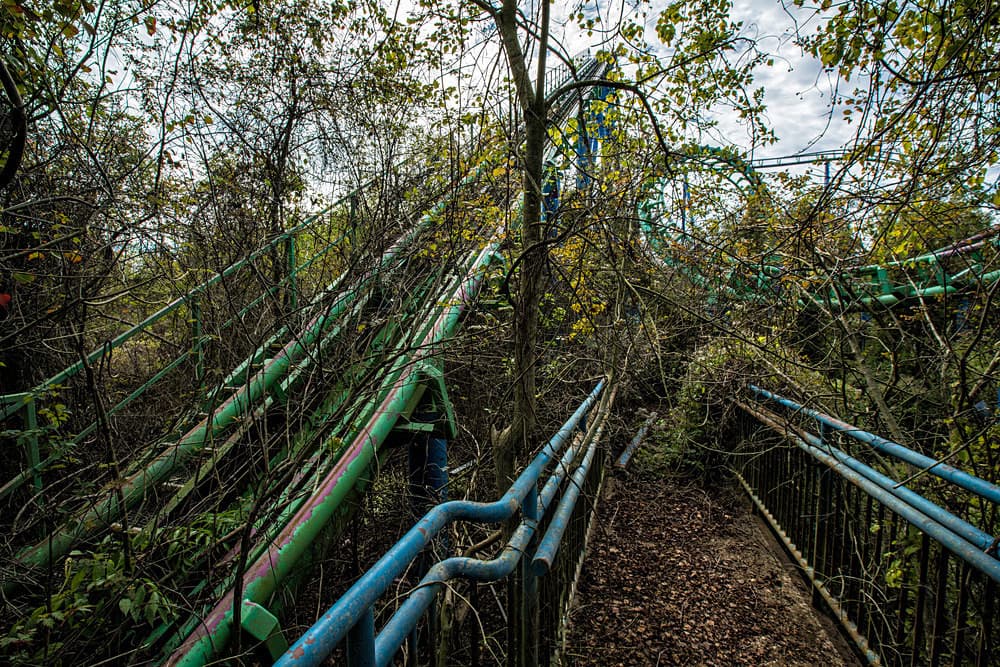
What are the most notable abandoned theme parks in the United States?
The most notable abandoned theme parks in the United States include Six Flags New Orleans, Dogpatch USA, Lake Shawnee Amusement Park, Ghost Town in the Sky, and Chippewa Lake Park. Together, these sites represent the full spectrum of abandoned leisure landscapes: standing ruins, partially preserved grounds, and historically important former parks that were later demolished or redeveloped.
Quick summary
- Six Flags New Orleans is the most famous abandoned amusement park site in the country.
- Some parks on this list still have visible remains, while others are historically important former sites.
- Closures often came from storm damage, insurance costs, debt, low attendance, or failed redevelopment.
- Many abandoned parks are private property, fenced, or structurally unsafe.
- The best approach is documentation, legal viewpoints, archival research, and verified mapping.
- MapUrbex prioritizes preservation-first research over risky access.
Quick facts
- Country: United States
- Topic: Abandoned theme parks and amusement parks
- Search intent: Informational reference
- Scope: Top 20 notable sites across multiple states
- Legal context: Many sites are private property or not open to the public
- Best use: History, photography from legal access, route research, and preservation context
If you want broader planning resources, start with Browse all urbex maps and compare them with national guides such as Top 10 Abandoned Places to Explore in the USA in 2025.
Access the free urbex map
Why do abandoned theme parks attract so much interest in the United States?
Abandoned theme parks attract so much interest because they compress spectacle and decline into one place. A roller coaster frame, empty midway, or flooded queue line makes economic failure instantly visible.
They also tell a wider American story. Many of these parks were tied to highway travel, suburban expansion, regional tourism, or optimistic real-estate development. When attendance fell or ownership changed, the parks became expensive liabilities with large footprints and limited reuse options.
For urbex readers, the appeal is usually visual and historical. For responsible researchers, the real value is documentation: what was built, why it failed, and what remains today.
Which parks belong on a reliable top-20 list?
A reliable top-20 list should include both iconic standing ruins and historically important former park sites. The list below favors parks that are widely documented, culturally recognizable, and relevant to the history of abandoned leisure spaces in the United States.
| Park | State | Current context |
|---|---|---|
| Six Flags New Orleans | Louisiana | Flood-damaged site with major remaining structures |
| Dogpatch USA | Arkansas | Closed Ozarks park with surviving buildings and long redevelopment interest |
| Lake Shawnee Amusement Park | West Virginia | Former amusement park now known for tours and local legend |
| Ghost Town in the Sky | North Carolina | Mountaintop western-themed park, closed with intermittent revival attempts |
| Chippewa Lake Park | Ohio | Historic park site, many features removed or lost over time |
| Joyland Amusement Park | Kansas | Long-abandoned Wichita park, later heavily damaged and demolished |
| Williams Grove Amusement Park | Pennsylvania | Closed park with years of visible ride abandonment |
| Old Indiana Fun Park | Indiana | Failed water and amusement park, notorious for decay and fires |
| Hard Rock Park / Freestyle Music Park | South Carolina | Major failed theme park project with partial reuse and redevelopment |
| Holy Land USA | Connecticut | Religious theme park site with abandonment and partial restoration history |
| Splendid China | Florida | Defunct Florida theme park, long abandoned before demolition |
| Geauga Lake | Ohio | Former amusement complex with long post-closure abandonment story |
| Americana Amusement Park | Ohio | Closed family park, abandoned rides later removed |
| Wild West World | Kansas | Short-lived western park project that quickly failed |
| Lincoln Park | Massachusetts | Historic New England park that stood abandoned before demolition |
| Rocky Point Park | Rhode Island | Legendary seaside park, now mostly remembered through archives and cleared land |
| Pacific Ocean Park | California | Classic demolished ruin of American amusement history |
| Boardwalk and Baseball | Florida | Former baseball-themed park left idle for years after closure |
| Opryland USA | Tennessee | Major Nashville theme park that closed and was demolished |
| Storybook Land | Ohio | Former children's park that became a well-known regional ruin |
1. Six Flags New Orleans, Louisiana
Six Flags New Orleans is the best-known abandoned amusement park in the United States. Built as Jazzland and later operated by Six Flags, it closed after Hurricane Katrina in 2005, when severe flood damage made reopening financially and logistically difficult.
Its rusting coaster frames and empty facades became a visual shorthand for post-disaster abandonment in America. The site is controlled private property and has been used for film production, so it should be understood as a documented ruin rather than a casual exploration stop.
2. Dogpatch USA, Arkansas
Dogpatch USA opened in the Ozarks as a hillbilly-themed park based on the Li'l Abner comic strip. It struggled with remote location issues, seasonal demand, and financial instability before finally closing in 1993.
The site remained one of the most discussed abandoned parks in the South because many structures survived for years. Its importance comes from how clearly it shows the risks of theme-based destination development in rural America.
3. Lake Shawnee Amusement Park, West Virginia
Lake Shawnee Amusement Park is one of the most unusual entries on this list because its afterlife became almost as famous as its operating years. The park closed in the 1960s after accidents and declining viability, and later gained a reputation through local ghost stories and media coverage.
Today, the site is better known as a heritage and paranormal tourism location than a pure abandoned park. That makes it a reminder that some abandoned leisure sites move from recreation to curated storytelling rather than simple decay.
4. Ghost Town in the Sky, North Carolina
Ghost Town in the Sky was a western-themed mountaintop park in Maggie Valley, North Carolina. Its scenic location gave it a strong identity, but access problems, high operating costs, and repeated financial trouble undermined long-term success.
The park closed, reopened in limited forms, and cycled through redevelopment plans for years. It remains one of the most recognizable abandoned theme park stories in the Appalachian region.
5. Chippewa Lake Park, Ohio
Chippewa Lake Park operated for more than a century, making it one of the most historically significant amusement park closures in the Midwest. It shut down in 1978 after attendance patterns changed and larger competitors drew visitors away.
For decades, the remaining rides and structures gave the site legendary status among abandoned-place researchers. Even though much has since been removed or lost, its legacy still shapes discussions of forgotten American amusement parks.
6. Joyland Amusement Park, Kansas
Joyland Amusement Park in Wichita was once a major regional family attraction. After closing in 2004, it sat vacant for years and became one of the most photographed abandoned amusement parks in the Great Plains.
Fire, vandalism, and neglect accelerated its destruction, and major remnants were eventually demolished. Joyland is important because it shows how quickly an abandoned park can move from intact decay to irreversible loss.
7. Williams Grove Amusement Park, Pennsylvania
Williams Grove Amusement Park near Mechanicsburg closed in 2005 and became widely known for its still-standing rides. In visual terms, it was one of the clearest examples of a classic American amusement park frozen in time.
That visibility also turned it into a cautionary example in urbex culture. The site is not a free-access playground, and its story is most useful as a case study in preservation, liability, and the limits of informal exploration.
8. Old Indiana Fun Park, Indiana
Old Indiana Fun Park was a large recreation complex in Thorntown, Indiana, combining water attractions and amusement rides. Financial failure, a chaotic ownership history, and later fires pushed it into long-term ruin.
The site became notorious not just for abandonment but for serious safety concerns. It is a strong example of why responsible abandoned-site research must start with legality and structural risk, not thrill-seeking.
9. Hard Rock Park / Freestyle Music Park, South Carolina
Hard Rock Park near Myrtle Beach was one of the most expensive theme park failures in modern American history. It opened in 2008, entered bankruptcy quickly, briefly returned as Freestyle Music Park, and then failed again.
Because the project was so recent and so ambitious, it became a symbol of overbuilt entertainment economics. Even where physical traces changed over time, its story remains essential to any serious list of abandoned theme parks in the United States.
10. Holy Land USA, Connecticut
Holy Land USA is not a conventional thrill-ride park, but it belongs in this conversation because it is one of the country's most recognizable abandoned religious theme park sites. Built around biblical scenes and devotional attractions, it declined and was left largely unused for years.
Its history is more complex than a simple ruin narrative because parts of the site have seen restoration and renewed visitation. Even so, it remains a key example of how abandoned themed environments can retain symbolic power long after closure.
11. Splendid China, Florida
Splendid China in Florida presented miniature and cultural displays inspired by Chinese landmarks and history. The park closed in 2003 after underperformance and controversy, then sat abandoned long enough to become famous in Florida urbex discussions.
Later demolition changed the physical site, but not its importance. It illustrates how a distinctive concept and a visible abandoned phase can keep a failed theme park relevant long after the buildings are gone.
12. Geauga Lake, Ohio
Geauga Lake was once one of the oldest amusement parks in the country and later expanded into a much larger regional resort complex. Closures came in stages, leaving portions of the property in a confusing post-park condition for years.
That long transition made Geauga Lake especially important in discussions of abandoned leisure landscapes. It shows that abandonment is often gradual, involving partial reuse, ride removal, and lingering infrastructure rather than one clean end point.
13. Americana Amusement Park, Ohio
Americana Amusement Park, formerly known as LeSourdsville Lake, was a long-running Ohio family park that closed in 1999. For years after closure, abandoned rides and empty grounds kept it visible in regional memory.
The park's appeal lay in its recognizable small-scale Americana atmosphere. Its decline also reflects a common pattern: local parks with loyal followings still struggled when capital investment and attendance no longer matched costs.
14. Wild West World, Kansas
Wild West World was a short-lived western-themed park project near Wichita. It failed almost immediately in 2007, making it less a decayed classic park than a striking case of entertainment overreach.
Its inclusion matters because abandoned theme parks are not always old. Some become notable precisely because they collapse so quickly, leaving behind unfinished branding, underused infrastructure, and a cautionary business story.
15. Lincoln Park, Massachusetts
Lincoln Park in North Dartmouth, Massachusetts, was a historic New England amusement park that closed in 1987. The Comet coaster and other remnants stood for years, making the site one of the most iconic former park ruins in the Northeast.
Although demolition changed the landscape, Lincoln Park remains important in amusement history. It is often cited when people discuss the emotional power of abandoned wooden coasters and lost regional parks.
16. Rocky Point Park, Rhode Island
Rocky Point Park was a beloved seaside destination in Rhode Island rather than a hidden ruin. After it closed in 1995, the empty site and fading memories of its rides gave it a major place in regional abandonment culture.
Most of the park no longer survives as a ruin, but its story still matters. It represents the difference between a park that is physically abandoned and a park that remains socially present through nostalgia, archives, and public memory.
17. Pacific Ocean Park, California
Pacific Ocean Park in Santa Monica closed in 1967 and was later demolished, but it still belongs on any serious historical list. Its decaying oceanfront structures became some of the most famous amusement-park ruin images in American visual culture.
The site shows that abandoned theme park history did not start with internet-era urbex. Long before digital photography, Pacific Ocean Park had already defined the look of a failed entertainment landscape.
18. Boardwalk and Baseball, Florida
Boardwalk and Baseball in Haines City combined amusement attractions with a baseball theme and spring training identity. It closed in 1990 and then spent years in a limbo state that fascinated both local historians and abandoned-place photographers.
Its story is useful because it links sports tourism, themed entertainment, and speculative development. Like several Florida sites, it demonstrates how quickly major leisure properties can move from optimism to vacancy.
19. Opryland USA, Tennessee
Opryland USA in Nashville was one of the highest-profile theme parks ever to close in the United States. It was not abandoned in the classic long-ruin sense for decades, but its closure and demolition turned it into a defining lost park of modern American entertainment history.
It belongs on this list because searchers often mean both abandoned parks and major vanished parks. Opryland is a benchmark example of how even successful, famous attractions can disappear when land value and corporate priorities change.
20. Storybook Land, Ohio
Storybook Land in Canton, Ohio, was a children's park that later slipped into abandonment and became a well-known regional ruin. Its fairy-tale theme made its decline especially striking because the decorative setting remained visible after operations ended.
That contrast between childhood imagery and decay explains why the park stayed memorable. Even modest abandoned parks can carry strong visual impact when the theming survives longer than the business model.
How should you research abandoned theme parks responsibly?
You should research abandoned theme parks responsibly by treating them as legal, historical, and preservation questions first. That means checking ownership, understanding whether any public access exists, and assuming that fences, closures, and unsafe structures are there for a reason.
Many of the parks above are private property, demolished, partially restored, or only visible from surrounding roads and public viewpoints. A responsible urbex approach favors archival work, mapped context, legal photography, and verified planning instead of forced entry.
For broader trip planning, compare Browse all urbex maps with current national reading such as Top 10 Abandoned Places in the USA to Explore in 2025 and Urbex Map USA 2026 (Flash Sale). MapUrbex is preservation-first: document what remains, respect closures, and do not damage sites.
Access the free urbex map
FAQ
Are abandoned theme parks legal to explore in the United States?
Not automatically. Many abandoned theme parks are private property, fenced, monitored, or structurally unsafe. Legal access varies by site, so you should verify ownership and public access before planning any visit.
What is the most famous abandoned amusement park in the United States?
Six Flags New Orleans is usually the most famous example. Its post-Katrina closure, large remaining structures, and frequent media appearances made it the best-known abandoned park site in the country.
Are all of these parks still standing today?
No. Some parks on this list still have visible remains, while others were largely demolished or redeveloped. They are included because they remain historically important in the broader story of abandoned American theme parks.
Why do so many American parks become abandoned?
The main causes are debt, weather damage, low attendance, rising insurance costs, competition, and redevelopment pressure. Large parks are expensive to maintain, and once they close, reuse is often slow and complicated.
What is the safest way to document a former theme park site?
The safest approach is legal observation from public space, historical research, and permission-based access when available. Some former parks host official tours or events, which is always preferable to entering a restricted property.
Conclusion
Abandoned theme parks in the United States are not all the same. Some are iconic standing ruins, some are partially revived sites, and some survive mainly through archives and collective memory. Taken together, they show how quickly entertainment landscapes can move from optimism to vacancy.
The best way to use this list is as a research tool. Study the history, verify the current status, and keep the focus on preservation-first documentation rather than risky access.
Browse all urbex maps
