 MapUrbex
A curated global list of 30 abandoned factories and industrial ruins that stand out in urbex galleries, with safety, legality, and preservation context.
Urbex Abandoned Factories: Top 30 Most Impressive Sites [Gallery]
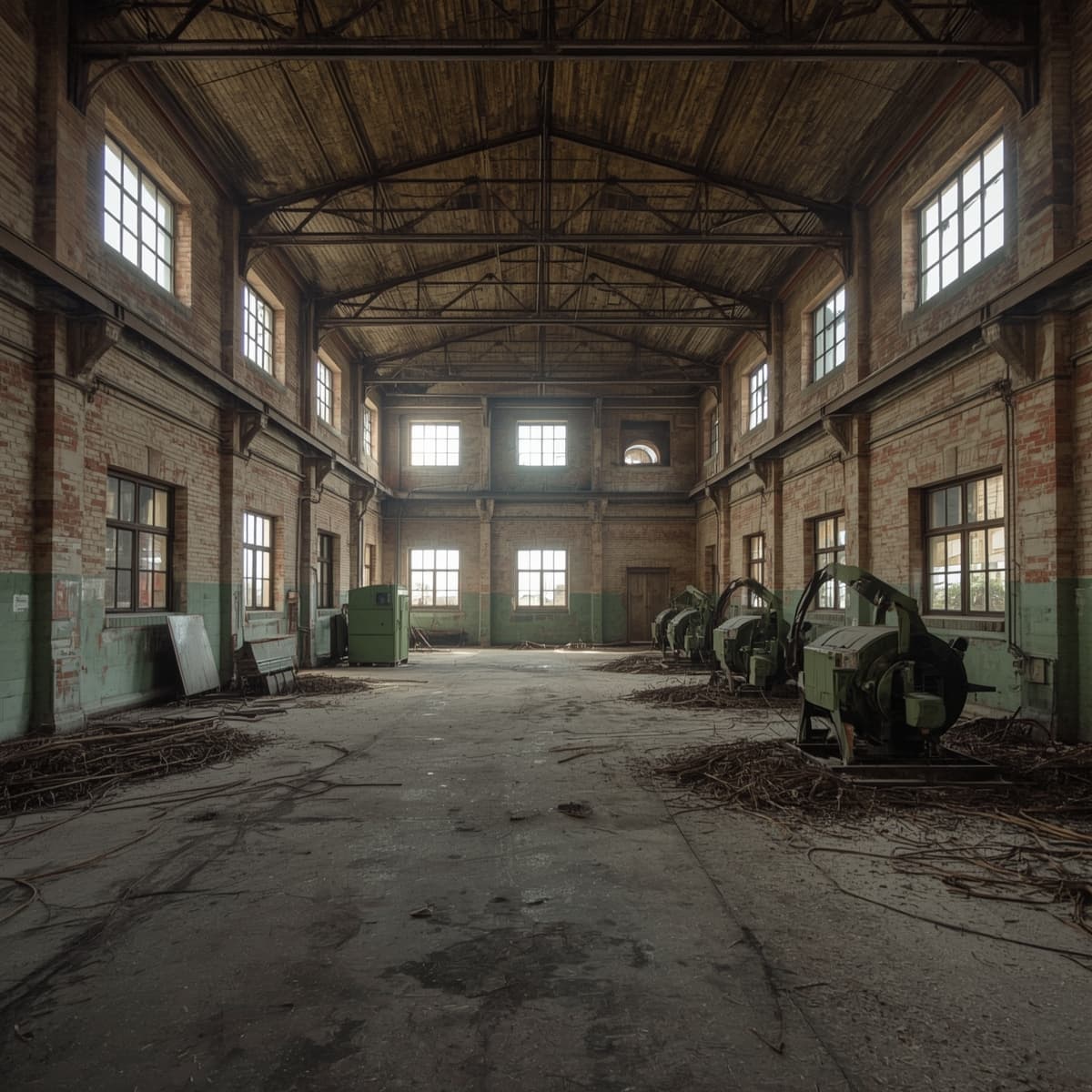
Abandoned factories sit at the core of industrial urbex. They combine scale, repeated geometry, broken light, and direct evidence of economic change.
They are also among the most sensitive places to document. Ownership, structural stability, and legal status change fast. A famous site in an old gallery may now be sealed, preserved, demolished, or actively redeveloped.
This guide is a curated global reference, not an access guide. MapUrbex recommends exterior observation, official tours when available, and a preservation-first approach.
What are the most impressive abandoned factories for urbex?
The most impressive abandoned factories for urbex are usually former automotive plants, textile mills, steelworks, power stations, and refineries with strong architecture and visible industrial layers. Worldwide, sites such as Packard, Kelenföld, Forges de Clabecq, Gunkanjima, and Filature Levavasseur stand out for scale, atmosphere, and documentary value, although legality and access conditions vary constantly.
Quick summary
- This list covers 30 globally known abandoned factories and industrial complexes often cited in urbex galleries.
- The most memorable sites tend to be automobile plants, textile mills, steelworks, and power stations.
- Many famous locations are no longer open, partly demolished, or only visible through guided heritage access.
- For research, the key filters are architecture, historical importance, current status, and safety.
- Responsible urbex never includes forced entry, vandalism, or publication of risky access tips.
- MapUrbex focuses on verified locations and curated maps rather than rumor-based spot sharing.
Quick facts
- Scope: global
- Format: top 30 list with industrial heritage context
- Best for: photography research, trip planning, and documentary reference
- Status note: conditions change quickly; verify legality and permission every time
- Safety note: industrial ruins can contain unstable floors, sharp metal, glass, asbestos, and vertical drops
Which abandoned factories appear most often in urbex galleries?
The sites below are the names that appear most consistently in abandoned factory discussions, industrial photography, and urbex galleries. They are listed for documentary interest, not as invitations to enter. Some are protected heritage sites, some are fenced, and some have already changed radically.
| Rank | Site | Country | Why it stands out |
|---|---|---|---|
| 1 | Packard Automotive Plant | United States | Vast auto complex and one of the most cited Detroit ruins |
| 2 | Fisher Body Plant 21 | United States | Repeated concrete floors and strong graphic lines |
| 3 | Bethlehem Steel | United States | Monumental blast furnaces, part heritage and part redevelopment |
| 4 | Carrie Furnaces | United States | Preserved ironmaking infrastructure with high heritage value |
| 5 | Silo City | United States | Cathedral-like scale, light, and industrial volumes |
| 6 | Domino Sugar Refinery | United States | Iconic former refinery remembered through major redevelopment |
| 7 | American Enka Rayon Plant | United States | Huge rayon works often cited in industrial documentation |
| 8 | Westinghouse Electric Complex | United States | Massive brick-and-steel manufacturing architecture |
| 9 | Huber Breaker | United States | Giant coal-processing site, now largely gone |
| 10 | Forges de Clabecq | Belgium | Classic European steelworks landscape for industrial urbex |
| 11 | IM Power Plant / Cooling Tower | Belgium | One of the best-known industrial images in urbex photography |
| 12 | Cokerie d'Anderlues | Belgium | Dense machinery and heavy coke-plant atmosphere |
| 13 | Filature Levavasseur | France | Riverside textile mill with striking open structure |
| 14 | Cotonificio Cantoni | Italy | Extensive textile remains and long brick halls |
| 15 | Ex-SNIA Viscosa | Italy | Former rayon factory tied to one of Rome's strangest ruins |
| 16 | Kelenföld Power Station | Hungary | Famous Art Deco control room and turbine halls |
| 17 | Völklinger Hütte | Germany | Former ironworks preserved as a major industrial monument |
| 18 | Brikettfabrik Louise | Germany | Former briquette factory valued for machinery preservation |
| 19 | Szombierki Power Station | Poland | Monumental power-plant architecture and long uncertain future |
| 20 | Temple Works | United Kingdom | Former flax mill known for its Egyptian-style facade |
| 21 | Hasard Cheratte | Belgium | Colliery complex often cited in European industrial urbex |
| 22 | Gunkanjima industrial facilities | Japan | Compressed concrete decay on a former mining island |
| 23 | Inujima Copper Refinery | Japan | Coastal refinery ruins with strong heritage interest |
| 24 | Shime Coal Mine | Japan | Distinctive concrete tower and former mining infrastructure |
| 25 | Red Triangle Factory | Russia | Vast former rubber factory with strong urban-industrial identity |
| 26 | Jupiter Factory | Ukraine | Former electronics plant often documented in post-Soviet ruin culture |
| 27 | Humberstone and Santa Laura Saltpeter Works | Chile | Desert industrial landscape preserved as heritage |
| 28 | Fordlandia industrial ruins | Brazil | Failed industrial experiment with scattered factory remains |
| 29 | Fray Bentos Anglo Plant | Uruguay | Former industrial complex of major world heritage interest |
| 30 | Wangi Power Station | Australia | Large former power station valued for raw scale |
Why do abandoned factories dominate urbex photography?
Abandoned factories dominate urbex photography because they offer size, rhythm, and material contrast in a single location. Long production halls, saw-tooth roofs, machine bases, and rusted infrastructure create images that are both documentary and architectural.
Common visual reasons include:
- repetitive windows and columns
- surviving machines or control rooms
- strong light beams and deep interiors
- visible traces of labor, logistics, and decline
How should you evaluate an abandoned factory before considering a visit?
You should evaluate an abandoned factory through four filters: legality, safety, current status, and documentary value. If any of the first three are unclear, the responsible choice is not to enter.
Use this checklist:
- Confirm whether the property is private, protected, active, or monitored.
- Check whether guided visits or exterior viewpoints exist.
- Avoid roofs, basements, shafts, tanks, and unsupported floors.
- Never force doors, cut fences, or climb unstable structures.
- Do not remove artifacts or disturb remaining machinery.
- Prefer daylight documentation and tell someone where you are going.
How does MapUrbex help you find industrial sites more responsibly?
MapUrbex helps by prioritizing verified locations, clear mapping, and preservation-first guidance. The goal is to replace rumor-based sharing with better research and safer planning.
You can Browse all urbex maps to compare regions and site types. If you prefer city-scale reading first, see Urbex Brussels: guide to abandoned places in and around Brussels, Urbex Strasbourg: 10 Abandoned Places to Know in Strasbourg and Nearby, and Urbex Toulouse: Best Abandoned Places In and Around Toulouse.
FAQ
Are abandoned factories always legal to visit?
No. Many are private property, protected heritage, active redevelopment zones, or explicitly closed to the public. Always verify ownership, permission, and local law first.
What makes a factory especially good for urbex photography?
The strongest sites combine scale, intact structure, historical texture, and safe legal ways to document them. Good light and surviving industrial details matter more than pure decay.
Are the most famous abandoned factories still accessible?
Often no. The best-known places change constantly. Some become museums, some are demolished, and some are sealed after accidents or vandalism.
Should beginners start with abandoned factories?
Usually not. Industrial sites are among the most hazardous urbex environments because of unstable floors, hidden drops, contamination, and complex layouts. Beginners should prefer legal heritage visits or simpler exterior documentation.
How does MapUrbex verify locations?
MapUrbex cross-checks site data, mapping, and recent status signals to reduce false leads. The emphasis is reliability, not sensationalism.
Conclusion
The best abandoned factories for urbex are not just visually dramatic. They are records of labor, technology, and economic change written into brick, steel, glass, and concrete.
That is why a useful ranking must include context, status, and responsibility. Spectacular galleries are easy to find; trustworthy, preservation-first information is harder. MapUrbex is built for that second need.
Access the free urbex map
