 MapUrbex
Explore a Centre-Val de Loire urbex map with 6 mysterious place types around Orléans and Tours, plus safety tips, verification advice, and responsible exploration rules.
Centre-Val de Loire Urbex Map: 6 Mysterious Places Around Orléans and Tours
The Centre-Val de Loire urbex map is usually searched by people who want a clear overview of abandoned places around Orléans, Tours, and the smaller towns between them. This region is especially varied. It combines industrial ruins, railway remains, empty institutions, rural manor houses, and forgotten religious sites.
For urbex, the hard part is not finding rumors. The real challenge is verifying whether a place still exists, whether it is legally accessible, and whether the structure is safe enough to approach without reckless behavior.
MapUrbex treats this topic as a reference subject, not a treasure hunt. The goal is to help readers work from verified locations, curated maps, and preservation-first habits. For a wider overview, you can Browse all urbex maps or read Centre-Val de Loire Urbex Map: Best Urbex Spots in the Region.
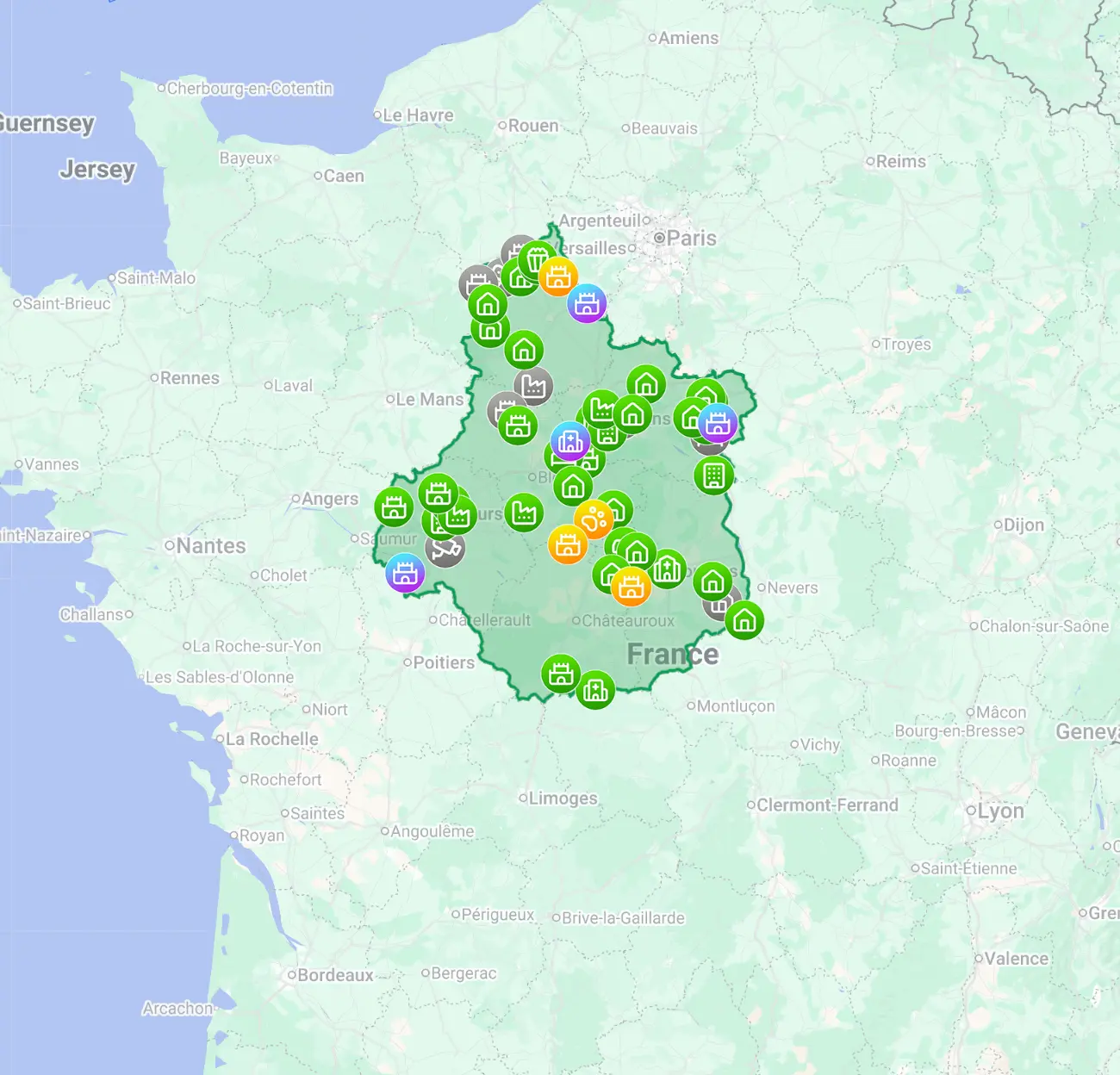
What does the Centre-Val de Loire urbex map include?
A Centre-Val de Loire urbex map usually includes a mix of industrial sites, abandoned institutions, railway remains, rural estates, and discreet buildings near Orléans and Tours. The most useful maps do not simply list rumors. They help users identify verified locations, filter fragile places, understand context, and plan responsible visits without exposing sensitive spots publicly.
Quick summary
- Centre-Val de Loire is one of the most varied French regions for urbex around Orléans, Tours, and nearby countryside.
- The most common site families are industrial ruins, rail infrastructure, closed institutions, religious buildings, manor houses, and small castles.
- A good Centre-Val de Loire urbex map is useful because site status changes fast.
- Public articles should explain patterns and risks, not publish exact entry points.
- Responsible urbex means no trespassing, no forced access, no theft, and no vandalism.
- MapUrbex focuses on verified locations, curated maps, and preservation-first exploration.
Quick facts
- Region covered: Centre-Val de Loire
- Main search cities: Orléans and Tours
- Typical site categories: industrial, railway, institutional, religious, rural heritage
- Best use of a map: verification before any trip
- Key rule: if access is illegal or unsafe, do not go in
- Helpful starter read: Abandoned Places Near Me: How to Find Urbex Spots Easily
Which 6 mysterious place types stand out on a Centre-Val de Loire urbex map?
The Centre-Val de Loire urbex map stands out for its diversity. Around Orléans and Tours, the strongest patterns are former factories, railway remains, abandoned medical or social institutions, empty religious properties, rural manor houses, and small forgotten château sites. These are the categories most often associated with the region in urbex research.
| Place type | Typical area | Why it draws interest | Main caution |
|---|---|---|---|
| Former factories and warehouses | Around Orléans and Tours | Large volumes, machinery traces, graphic textures | Floors, asbestos, security patrols |
| Railway remains and sidings | Urban edges and secondary towns | Strong atmosphere, transport history, open compositions | Active lines nearby, unstable metal, hidden pits |
| Abandoned institutions | Forest edges or outer districts | Long corridors, archives, layered decay | Structural instability, legal sensitivity |
| Disused religious buildings | Villages and old neighborhoods | Light, silence, heritage details | Fragile interiors, local visibility |
| Rural manor houses | Countryside outside major cities | Elegant decay, furniture remnants, parkland | Private ownership, rapid deterioration |
| Small château or estate outbuildings | Across the region | Regional identity, photogenic facades | Heritage protection, collapse risk |
Why is Orléans a key urbex area in Centre-Val de Loire?
Orléans is a key urbex area because it sits between urban history, transport infrastructure, and a wide rural belt. That combination creates variety within a relatively compact radius.
Searches for urbex Orléans and Centre-Val de Loire urbex map often focus on the same logic. People are looking for former industrial zones, rail-adjacent structures, empty service buildings, and satellite sites outside the city center. The city also works as a base for exploring smaller places spread across the Loiret area.
In practice, Orléans matters less for one iconic ruin than for the number of different site types nearby. That makes it useful for explorers who want options without driving across the entire region.
Why does Tours attract so many urbex photographers?
Tours attracts urbex photographers because it combines dense urban fabric with accessible countryside and a strong stock of older built heritage. Visually, that produces more contrast than many people expect.
Searches for urbex Tours and Tours urbex map usually point toward industrial shells, neglected civic buildings, peripheral estates, and transport-related remains. For photography, Tours is appealing because the city and its outskirts can offer brick, stone, metal, vegetation takeover, and long interior perspectives in a single day of scouting.
The important limitation is that photogenic does not mean visitable. Some of the most striking places are also the most unstable, most protected, or most exposed to neighbors and surveillance.
What abandoned places can you find beyond Orléans and Tours?
Beyond Orléans and Tours, the Centre-Val de Loire urbex map becomes more rural and more fragmented. That is where many explorers encounter manor houses, old farm estates, small château dependencies, disused schools, former religious properties, and isolated institutional buildings.
This rural layer is part of what makes the region distinctive. In some French regions, urbex is dominated by heavy industry. Here, the mix is broader. You may move from a warehouse shell to a decaying estate or a former convent within the same broader search zone.
Rural sites are also the places where caution matters most. Ownership is often private, local visibility is high, and decay can be severe because maintenance has stopped for years.
How should you use a Centre-Val de Loire urbex map responsibly?
A Centre-Val de Loire urbex map should be used as a planning tool, not as an invitation to take risks. Its best purpose is to help you verify categories, compare current status, and avoid wasted trips to demolished, occupied, or highly sensitive places.
A responsible approach usually follows these steps:
- Check whether the place is still abandoned and not back in use.
- Confirm whether the property is public, private, protected, or monitored.
- Never force entry, climb unsafe structures, or bypass obvious security measures.
- Keep exact coordinates off public social platforms when a site is fragile.
- Leave no trace and remove nothing from the location.
Legal and safety reminder: urbex never justifies trespassing, forced access, vandalism, or dangerous behavior. If a site is active, secured, or structurally compromised, the correct decision is to leave.
If you want to improve your method before planning a trip, read Urbex Near Me: How to Find Abandoned Places Fast.
When is a site no longer worth visiting?
A site is no longer worth visiting when it is empty of interest, too exposed, too damaged, or too risky to enter legally and safely. Many abandoned places lose value after stripping, fire, demolition, or repeated vandalism.
This matters because old blog posts and recycled coordinates age badly. A place that looked excellent two years ago may now be sealed, cleared out, or partially collapsed. That is why verified updates are more valuable than viral location lists.
In practical terms, the best Centre-Val de Loire urbex map is not the one with the most pins. It is the one with the most reliable current information.
FAQ
Is Centre-Val de Loire a good region for urbex?
Yes, Centre-Val de Loire is often considered a strong urbex region because it offers several site families in a relatively broad but manageable area. The appeal comes from variety rather than from one single famous ruin.
Is Orléans or Tours better for urbex beginners?
Neither city is automatically better for beginners. Orléans is useful for mixed industrial and transport-related searches, while Tours often attracts photography-focused scouting. In both cases, beginners should prioritize legal, low-risk, well-documented places and avoid unstable structures.
Should a public article publish exact coordinates for abandoned places?
Usually no. Publishing exact coordinates can accelerate vandalism, theft, unsafe visits, and conflict with owners. Public guides are more useful when they explain categories, geography, and responsible research methods.
How can you tell whether an abandoned place is still accessible?
You cannot assume a place is still accessible from old photos or forum posts. Check recent reports, ownership signals, visible activity, construction updates, and local changes. If the status is unclear, treat the place as unavailable.
What is the safest first step before planning a visit?
The safest first step is verification. Confirm that the site still exists, that it is not occupied, and that approaching it would not require trespassing or unsafe access. Good planning prevents most bad decisions.
Conclusion
The Centre-Val de Loire urbex map is valuable because the region offers genuine variety around Orléans, Tours, and the countryside between them. Former factories, railway remains, empty institutions, religious buildings, manor houses, and estate outbuildings all shape the local urbex landscape.
The important point is not to chase exposure. It is to work from reliable information, respect property and heritage, and avoid turning fragile sites into public targets. That is where curated, verified mapping is most useful.
Access the free urbex map
